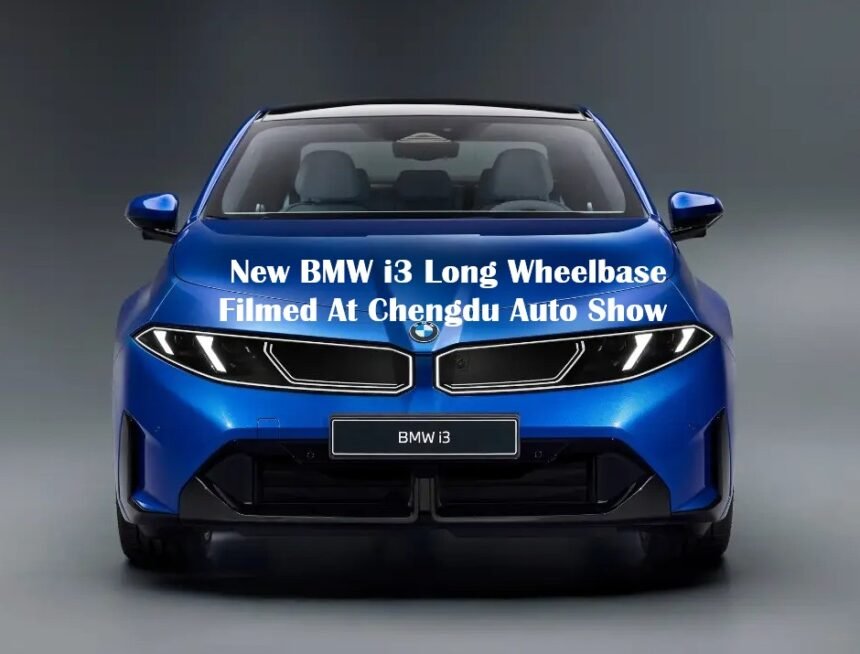
BMW brought a special surprise to the 2026 Chengdu Auto Show. The German automaker unveiled a stretched version of its new i3 sedan, built specifically for the Chinese market. Codenamed NA8, this long-wheelbase variant stands apart from the global model that customers elsewhere will receive. August usually marks a slow season for automotive news, but China’s biggest auto show proved otherwise this year. BMW seized the moment and showcased the bigger, more luxurious i3 alongside its standard-wheelbase sibling, known internally as NA0.
A Bigger Body for Chinese Buyers
The display car arrived in Le Castellet Blue, paired with the M Sport Package and black wheels. Longer rear doors and a more generous greenhouse mark the most obvious differences from the global model. These changes reflect a broader stretch across the car’s body. A closer look reveals another distinct detail. The Chinese i3 sedan uses a pull-up door handle design instead of the flush handles found on the international version. This adjustment stems from new safety regulations that now restrict fully flush door handles in the Chinese market.
Subtle Styling Cues
BMW added a small but notable design touch near the rear pillar. An illuminated M logo sits within the Hofmeister kink, catching the eye of enthusiasts who might assume a performance model lurks underneath. That assumption would be incorrect, at least for now. This particular i3 remains a standard 40 xDrive variant. BMW plans to introduce M Performance and full M derivatives at a later stage, though no firm timeline has emerged yet.
Stretching the Wheelbase
BMW has not released full specifications for the Chinese i3, but the wheelbase measurement stands out clearly. It stretches to 3,005 millimeters, or roughly 118.3 inches. That figure represents a substantial 108-millimeter increase over the wheelbase offered on the international model. This extra length translates directly into more legroom for rear passengers. Chinese buyers increasingly favor spacious rear seating, and BMW’s engineering choice speaks directly to that regional preference.
Interior Details on Display
Visitors at the Chengdu show got a glimpse of the cabin as well. BMW equipped the display car with Castanea artificial leather upholstery and a new 3D head-up display, both signaling a more premium feel than the standard-wheelbase version might offer. Trunk space also drew attention from onlookers.
The standard-wheelbase i3 holds 420 liters, or nearly 15 cubic feet, in its rear cargo area. A front storage compartment adds another 31 liters, close to 1.1 cubic feet, thanks to the model’s dedicated electric vehicle platform. Whether these figures carry over unchanged to the long-wheelbase variant remains unclear.
Pricing Still Under Wraps
BMW has stayed quiet regarding pricing for the i3 40L xDrive. Industry watchers expect the sedan to undercut its SUV counterpart, the iX3, which shares much of its underlying technology. The iX3 40L xDrive currently starts at RMB 299,900, translating to roughly $44,600 or €38,100.
Some analysts wonder whether BMW will introduce a cheaper rear-wheel-drive 30 variant for the i3 sedan as well. If such a model appears, pricing would likely fall below the RMB 269,900 starting point of the entry-level iX3 30L, equivalent to about $40,000 or €34,300.
A Familiar Nameplate With New Roots
BMW’s relationship with the i3 sedan in China stretches back several years. The company began selling an i3 sedan there in 2022, following the retirement of the original quirky hatchback that first carried the name globally. That earlier Chinese sedan rode on the CLAR platform, shared with the outgoing long-wheelbase 3 Series known as the G28. Pricing for that model started at RMB 278,000, or approximately $41,400 and €35,300.
The new Neue Klasse-based replacement appears likely to land in a similar price range, based on early signals from BMW’s positioning strategy. This continuity suggests the automaker wants to maintain accessibility for returning customers while delivering meaningfully upgraded technology underneath.
Positioning Within a Growing Lineup
The long-wheelbase i3 joins a growing family of stretched electric models tailored for China. BMW has applied similar wheelbase extensions to other vehicles in its lineup, recognizing that space and comfort carry particular weight among buyers in that market. This localized approach extends beyond dimensions alone. Regulatory compliance, styling adjustments, and interior materials all reflect BMW’s effort to tailor the Neue Klasse-based i3 specifically for Chinese consumer expectations rather than simply exporting the global variant unchanged.
What Comes Next
BMW has not confirmed an exact sales launch date for the i3 40L xDrive, though the Chengdu Auto Show appearance signals that a formal debut sits close on the horizon. Production timing, additional trim details, and full pricing information should surface in the coming months as BMW finalizes its rollout strategy.
For now, the long-wheelbase i3 stands as a clear statement of intent. BMW continues investing heavily in China’s electric vehicle market, adapting its newest technology platform to meet the specific tastes and regulatory demands of one of the world’s largest automotive markets. Enthusiasts and analysts alike will watch closely as more details emerge, particularly regarding performance variants that could eventually carry the M badge already teased through that illuminated pillar logo.