



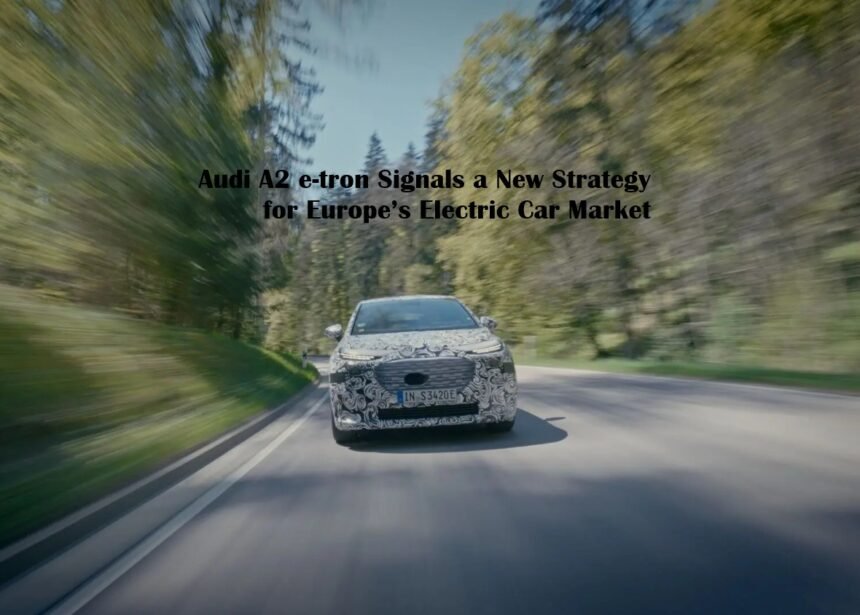
Audi is changing the way it approaches the European electric vehicle market by placing greater emphasis on compact dimensions, energy efficiency, and practical everyday driving. The German premium automaker has introduced the new A2 e-tron, a battery-powered model designed to attract customers looking for a smaller electric car without moving away from Audi’s premium positioning. The launch comes at a critical time for the Volkswagen-owned brand.
Audi has experienced declining sales for two consecutive years, while its global business has faced pressure from intense competition in China, changing consumer demand, and U.S. tariffs. During the first half of 2026, Audi’s sales dropped 7%, increasing the importance of new models capable of generating demand in key markets.
Compact EVs Become More Important for Audi
The A2 e-tron represents Audi’s attempt to strengthen its position in a segment that is becoming increasingly important across Europe. Instead of focusing exclusively on larger premium vehicles, the company is turning toward a smaller format that could appeal to urban drivers and consumers seeking lower energy consumption.
Audi CEO Gernot Doellner has argued that premium mobility should not simply be associated with larger vehicles, greater performance, or increased resource consumption. The company wants to demonstrate that efficiency can also become an important part of the premium experience.
That philosophy is reflected in the A2 e-tron’s technical targets. Audi says the vehicle consumes only 12.8 kilowatt-hours of electricity per 100 kilometers, making it the most energy-efficient model in the company’s history. Its maximum driving range is rated at 646 kilometers, giving the compact EV a combination of efficiency and long-distance usability.
A Familiar Name With a Modern Electric Identity
The A2 name is also significant for Audi. The original A2 was known for its compact design and unconventional approach to efficiency during the early 2000s. Bringing the name back for an electric vehicle allows Audi to connect its historical focus on lightweight and efficient mobility with the requirements of the modern EV market.
However, the new model arrives in a dramatically different competitive environment. Chinese automakers are expanding their presence across Europe with increasingly affordable electric vehicles, putting pressure on established manufacturers to offer products that combine technology, efficiency, and competitive value. For Audi, the A2 e-tron therefore represents more than another addition to its electric lineup. It is part of a broader attempt to adapt its product strategy to changing European consumer preferences.
German Production Supports Audi’s EV Plans
Production of the new electric model will take place at Audi’s Ingolstadt facility in Germany, reinforcing the company’s commitment to domestic manufacturing. Customer deliveries are scheduled to begin in December 2026. The decision comes while Volkswagen Group is undergoing significant restructuring. The group has approved major job reductions as it attempts to address overcapacity, tariffs, and stronger competition from Chinese manufacturers.
Audi is also reviewing the future of its Neckarsulm plant in southwestern Germany. The facility currently faces uncertainty because Audi has not allocated a new model there beyond 2034. Management plans to work with labor representatives on measures aimed at improving the factory’s long-term competitiveness.
Can the A2 e-tron Revive Audi’s Momentum?
The A2 e-tron enters the market at a time when European consumers are becoming increasingly interested in efficient electric vehicles. Audi’s own first-half figures show that demand for fully electric models in Germany increased significantly, while incoming orders in Western Europe also improved. The challenge will be converting that interest into sustained sales growth. Audi must compete against established European brands as well as rapidly expanding Chinese EV manufacturers.
With its compact design, low energy consumption, and 646-kilometer range, the A2 e-tron gives Audi a product aimed directly at the changing priorities of European EV buyers. Its success could ultimately determine whether Audi’s shift toward smaller and more efficient electric cars becomes a major part of its future strategy.