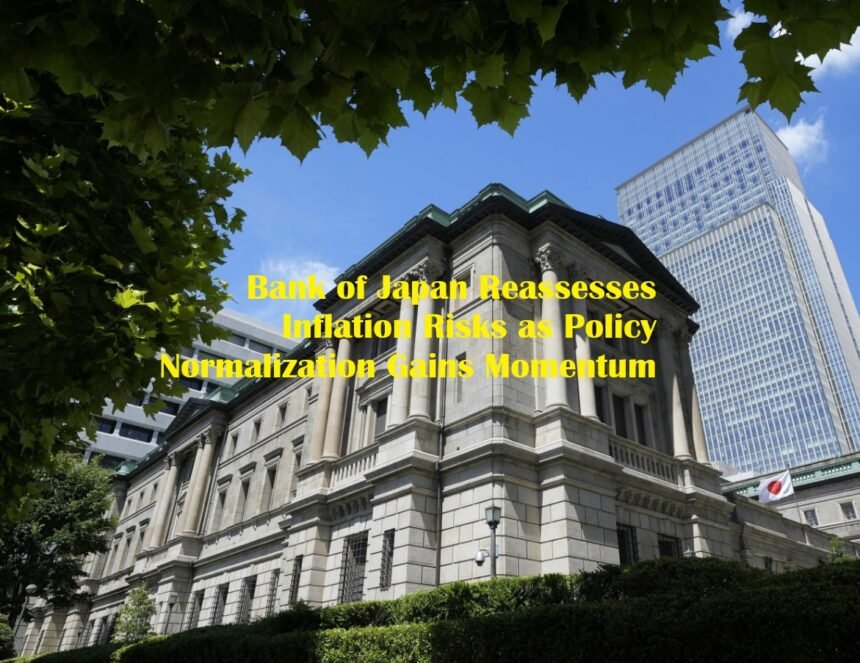
Japan’s monetary policy is entering a more closely watched phase as inflation risks push Bank of Japan policymakers to reconsider how quickly borrowing costs should rise. Minutes from the BOJ’s July meeting reveal that several officials were already discussing the possibility of moving faster, even though the central bank ultimately decided to keep its benchmark interest rate unchanged at the time. The discussion offers an important look into how the BOJ is adjusting its policy framework after years of extremely loose monetary conditions.
Rather than concentrating primarily on supporting higher inflation, policymakers increasingly focused on preventing price pressures from becoming entrenched above the central bank’s 2% objective. The minutes, released on September 28, show that inflation had become a more prominent concern within the nine-member policy board. Some members argued that the central bank should not automatically follow the market expectation of relatively long intervals between rate increases.
Inflation Has Changed the BOJ’s Policy Calculation
At its July 30-31 meeting, the BOJ maintained its policy rate at 1%. That decision followed a rate increase in June and came before the central bank raised borrowing costs again in September to 1.25%, the highest level in 31 years. The July minutes indicate that the pause did not mean policymakers had abandoned the tightening cycle. Instead, officials were assessing whether inflationary pressures were becoming broad enough to require a faster response. One policymaker said financial markets appeared to anticipate rate increases at roughly six-month intervals.
However, the official noted that the actual pace could be quicker because underlying inflation was approaching 2% and upside risks to prices were becoming more important. Another board member argued that the BOJ needed to respond flexibly to changes in price conditions rather than follow a predetermined timetable. A separate policymaker warned that delaying action could become increasingly costly if inflation risks materialized.
This debate highlights a significant change in the central bank’s policy challenge. Japan spent decades struggling with weak inflation and deflationary pressure. Policymakers now have to determine whether price increases represent a sustainable shift in the economy or a temporary consequence of external costs.
Weak Yen and Higher Import Costs Add Pressure
Currency movements have become another important factor in Japan’s inflation outlook. The yen’s weakness has increased the cost of imported fuel, raw materials and other goods. At the same time, geopolitical developments have contributed to higher energy prices, adding another source of pressure for Japanese households and businesses. The July minutes specifically pointed to growing concerns that higher wholesale prices could spread into broader inflation.
That possibility matters because the BOJ’s objective is not simply to react to temporary price increases but to determine whether inflation is becoming persistent enough to influence wages, consumption and business pricing decisions. Recent data have reinforced those concerns.
Tokyo’s core inflation accelerated for a third consecutive month in August, providing another indication that price pressures were becoming broader. The combination of currency weakness, higher input costs and domestic price pressures therefore gives the BOJ more reason to monitor inflation closely as it decides when and how far to raise interest rates.
Rate Normalization Could Continue
The July minutes also provide additional context for Japan’s gradual move away from extraordinary monetary accommodation. For years, the BOJ maintained exceptionally low interest rates as it attempted to overcome deflation and encourage economic activity. The current environment is different. Policymakers increasingly have to balance the risk of allowing inflation to remain elevated against the possibility that aggressive tightening could weaken economic growth.
The September increase to 1.25% demonstrates that the normalization process has already advanced beyond the July position. Yet the minutes suggest that officials were considering an even more flexible approach to future decisions. BOJ officials have subsequently continued to emphasize inflation risks. Deputy Governor Ryozo Himino said in August that the central bank needed to make timely decisions while paying close attention to the possibility of inflation overshooting its target.
Board member Kazuyuki Masu also warned in September that the BOJ could eventually be forced to raise rates rapidly if inflation accelerated. He argued that Japan’s financial conditions remained loose and that underlying inflation had moved very close to the 2% target.
Markets Face a Different BOJ Policy Environment
The possibility of a faster tightening cycle has implications beyond Japan’s domestic economy. Higher Japanese interest rates can influence government bond yields, the yen and international investment flows. Investors who previously relied on Japan’s exceptionally low borrowing costs may need to reassess strategies as the difference between Japanese and overseas interest rates changes. Japanese government bond yields have already moved higher amid stronger expectations for monetary tightening.
The benchmark 10-year yield approached multi-decade highs on September 28 as markets assessed inflation data and the BOJ’s policy direction. Currency markets are also closely watching the central bank. A faster rate-hike cycle could alter expectations for the yen, although exchange-rate movements depend on multiple factors, including overseas interest rates and global risk sentiment.
What Comes Next for Japanese Monetary Policy
The July minutes do not establish a fixed schedule for future BOJ rate increases. Instead, they show that policymakers were already debating whether the traditional gradual approach remained appropriate as inflation risks increased. The central bank therefore faces a delicate balancing act. It must determine whether domestic inflation has become sufficiently persistent to justify further tightening while avoiding unnecessary damage to economic activity. For investors and businesses, the key issue is no longer simply whether Japan is leaving its ultra-loose monetary policy behind.
The more important question is how quickly that normalization will proceed. With underlying inflation approaching the BOJ’s 2% objective, a weak yen adding to import costs and policymakers openly discussing the possibility of faster action, future economic data will play a central role in determining the direction of Japanese interest rates. The July minutes show that the debate inside the central bank has already shifted toward managing inflation risks rather than simply encouraging prices to rise.