



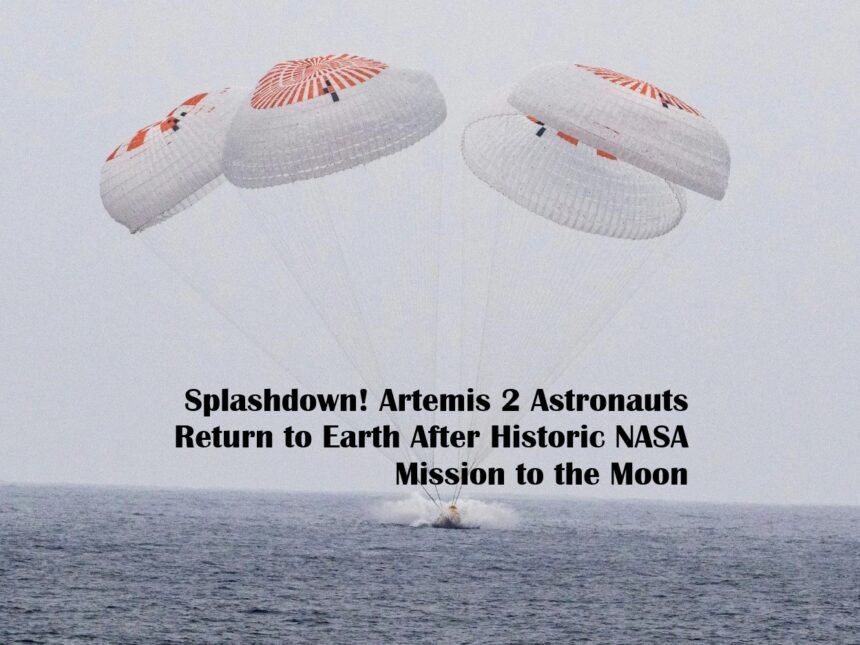
Artemis 2 astronauts have safely returned to Earth after a historic mission around the Moon. The crew completed a key step in human deep space exploration. The spacecraft splashed down in the ocean after reentry. Recovery teams quickly secured the capsule. The mission marks a major milestone for future lunar exploration. NASA confirmed all astronauts are safe and in good condition. The return closes an important chapter in modern spaceflight.
Historic Mission to the Moon
The Artemis 2 mission sent astronauts farther from Earth than any human mission in decades. The spacecraft traveled around the Moon without landing. The mission tested systems needed for future lunar landings. NASA designed the mission to validate deep-space travel procedures. The flight path included a loop around the lunar surface.
The crew observed the Moon at close range. They also collected valuable operational data. This mission built confidence for upcoming lunar landing plans. Engineers monitored every stage closely. The spacecraft performed as expected during most phases of flight. Mission control praised the smooth execution.
Crew and Spacecraft
The crew included experienced astronauts selected for deep space travel. Each member trained for years before launch. They practiced emergency procedures and navigation tasks. The spacecraft used for the mission was built for extended lunar travel. It included advanced life support systems.
It also featured improved navigation and communication tools. The crew worked closely with mission control throughout the journey. They performed system checks and scientific observations.
They also documented their experience for future missions. Every system on board was designed for safety and precision. The capsule provided protection during radiation exposure in deep space. It also maintained stable living conditions for the astronauts.
Journey Back to Earth
The return journey began after the spacecraft completed its lunar orbit. The crew prepared for reentry procedures. They secured equipment and checked all systems. The spacecraft left lunar orbit and headed toward Earth. Engineers monitored its trajectory carefully. Small adjustments were made to maintain accuracy.
As the capsule approached Earth, it separated from the service modules. The heat shield was activated for reentry protection. The spacecraft entered the atmosphere at high speed. Plasma formed around the capsule during descent.
Communication briefly weakened due to heat interference. The crew remained calm and followed procedures. The spacecraft slowed as it moved through the atmosphere. Parachutes deployed to reduce speed further. The descent became stable before ocean contact.
Splashdown and Recovery
The capsule splashed down safely in the ocean. Recovery teams reached the landing site quickly. They secured the spacecraft and assisted the crew. Helicopters transported astronauts from the capsule to a recovery ship. Medical teams performed initial health checks. All astronauts showed stable conditions.
The recovery process followed strict safety protocols. Engineers inspected the spacecraft for damage. They confirmed that the heat shield performed well during reentry. Mission officials celebrated the successful landing. The recovery marked the completion of a complex mission phase. Teams worked efficiently under challenging conditions.
Science and Achievements
The mission delivered valuable scientific and engineering data. NASA collected information on deep space travel effects. The crew also recorded human responses to lunar distance conditions. The spacecraft tested navigation systems beyond low Earth orbit. Engineers studied communication delays and system performance. These results will support future lunar missions.
The mission also tested life support reliability. Oxygen, temperature control, and radiation shielding were performed effectively. This data will improve future spacecraft designs. Astronauts observed the Moon during close orbital passes. They documented surface features and lighting conditions. These observations support planning for future landing sites.
NASA’s Next Steps
NASA plans to use Artemis 2 results for upcoming missions. The agency will prepare for a crewed lunar landing mission. Engineers will refine systems based on collected data. Training programs for future astronauts will continue. New mission simulations will include lessons from this flight. Teams will focus on safety and precision improvements.
Spacecraft development will also continue. Future vehicles will support longer lunar surface stays. Engineers aim to improve sustainability in deep space travel. The success of this mission builds momentum for exploration goals. NASA aims to establish a long-term presence on the Moon. This mission brings that goal closer.
Global Impact
The mission attracted global attention from scientists and space enthusiasts. Many viewed it as a return to deep-space human exploration. It inspired interest in future space programs. International partners observed the mission closely. Collaboration in space research continues to grow. Shared data may support global exploration efforts.
Educational institutions also followed the mission. Students studied its progress and outcomes. The mission encouraged interest in science and engineering fields. The achievement shows progress in human spaceflight capability. It also demonstrates improved technology for long-distance missions. The success may influence future international cooperation.