



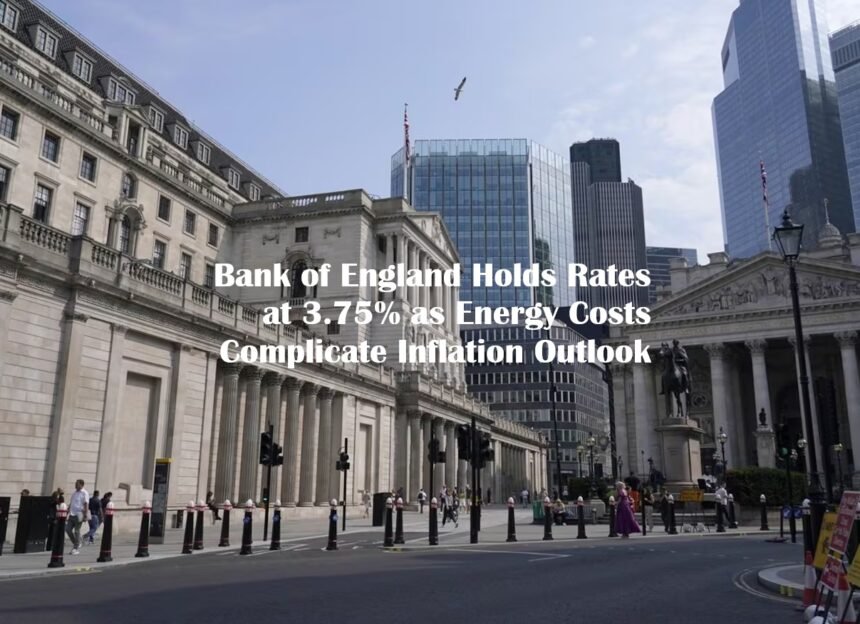
The Bank of England has chosen to keep its benchmark interest rate unchanged at 3.75%, highlighting how differently central banks can respond to the same global inflation pressures. While the U.S. Federal Reserve and European Central Bank have recently moved toward higher borrowing costs, British policymakers decided that another immediate increase was not yet necessary.
The decision came as rising energy prices continued to put pressure on the United Kingdom’s inflation outlook. Consumer-price inflation climbed to 3.1% in August, remaining well above the Bank of England’s 2% target. However, policymakers found limited evidence that higher energy costs were creating broader increases in wages and everyday prices.
Energy Prices Put Policymakers Under Pressure
The latest inflation challenge has been closely connected to developments in global energy markets. Crude oil prices moved above $110 a barrel, while European natural-gas prices reached their highest levels since 2023 amid renewed concerns about supply disruptions linked to conflict in the Middle East. For the Bank of England, the central question is whether these energy costs will remain a temporary shock or become embedded throughout the economy.
Governor Andrew Bailey indicated that the longer energy-market volatility continues, the greater the possibility that inflation could become persistent enough to require another increase in Bank Rate. The central bank therefore maintained a cautious approach rather than committing to a particular future path.
Wage Growth Offers Some Relief
One reason the Monetary Policy Committee did not immediately raise rates is that there are still relatively few signs of significant second-round inflation effects. Average weekly earnings slowed during the three months through July, while payroll employment also declined.
These developments suggest that higher energy costs have not yet translated into an acceleration in wage-setting behavior. That distinction matters for monetary policy. A temporary increase in fuel and household energy expenses can push inflation higher without necessarily creating a prolonged inflation cycle.
Policymakers must therefore determine whether the current price pressure will fade or spread into other parts of the economy. The committee remains divided. Three of its nine members supported increasing the Bank Rate to 4%, demonstrating that concern over inflation remains significant within the central bank.
Higher Bond Yields Add Another Constraint
The Bank of England is also dealing with rising government bond yields. Ten-year gilt yields reached their highest level since 2008, increasing borrowing costs across the economy. At the same time, the central bank announced changes to its quantitative-tightening strategy.
It plans to reduce its remaining government-bond holdings at an average pace of £46 billion per year, with £20 billion coming from annual bond sales and the remainder primarily through securities reaching maturity. The Bank currently holds about £368 billion through its asset-purchase facility. It also said it would avoid selling £222 billion of gilts maturing before 2035 and temporarily pause bond auctions while reviewing its approach.
What the Decision Means for Future Rates
The Bank of England’s latest decision leaves its next moves closely tied to inflation and energy-market developments. If fuel and gas prices remain elevated for an extended period, pressure for tighter monetary policy could increase. However, weaker wage growth and declining payrolls provide reasons for policymakers to monitor the economy before making another move.
The September decision therefore leaves the Bank of England navigating between two competing risks: allowing inflation to remain above target for too long and tightening monetary conditions while economic activity is already facing pressure from higher borrowing costs. With three policymakers already favoring a rate increase, the debate is likely to remain active in the coming meetings. Future decisions will depend heavily on whether energy-driven inflation begins spreading more broadly through wages, services and consumer prices.
Conclusion
The Bank of England’s decision to hold interest rates at 3.75% reflects a cautious response to an uncertain inflation environment. Rising energy prices continue to create upward pressure on consumer costs, but slower wage growth and weaker employment indicators suggest that inflation has not yet become broadly entrenched. With policymakers divided over the need for further tightening, future interest-rate decisions will largely depend on whether energy-related price increases persist and begin spreading across the wider UK economy.