



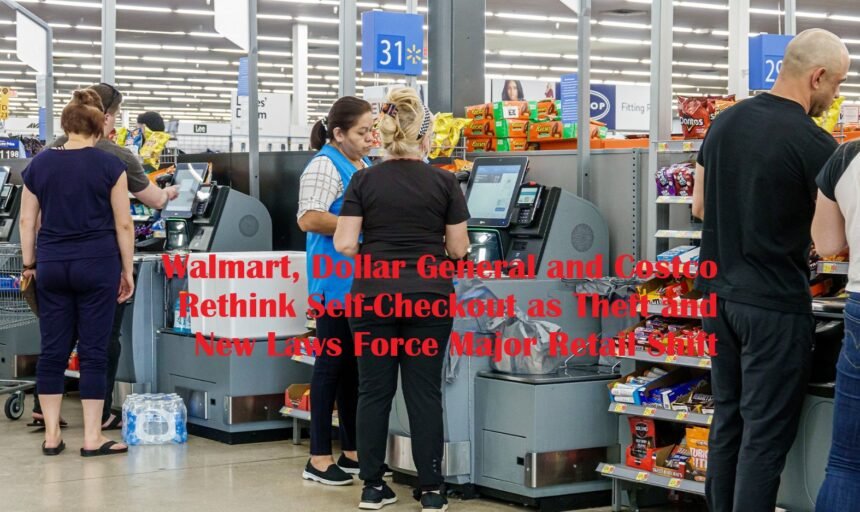
Major retailers across the United States are rethinking self-checkout strategies. Companies like Walmart, Dollar General, and Costco once embraced automation as the future of retail. Today, that vision is being reshaped by rising theft and increasing regulatory pressure. This shift marks a turning point in how stores balance efficiency, security, and customer experience.
The Rise and Promise of Self-Checkout
Self-checkout systems were introduced to reduce labor costs and speed up transactions. Retailers believed customers would benefit from shorter lines and greater convenience. Adoption accelerated during the pandemic.
Many shoppers preferred minimal interaction, and businesses expanded automation quickly. For a time, self-checkout appeared to be a win for both retailers and consumers. However, early optimism overlooked a critical weakness. These systems rely heavily on customer honesty and proper usage.
The Core Problem: Shrinkage and Theft
The biggest issue facing self-checkout is “shrinkage.” This term refers to inventory losses caused by theft, fraud, or human error. Studies reveal alarming patterns. Many shoppers admit that self-checkout makes theft easier. A significant percentage of users have intentionally skipped scanning items. Others have made accidental mistakes and kept the products anyway.
Retail experts highlight two main drivers. First, limited supervision creates opportunity. Second, complex interfaces lead to frequent scanning errors. Unlike traditional cashier lanes, self-checkout lacks consistent oversight. This gap increases both deliberate and unintentional losses. As a result, the cost of shrinkage has risen sharply.
Why Retailers Are Pulling Back
Retailers initially adopted self-checkout to save on wages. Over time, the financial losses from theft began to outweigh those savings. Walmart has started removing self-checkout machines in certain locations. The company frames the decision as a move to improve customer experience.
However, theft reduction plays a central role. Dollar General has taken an even more aggressive approach. The company removed self-checkout systems from thousands of stores. This decision reflects the scale of losses linked to shrinkage. Costco has chosen a different path.
Instead of eliminating self-checkout, the company has introduced more staff involvement. Employees now assist with scanning items before customers complete payment. Each strategy reflects the same conclusion. Unsupervised automation creates financial risk.
The Hidden Cost of “Convenience”
Self-checkout promised faster shopping. In reality, it often creates friction. Customers frequently encounter technical issues. Machines may fail to scan items correctly. Error messages can interrupt the process and require staff assistance.
These problems reduce efficiency. They also increase frustration, especially for customers with large purchases. Retailers now recognize that convenience alone cannot justify widespread automation. A system must also be reliable and secure.
New Laws Are Changing the Rules
Government action has added pressure on retailers. Lawmakers in several states have proposed regulations targeting self-checkout systems. Some proposals limit the number of items allowed per transaction. Others require a minimum number of staffed checkout lanes. Additional rules restrict how many machines one employee can supervise.
These measures aim to reduce theft and protect retail jobs. They also ensure that automation does not fully replace human workers. In some regions, penalties for non-compliance include significant fines. This legal pressure forces companies to rethink their checkout strategies more quickly.
Industry-Wide Shift
The move away from self-checkout is not limited to one company. It reflects a broader industry trend. Retailers across the sector are scaling back or modifying their systems. Some stores have introduced item limits. Others have added more staff to monitor machines.
In many cases, companies are adopting hybrid models. These systems combine automation with human oversight. This approach helps reduce theft while maintaining efficiency. Costco’s model stands out as a key example. Staff members scan items before customers reach the register. This reduces errors and limits opportunities for theft.
Balancing Cost and Control
Retailers now face a difficult trade-off. Hiring more employees increases operating costs. However, reducing theft can offset those expenses. Many companies have concluded that controlled systems deliver better results. A staffed checkout lane may cost more upfront, but it reduces losses significantly. This shift highlights a broader lesson. Technology cannot fully replace human judgment in complex environments like retail.
Customer Behavior Plays a Key Role
Consumer behavior remains central to the issue. Self-checkout depends on trust, but real-world conditions often challenge that assumption. Economic pressure has influenced shopping habits. Some individuals justify theft as a response to rising prices. Others make mistakes and choose not to correct them. Retailers must design systems that account for these behaviors. Without proper safeguards, losses will continue to rise.
The Future of Self-Checkout
Self-checkout is unlikely to disappear completely. Instead, it will evolve. Retailers are moving toward smarter, more controlled systems. These include AI-assisted scanning, membership-based access, and improved monitoring tools. Hybrid models are expected to dominate.
They combine the speed of automation with the accountability of human oversight. In high-risk locations, traditional cashier lanes may return as the primary option. In lower-risk areas, self-checkout will remain part of the shopping experience.