


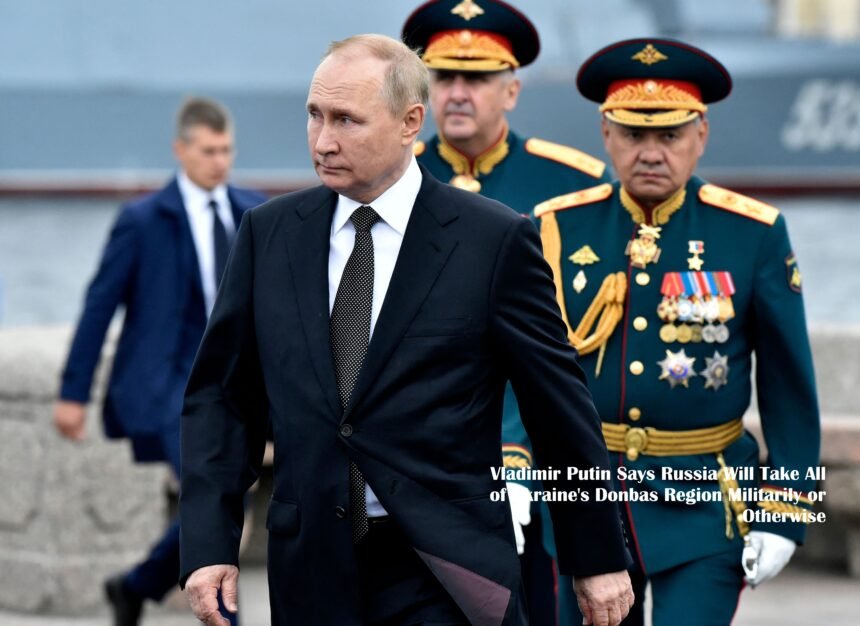
In a recent interview, the Russian President Vladimir Putin declared that Russia will seize full control of the entire Donbas region of Ukraine by force, if necessary, or through withdrawal by Ukrainian forces. The statement reinforced Moscow’s longstanding ambition over the Donetsk and Luhansk territories.
He told the media that Russia would either “liberate these territories by force of arms, or Ukrainian troops must leave these territories.” The remark came ahead of his planned visit to New Delhi and was broadcast on Russian state television. That demand directly challenges Ukraine’s position. Kyiv has firmly rejected the idea of surrendering any part of its territory.
Ukrainian officials have insisted they will not cede land that has been defended through military resistance. Ukraine’s refusal underlines a core principle: the country will not give away land won or held under fire. Any such concession, Kyiv argues, would betray the lives lost and the struggle endured to defend sovereignty.
The Scope of Russian Control
As of now, Russia controls roughly 19.2% of Ukraine’s territory, according to the latest figures. That includes the entire Luhansk region, most of Donetsk, and considerable parts of Kherson and Zaporizhzhia, plus the Crimea, which Moscow annexed in 2014.
Within the Donbas, only a fraction remains under Ukrainian control. Around 5,000 square kilometres of Donetsk Oblast have not fallen to Russian forces. Russia’s demand now is for total control of both Donetsk and Luhansk, meaning that whatever lands remain under Kyiv’s control must be handed over or captured.
Were that demand to be met, Ukraine’s territorial integrity would suffer a major blow. The change would reshuffle entire front-line maps, extinguish any remaining Ukrainian presence in Donbas, and shift control of strategic eastern corridors to Moscow.
Strategic Significance of Donbas
The Donbas region carries deep strategic and symbolic value. Historically, it was a heavily industrialised zone rich in resources, infrastructure, and industrial capacity. While decades of conflict and economic decline have reduced much of its former glory, the area still retains strategic and military significance.
Control of Donbas would provide Russia with a direct land corridor linking territories it has occupied around Kherson and Zaporizhzhia to those in the east, reinforcing supply routes, military logistics, and the consolidation of territory.
For Ukraine, losing Donbas would mean not only the loss of land but also the loss of a crucial defensive buffer, jeopardizing national integrity and opening the way for further advances. Ukrainian leaders have repeatedly warned that surrendering Donbas would only serve as a springboard for additional aggression.
Thus, the Donbas is not just a territory; it stands as a symbol of resistance, sovereignty, and the broader struggle for Ukraine’s future.
Rejection by Ukraine and the International Response
Ukraine has categorically rejected the demand for withdrawal or surrender. Its leaders argue that giving up Donbas would legitimize aggression and punish a nation for defending itself. Withdrawals would be unconstitutional and would set a dangerous precedent.
In turn, Russia has tried to press its demands during talks with U.S. envoys. Moscow reportedly expects the United States to informally acknowledge Russian authority over the entire Donbas as part of any peace arrangement. Western nations and Kyiv have rejected previous annexation referendums as illegitimate.
They have maintained that Donbas, as well as Crimea and other occupied territories, remain sovereign Ukrainian land under international law. Thus far, diplomatic efforts to end the war have not yielded meaningful concessions from Moscow on these territorial demands.
Why the Statement Matters Now
The recent declaration by the Vladimir Putin comes at a sensitive moment. Peace discussions with U.S. envoys have offered a window to negotiate a possible ceasefire or settlement. But Russia’s renewed insistence on full control over Donbas complicates those efforts, closing doors for compromise.
Declaring that “military or otherwise” force will be used signaled that Russia has not ruled out further escalation. It also revealed Moscow’s intention to anchor any peace talks on territorial gains already made rather than negotiate territory returns or cease-fire lines favorable to Ukraine.
That stance dramatically raises the stakes. If Russia achieves full control over Donbas, the war may not end; instead, the front lines could shift, and the conflict could transition from dynamic warfare to frozen occupation and long-term control.
For Ukraine and its supporters, that scenario is unacceptable. For Russia, the statement reaffirms ambition, signals resolve, and sets a clear line for what it demands in any future peace framework.