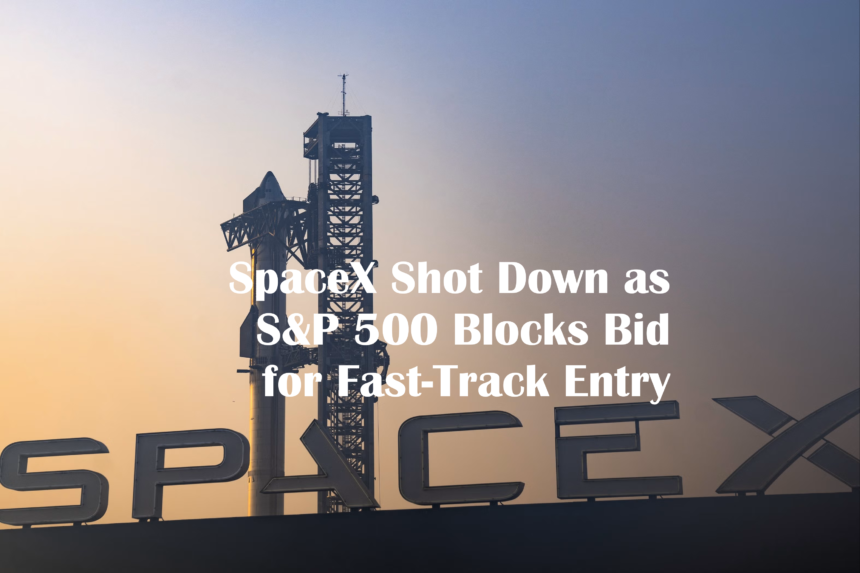
SpaceX has hit a major obstacle in its quest for rapid inclusion in the S&P 500. The decision by S&P Dow Jones Indices to maintain its current eligibility requirements means the aerospace giant will not receive special treatment despite its massive size and highly anticipated public debut.
Many investors expected regulators to relax the rules for mega-cap initial public offerings. Instead, index officials chose consistency over flexibility. The move could reshape expectations for future technology and artificial intelligence companies that plan to enter public markets at enormous valuations.
S&P Sticks to Existing Standards
S&P Dow Jones Indices recently confirmed that it would not modify the requirements for fast entry into its flagship indexes. The announcement ended speculation that SpaceX could bypass the standard waiting period and gain immediate access to the benchmark S&P 500 index.
The index provider emphasized that company size alone should not determine eligibility. Officials argued that financial viability, public float requirements, and seasoning periods remain essential parts of the selection process. These rules help maintain the integrity and credibility of the index.
As a result, SpaceX must follow the same path as every other newly listed company. The firm cannot receive an accelerated entry simply because of its enormous market value.
Why SpaceX Wanted Early Inclusion
Early inclusion in the S&P 500 offers significant advantages. Once a company joins the index, funds that track the benchmark often purchase large amounts of its shares. This buying activity can increase demand and support the stock price.
For a company as large as SpaceX, the impact could have been substantial. Analysts estimated that billions of dollars could flow into the stock if index-tracking funds were required to add it shortly after its public debut. SpaceX has already attracted intense investor interest.
The company aims to raise approximately $75 billion through its public offering while seeking a valuation of around $1.75 trillion. Such figures would place it among the most valuable publicly traded companies in the United States. However, the company’s size was not enough to convince S&P officials to rewrite long-standing rules.
Profitability Remains a Key Issue
One of the biggest barriers for SpaceX involves profitability requirements. To qualify for the S&P 500, a company must demonstrate positive earnings under Generally Accepted Accounting Principles. The rules require profitability in the most recent quarter and across the previous four quarters combined.
Reports indicate that SpaceX posted a net loss of nearly $5 billion during 2025. That performance places the company outside the eligibility standards currently required for inclusion in the index.
Because of these financial results, SpaceX would still face challenges even if the waiting period were to disappear. The profitability requirement remains a central hurdle that the company must overcome before earning a place in the benchmark index.
The Importance of the 12-Month Waiting Period
Another important rule involves the seasoning period. S&P requires newly listed companies to trade publicly for at least 12 months before becoming eligible for consideration. The waiting period allows investors to evaluate a company’s performance under public market conditions. It also helps establish trading patterns and liquidity levels.
Supporters of the rule argue that it protects investors from excessive volatility. Newly listed stocks often experience significant price swings during their first months of trading. A waiting period can provide a clearer picture of long-term value. By preserving this requirement, S&P signaled that market stability remains a higher priority than accommodating large IPOs.
Different Approaches Across the Industry
S&P’s decision contrasts sharply with actions taken by other index providers. Nasdaq has introduced policies that allow some mega-cap companies to enter major indexes much faster. Under these guidelines, newly listed firms can become eligible within a matter of weeks if they meet certain size requirements.
This difference creates a split within the index industry. While Nasdaq has embraced faster inclusion for large public offerings, S&P continues to favor a more conservative approach. The contrasting strategies highlight a broader debate about how financial markets should handle companies that achieve extraordinary scale before becoming publicly traded.
Investor Reactions
The decision generated mixed reactions throughout the investment community. Some market participants welcomed the announcement. They argued that index rules should apply equally to all companies regardless of their market value. According to this view, exceptions could undermine confidence in benchmark indexes and expose passive investors to unnecessary risks.
Others viewed the decision as a missed opportunity. They believe modern companies can reach massive valuations while still operating as private businesses.
As a result, traditional index rules may no longer reflect the realities of today’s financial markets. The debate is likely to continue as more technology firms approach public offerings with valuations once reserved for mature corporate giants.
What Happens Next for SpaceX?
Although the fast-track effort failed, SpaceX remains one of the most closely watched companies in the market. The company still plans to move forward with its public debut. Investor demand appears strong, and the offering could become one of the largest IPOs in history.
If SpaceX improves its financial performance and meets profitability standards, it could eventually qualify for inclusion in the S&P 500. Under current rules, eligibility may not arrive until at least mid-2027. For now, the company must prove itself in the public markets before earning a place in one of the world’s most influential stock indexes.