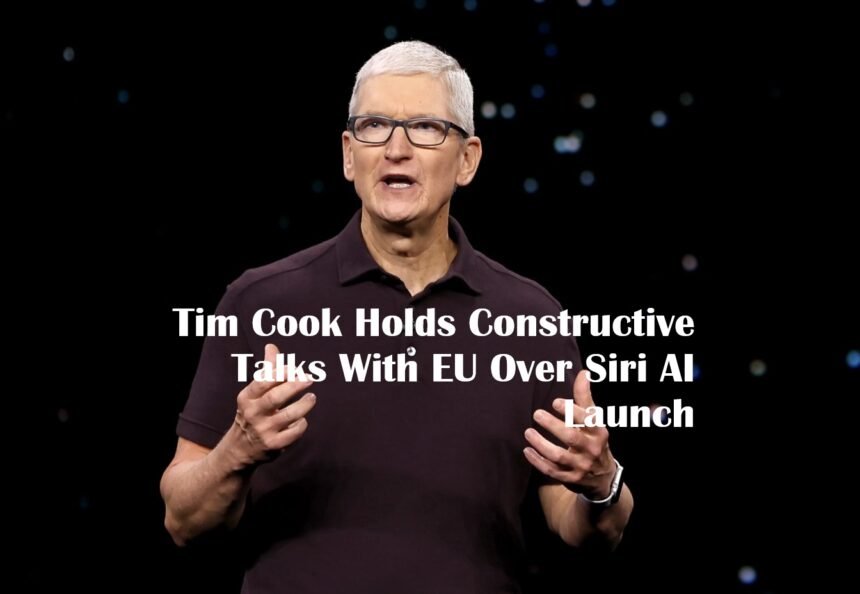
Apple CEO Tim Cook has opened a new chapter in the company’s discussions with European regulators. He recently held what officials described as constructive talks with the European Union regarding the delayed launch of Siri AI across the region. The meeting signals that both sides remain committed to finding common ground despite their recent disagreements.
The conversation focused on issues that continue to delay the rollout of Apple’s latest artificial intelligence features in Europe. Company executives and EU officials explored possible solutions that could satisfy regulatory requirements while preserving Apple’s approach to user privacy and device security.
Although no final agreement emerged from the discussion, the positive tone marked an important step forward. Both parties appear willing to continue negotiations in the coming months.
Why Siri AI Faces Delays
Apple plans to introduce its upgraded Siri AI alongside iOS 27 and iPadOS 27 later this year. Users in many regions will receive the new features immediately after launch. European customers, however, may need to wait longer. The delay stems from ongoing concerns surrounding the European Union’s Digital Markets Act.
Apple believes some provisions create challenges for introducing advanced AI features while maintaining its privacy standards. The company has argued that its technology relies on carefully designed protections. Apple wants to ensure that users enjoy intelligent assistance without exposing sensitive personal information.
European regulators have taken a different position. They believe major technology companies must provide fair opportunities for competing services. Their interpretation of the law requires Apple to support greater interoperability between Siri and rival AI assistants. This disagreement has slowed the European rollout.
A Constructive Meeting
The recent meeting between Tim Cook and European technology chief Henna Virkkunen offered a more encouraging atmosphere than previous exchanges. According to officials, the discussion covered topics of common interest. Both sides agreed to continue working toward practical solutions that comply with existing regulations.
The conversation also demonstrated that communication remains active despite public disagreements during recent weeks. Instead of exchanging criticism through public statements, Apple and EU representatives have returned to direct dialogue.
Such discussions often play a key role in resolving complex technology issues. Regulations surrounding artificial intelligence continue to evolve across global markets, making cooperation increasingly important.
Apple’s Privacy Concerns
Apple continues to place privacy at the center of its AI strategy. The company believes intelligent assistants should process user requests without weakening device security. Many of Siri AI’s new capabilities depend on deeper integration with Apple’s operating systems.
These improvements include more natural conversations, stronger writing assistance, expanded visual intelligence features, and smarter interactions across different apps.
Apple argues that opening these system capabilities to competing assistants requires careful safeguards. The company fears that broader access could introduce new security risks if regulators require equal access without sufficient protections. For Apple, maintaining customer trust remains one of its highest priorities.
The EU’s Regulatory Perspective
European regulators view the situation from another angle. The Digital Markets Act aims to increase competition across digital platforms. Officials believe consumers should enjoy greater freedom when choosing software and digital services. Under this framework, competing AI assistants should be granted access to important device functions when users grant permission.
Regulators argue that such interoperability encourages innovation while preventing dominant platforms from limiting consumer choice.
The European Commission has stated that Apple remains responsible for meeting these legal requirements. Officials also noted that exemptions from interoperability obligations are not available under current rules. As a result, Apple must develop solutions that satisfy both technical and legal expectations.
Siri AI Brings Major Upgrades
The new version of Siri represents Apple’s most ambitious AI assistant to date. Users will gain access to more conversational interactions that better understand context across multiple requests. Siri will also remember previous conversations, allowing more natural follow-up questions.
Apple has expanded Visual Intelligence capabilities as well. Users can receive richer information about objects, places, and text captured through their devices.
Writing tools have also received meaningful improvements. Siri AI can assist with drafting, editing, summarizing, and refining text directly within supported applications. Another addition includes deeper camera integration, making it easier for users to interact with visual content while using their iPhones. These enhancements form an important part of Apple’s broader AI strategy.
Europe Remains a Key Market
Despite the regulatory challenges, Europe remains one of Apple’s largest markets. Millions of customers across the region use iPhones, iPads, Macs, and other Apple products every day. Delaying Siri AI means many loyal users must wait longer to experience features already planned for other markets.
Both Apple and European regulators understand the significance of reaching an agreement. Apple wants to deliver its latest innovations without compromising its privacy principles. European officials want technology companies to respect competition rules that protect consumers and encourage market fairness. Finding a balanced solution would benefit both sides.
What Happens Next?
The recent meeting does not guarantee an immediate resolution. Technical discussions will likely continue as Apple explores ways to satisfy regulatory expectations while preserving its security architecture. Engineers and legal experts may need additional time to develop compliant solutions.
Future negotiations could also influence other Apple services that rely on similar technologies. The outcome may shape how advanced AI features arrive in Europe over the coming years. Industry observers will closely watch the next stages of these discussions.
A Positive Sign for Future Cooperation
Although important differences remain, the latest talks reflect a more cooperative approach between Apple and the European Union. Constructive dialogue creates opportunities for compromise that public disputes rarely achieve. Both sides appear interested in continuing conversations rather than allowing disagreements to escalate. For consumers, this represents encouraging news.
A successful agreement could eventually bring Siri AI to European users while respecting both privacy expectations and competition rules. Artificial intelligence continues to transform the technology industry at a rapid pace. Governments and technology companies must work together to establish clear standards that protect users without slowing innovation.
The recent meeting between Tim Cook and EU officials demonstrates that meaningful conversations remain possible even when complex regulatory questions stand in the way. While no immediate breakthrough has emerged, the willingness to continue discussions suggests that progress remains within reach.
If both sides maintain this constructive spirit, European users may eventually gain access to Apple’s next-generation Siri AI under a framework that balances innovation, consumer choice, and digital security. The coming months will determine whether those negotiations can produce a lasting solution that satisfies both Apple and European regulators.