



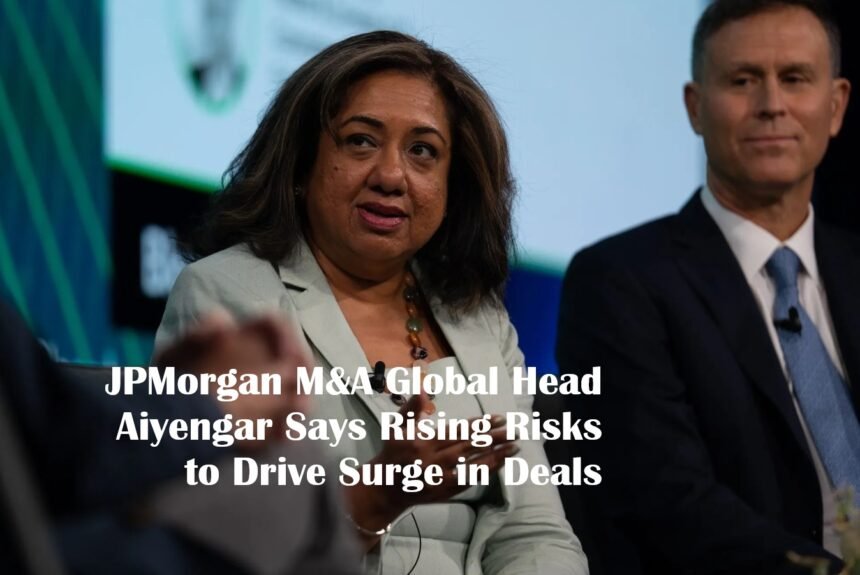
In a key interview, Anu Aiyengar, Global Head of Advisory and M&A at JPMorgan, said that rising economic and geopolitical risks could fuel a significant increase in merger and acquisition (M&A) activity in the year ahead. According to her, companies are now making moves to strengthen their scale and resilience amid global uncertainty.
Her comments reflect broader trends in dealmaking during 2025, a period when M&A values reached one of the highest levels on record. The outlook for 2026 suggests that this momentum may continue as firms seek strategic combinations to navigate volatile markets.
CEOs Seek Scale to Weather Uncertainty
Aiyengar explained that CEOs are increasingly viewing mergers and acquisitions as tools to mitigate risks from a wide range of challenges. These include shifts in technology, disruptions from artificial intelligence, supply chain instability, geopolitical tensions, and fluctuations in energy prices.
She noted that the complexity of these risks has made it difficult for business leaders to rely on conventional strategies alone. In this environment, companies with greater scale have an edge because they can access more operational levers and resources during turbulent times.
Strong M&A Performance in 2025
Last year’s M&A activity was marked by significant deal volume, despite intense market volatility. Deal values reached approximately $5.1 trillion, making 2025 the second-highest year ever for mergers and acquisitions. Aiyengar described this performance as notable given the economic and political headwinds facing corporations.
One standout trend was the surge in large deals. Data showed that 68 transactions valued at $10 billion or more were completed in 2025, twice as many as the previous year. This growth highlights that companies are pursuing more ambitious deals to build scale and competitive advantage.
JPMorgan’s Role in Major Deals
JPMorgan itself played a significant role in this high level of activity. The bank ranked No. 2 globally for merger and acquisition advisories during the year, reflecting its deep involvement in major transactions across sectors. A few high‑profile deals underscored this trend. One was Warner Bros.
Discovery’s proposed sale, which involved an enormous transaction value, and another was Kimberly‑Clark’s acquisition of a major consumer health products maker. JPMorgan advised on both, signaling the bank’s importance in guiding complex strategic deals.
Commodities and Megadeals on the Horizon
Aiyengar also highlighted sectors likely to see heightened deal activity. Commodities, energy, and technology were named among the key areas of interest. Consumer and healthcare sectors were also expected to pursue tie‑ups as companies look for growth opportunities.
Early talks between major mining corporations signal this trend. These discussions, if they result in a merger, could create one of the largest metals companies in the world. Such transactions point to the scale of ambition driving current dealmaking, and they offer insight into how future M&A activity could reshape industries.
Different Drivers Compared to Past Years
Traditionally, dealmaking was mainly driven by optimism about future economic growth or abundant capital. In contrast, Aiyengar said that current activity is being pushed by a desire to survive and thrive in an era of uncertainty.
Boardrooms now view M&A as a strategic necessity rather than an optional growth strategy. Political turmoil, market disruption from new technologies, and unpredictable global trade conditions are among the drivers decision‑makers consider when evaluating deals.
This shift in motivation suggests that future deals may not only be about expansion, but also about risk reduction. Companies are looking for partners with complementary strengths to help them weather future shocks and competitive pressures.
Strategic Use of M&A for Competitive Advantage
Aiyengar stressed that the current deal environment reflects both fear and opportunity. CEOs do not want their companies to fall behind as competitors consolidate resources. Instead, they pursue strategic combinations to stay relevant and resilient.
She noted that leaders are reacting to the “shots” and volatility hitting the system from many angles — from policy shifts to disruptive technologies. In this context, merging with or acquiring another company can be a defensive maneuver against future instability.
Sectors Expected to Lead Activity
The commodities sector appears poised for continued deal flow, driven by demand for natural resources and supply chain resilience. Energy companies, especially those involved in transition technologies or critical infrastructure, are also expected to be active in M&A discussions.
Technology companies, particularly those focused on artificial intelligence and disruptive digital services, remain attractive targets or partners. Firms in these areas may leverage acquisitions to accelerate innovation and build capabilities that are costly to develop organically.
Healthcare and consumer industries also showed interest in strategic combinations. These sectors are facing pressure to innovate while controlling costs. M&A can provide a way for firms to scale operations or diversify offerings in response to market demands.
What This Means for Investors
For investors, the possibility of continued high M&A activity may signal growing confidence in corporate strategy amid uncertain markets.
Deals can unlock shareholder value, unlock synergies, and help companies achieve long‑term stability. However, the rise in large transactions also brings complexity and risks. Integration challenges, regulatory scrutiny, and financing conditions are factors that investors will watch closely as deals emerge.
Outlook for 2026 and Beyond
Looking ahead, 2026 appears set to be another active year for global mergers and acquisitions. Companies are aligning their strategic priorities with the realities of a complex global environment. As they pursue scale and adaptability, M&A deals could become a defining feature of corporate growth plans.
With major deals already on the horizon and broader economic uncertainties continuing, Aiyengar’s view suggests that dealmakers will remain busy. Strategic combinations may help firms reduce risk exposure, strengthen competitive positions, and capture future opportunities in a rapidly shifting global economy.