



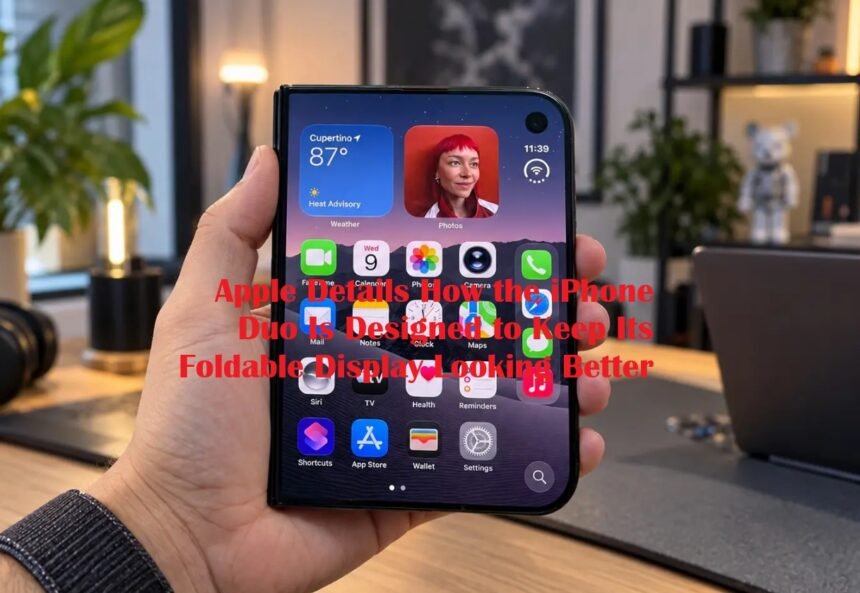
Apple’s first foldable iPhone is approaching its retail debut, and one of the biggest questions surrounding the device is no longer whether it can fold, but how well its display will hold up after years of use. The iPhone Duo introduces a book-style foldable design with a large flexible screen positioned at the center. Like virtually every foldable smartphone, the device has a crease where the display bends. Apple is now emphasizing the engineering behind the screen and hinge to address concerns that the crease could become increasingly noticeable as the phone ages.
Tom Marieb, Apple’s vice president of hardware engineering, recently discussed the device’s design with TechRadar. Rather than promising that the crease will disappear completely, he highlighted Apple’s approach to making it less visually distracting over time.
Matte Display Is Part of Apple’s Solution
One of Apple’s key decisions involves the surface treatment of the iPhone Duo’s display. The device uses a matte nano-texture finish designed to reduce glare. According to Marieb, that finish also has another purpose, making changes around the folding area less visually obvious. Glossy displays can reflect light directly toward the viewer, making differences in the surface easier to notice. A matte finish scatters reflected light, which can reduce the visibility of small changes in the display’s surface.
This approach could become particularly important as the hinge and flexible display experience repeated folding and unfolding. Apple expects the matte surface to remain more forgiving if the physical characteristics around the hinge change gradually over time. The strategy does not mean Apple is claiming that the crease will never change. Instead, the company appears to be focusing on controlling how noticeable that change becomes during everyday use.
Apple Wants Users to Watch the Crease
Marieb’s comments also stand out because Apple is effectively inviting users to judge the durability of the design themselves. He asked customers to hold Apple accountable for how the crease looks over time. That puts long-term durability at the center of the iPhone Duo experience rather than treating the crease as a minor cosmetic detail. Foldable smartphones have historically faced questions about how their flexible displays behave after thousands of folding cycles.
The appearance of a crease is therefore closely connected to consumer confidence in the technology. Apple’s decision to discuss the issue before the iPhone Duo reaches customers suggests that the company understands the display crease will be one of the first things users examine.
The Hinge Gets Extensive Engineering Attention
The display is only one part of Apple’s durability strategy. The hinge itself received extensive engineering work. Marieb said Apple spent significant time developing the hinge’s torque profile. Torque determines how much resistance users feel when opening, closing or positioning the device. Apple wanted the hinge to provide a solid and controlled sensation rather than feeling loose.
The intended experience was compared by Marieb to the feel of closing a premium automobile door. That design goal has practical consequences. A hinge that is too loose could make the device feel less substantial, while one that is too stiff could make opening and closing uncomfortable. Apple therefore had to balance mechanical resistance with everyday usability.
Multiple Folding Positions Expand Usability
The hinge is also designed to support more than simply fully open and fully closed positions. Apple’s implementation allows the iPhone Duo to operate in partially folded configurations, including seated and standing modes. This gives users additional ways to position the phone depending on the task.
A partially folded configuration could be useful when viewing content without holding the device completely open. It could also provide a more convenient angle for certain activities where the phone needs to remain upright. These capabilities place additional demands on the hinge because it must maintain its position at different angles while continuing to provide consistent resistance.
Durability Is Central to Apple’s Foldable Strategy
Apple’s approach demonstrates that introducing a foldable iPhone involves more than simply creating a flexible OLED panel. The company has to engineer the hinge, display surface and mechanical structure as a unified system. Each component affects the way users perceive the device after months or years of repeated use.
The iPhone Duo’s matte nano-texture display is therefore part of a broader design strategy. Apple is attempting to make the crease less distracting while simultaneously developing a hinge that feels durable and precise. The company has also discussed Ceramic Shield 2 as part of the device’s protection features, adding another layer to its approach to durability.
iPhone Duo Launch Timeline
The iPhone Duo is scheduled to arrive later than Apple’s conventional iPhone models. Pre-orders are set to begin on October 16, with the device launching on October 23. Apple has set the starting price at $1,999, placing the foldable iPhone well above the company’s standard smartphone lineup. That premium price makes the durability of the display and hinge particularly significant. Buyers will likely expect the device to maintain its functionality and appearance over an extended period.