



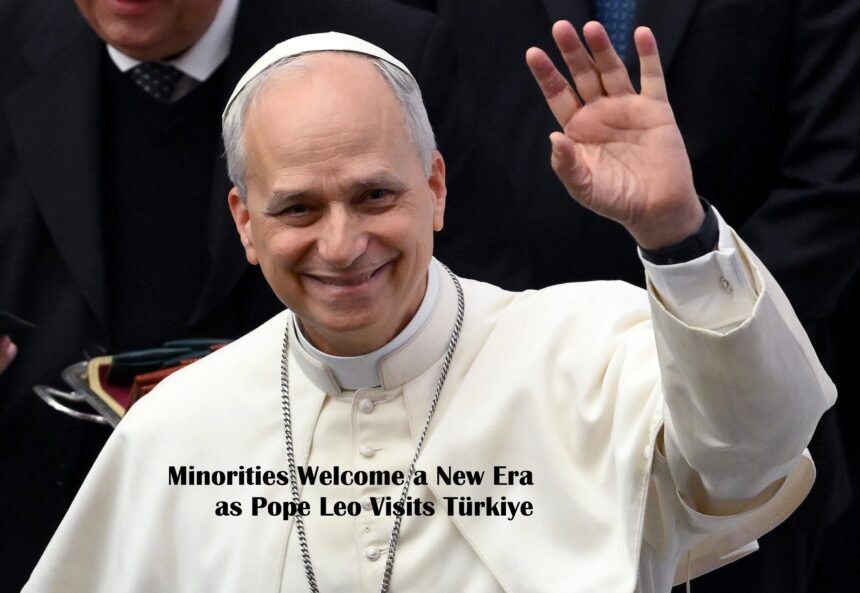
The recent visit of Pope Leo XIV to Türkiye stirred hope among the country’s long-established Christian minorities. Representatives of Greek, Armenian, Syriac and Latin Christian communities welcomed the pontiff’s arrival as a marker of renewed openness. A sense of confidence and belonging that many had lost began to re-emerge.
The visit carries deep symbolic value. Turkey, a majority Muslim country, has ancient Christian roots alongside centuries of Islamic tradition. For many minority Christians, the papal visit signalled recognition and respect.
A Deeply Symbolic Journey: Why This Visit Matters
Pope Leo trip to Türkiye is his first foreign journey as Pope. He chose Türkiye and a second country for his maiden trip abroad, a decision that many see as profoundly intentional. His agenda included a pilgrimage to Iznik, historically known as Nicaea, where the early Christian council shaped a creed still central to Christianity today.
That act resonated with both Orthodox and Catholic communities. At a public address in the capital, he described Türkiye as “a land inextricably linked to the origins of Christianity,” and emphasised that the country’s diversity of cultures, faiths and traditions should be honoured, not suppressed.
The Pope called for unity, dialogue, and respect across religious and cultural lines. He urged Christians to see themselves as part of Türkiye’s identity and future, not as outsiders.
Minority Communities Feel Renewed Confidence
Minority community representatives described the atmosphere as markedly different from decades past. For many, the visit brought a sense of visibility and dignity that had been long absent. In conversation with community leaders, a striking contrast emerged between past decades of insecurity and the present mood of cautious optimism.
One representative noted that thousands of historical properties had been returned over the years, a process that helped restore a sense of belonging for many small communities. In certain regions, especially in historically Christian heartlands, the return of emigrants has begun.
Some previously displaced Syriac families are rebuilding homes and returning to ancestral villages. Improved security and stability in those regions were cited as the main factors enabling this gradual return. The sense of being full citizens rather than tolerated outsiders was often repeated.
As one community member said, “This feels like the most comfortable period we have experienced in decades.”
Interfaith and Ecumenical Bridges Rebuilt
During his visit to Iznik, Pope Leo joined Christian leaders from diverse traditions, Catholic and Orthodox among them, for an ecumenical prayer service. At the event, he denounced religious violence and appealed for unity among Christians. Such gestures held great meaning for minority Christians in Türkiye.
After centuries of divisions and historical grievances, the image of different Christian denominations praying side by side at a site of deep historical importance rekindled hope for mutual respect and solidarity. The Pope’s emphasis on Türkiye’s pluralistic identity a bridge between faiths and cultures also resonated with minority groups.
They saw potential for their voices to be heard not only within their circles but as integral parts of the country’s social and cultural fabric.
Many expressed hope that the visit could mark a turning point: a step toward genuine religious freedom and equal recognition for minorities in a majority-Muslim nation.
Challenges Remain and the Road Ahead
Despite the optimism, minority leaders caution that significant challenges remain. Legal and administrative issues around foundations, property rights, and full autonomy of minority institutions have not all been resolved. Some demand reforms, more transparent governance of foundations, equal treatment compared to Muslim charities, and formal recognition of community rights.
Others call for broader social change. They hope the visit will encourage society at large to view minorities not as relics of the past, but as living, contributing parts of modern Türkiye fully accepted and free to practise their faith. For many, the aspiration now is sustained, not temporary renewal. They stress that symbolic gestures must be followed by concrete legal and societal shifts.
What the Visit Symbolises and What It Could Mean
The Pope’s visit signalled more than a religious gesture. It carried political and cultural meaning. It affirmed that diversity can be a strength, not a threat. It offered minority Christians a renewed sense of belonging. It also underlined Türkiye’s potential role as a mediator between faiths, facing modern global tensions with openness and pluralism.
For minorities, this could mean expanding space for identity, faith, and community life. While many questions remain legal, social, and practical, the visit gave hope that a new chapter is possible. A chapter where Christians and Muslims, old minorities and majority populations, share a future built on recognition, respect, and mutual dignity.