



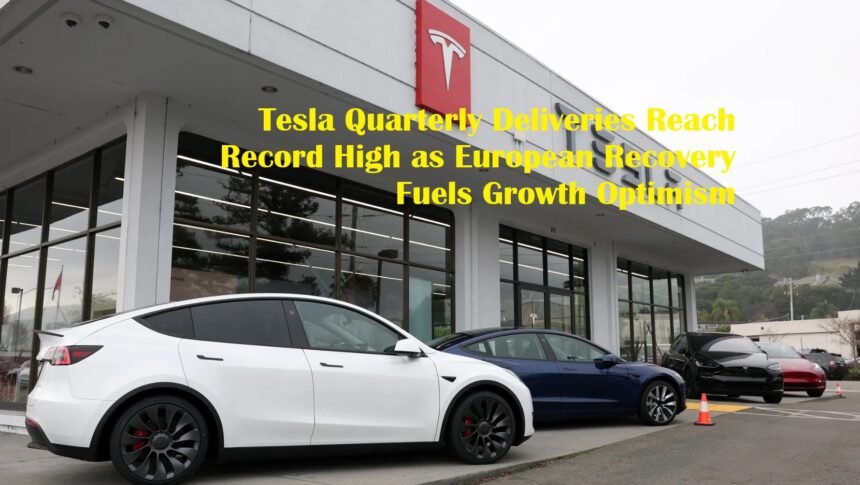
Tesla delivered a stronger-than-expected performance in the second quarter of 2026, giving investors fresh reasons to believe the company can resume annual growth after two years of declining vehicle sales. A sharp rebound across several European markets played a major role in the impressive results, while stable demand in China helped balance ongoing challenges in North America.
The latest delivery figures highlight Tesla’s ability to adapt to changing market conditions. Although competition remains intense, the company continues to benefit from competitive pricing, updated vehicle offerings, and expanding demand for electric vehicles in several regions.
Record Quarterly Deliveries Surprise Analysts
Tesla delivered 480,126 vehicles during the April through June period. The figure represented a 25% increase compared with the same quarter last year and exceeded most market expectations. Analysts had predicted deliveries of slightly above 400,000 vehicles before the announcement.
The company also produced 451,758 vehicles during the quarter. Deliveries exceeded production by more than 28,000 units, allowing Tesla to reduce inventory that had accumulated earlier in the year. This improvement reflected stronger customer demand and more efficient inventory management.
The better-than-expected performance marked an important milestone for Tesla. It suggested that the company’s core automotive business remains resilient despite economic uncertainty and growing competition in the global electric vehicle industry.
Europe Becomes the Main Growth Engine
Europe emerged as Tesla’s strongest regional market during the second quarter. Sales recovered across several countries after a difficult period last year. Several factors contributed to the rebound. Higher fuel prices encouraged more consumers to consider electric vehicles. Government incentives also continued to support EV purchases in many European markets.
At the same time, businesses accelerated the transition of corporate fleets toward electric transportation. Tesla also benefited from easing consumer concerns that had affected demand in previous months. Combined with attractive financing programs and competitive pricing, these improvements encouraged more buyers to return to Tesla showrooms.
Industry analysts believe Europe currently represents Tesla’s largest growth opportunity. The region’s strong performance offset weaker demand in North America and strengthened expectations for higher global sales during the rest of the year.
North America Still Faces Challenges
While Europe delivered encouraging results, North America remained a difficult market for Tesla. The removal of certain electric vehicle purchase incentives reduced affordability for many customers. Higher borrowing costs also continued to influence consumer spending decisions.
These conditions slowed demand compared with previous years. Even so, Tesla’s sales decline in the United States appeared less severe than the broader slowdown affecting the domestic electric vehicle market. Analysts noted that Tesla continued to outperform several competitors despite the difficult environment.
The company also introduced additional versions of its popular Model 3 and Model Y vehicles at lower price points. These models helped attract budget-conscious buyers and supported overall delivery growth.
China Continues to Provide Stability
China remained another important contributor to Tesla’s quarterly performance. Demand for vehicles produced at the Shanghai factory improved throughout the year despite fierce competition from domestic manufacturers. The refreshed Model Y attracted new buyers and supported higher production levels. The Shanghai facility also continued to supply export markets, especially in Europe, where demand strengthened significantly during the quarter.
Although local competitors continue to expand rapidly, Tesla has maintained solid momentum by combining updated products with efficient manufacturing operations. Continued export activity also improved factory utilization and supported overall delivery numbers.
Automotive Business Supports Future Investments
Vehicle sales remain Tesla’s largest source of revenue even as the company expands into artificial intelligence, autonomous driving, and robotics. Strong automotive performance provides financial support for these ambitious projects. The company plans to increase capital spending significantly during 2026 to expand AI infrastructure, battery production capacity, Cybercab manufacturing, and development of the Optimus humanoid robot. Tesla also continues expanding availability of its Full Self-Driving software across Europe.
Broader deployment of advanced driver assistance features could improve customer interest and strengthen demand in additional markets during the coming months. These long-term investments demonstrate that Tesla aims to build a technology ecosystem that extends well beyond electric vehicles.
Investors Remain Cautious
Despite the record delivery figures, Tesla shares declined after the announcement. Many investors had already anticipated stronger results following recent gains in the company’s stock price. As a result, the positive delivery report failed to create another major rally because much of the optimism had already been reflected in market valuations.
Market participants also continue focusing on Tesla’s long-term strategy rather than short-term vehicle sales alone. Expectations surrounding artificial intelligence, autonomous driving technology, and robotics remain key factors influencing investor sentiment.
Analysts nevertheless viewed the delivery report as an encouraging signal. Several experts suggested that Tesla now has a stronger chance of ending its two-year streak of annual sales declines if current momentum continues through the second half of 2026.
Outlook for the Rest of 2026
Tesla enters the second half of 2026 with improving momentum across several important markets. Europe appears ready to remain a major growth driver, while China continues delivering consistent support through domestic sales and exports. North America still presents challenges, but competitive pricing, updated vehicle models, and continued technology development may gradually strengthen demand.
The company’s upcoming financial results will provide additional insight into profitability, operating margins, and future investment plans. Investors will closely monitor whether Tesla can sustain higher deliveries while balancing expanding capital expenditures.
If European demand remains strong and global production stays efficient, Tesla could finish 2026 with renewed annual growth. Such an outcome would mark a significant turnaround after two consecutive years of declining sales and reinforce the company’s position as one of the world’s leading electric vehicle manufacturers.