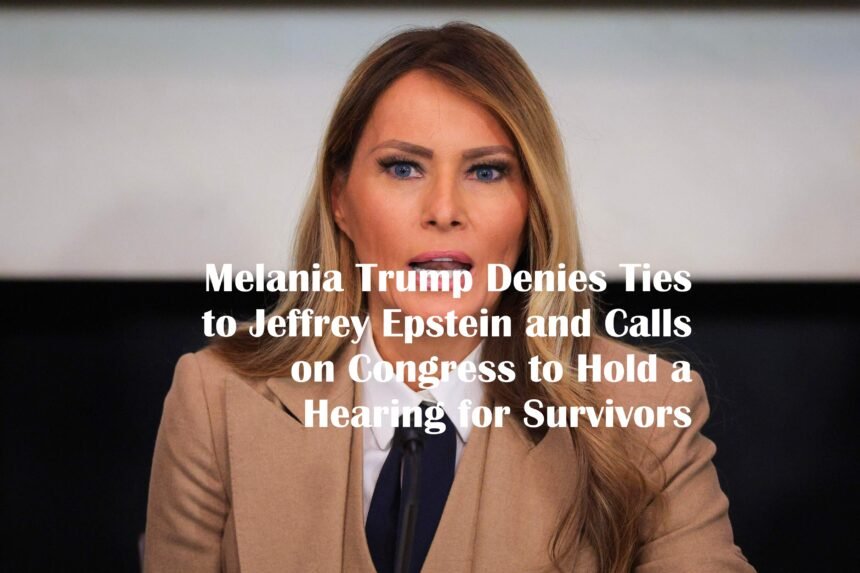
Melania Trump has publicly rejected any suggestion of connections to Jeffrey Epstein. She also called on Congress to organize a formal hearing focused on survivors. Her statement arrives at a time when public scrutiny around Epstein-related issues remains high. The former First Lady chose direct language to address the matter and shift attention toward accountability and support for victims.
Strong Denial of Allegations
Melania Trump firmly denied any association with Jeffrey Epstein. She stated that claims linking her to the disgraced financier are false and misleading. Her response aimed to prevent speculation from spreading further. She emphasized that her name should not be tied to actions or networks connected to Epstein.
She also expressed concern about how misinformation can harm reputations. Public figures often face scrutiny, but she argued that false narratives must be corrected quickly. By speaking out, she attempted to clarify her position and prevent confusion.
Her denial aligns with broader efforts by public figures to distance themselves from Epstein. Many individuals have faced questions about past interactions, even when those interactions were limited or unclear. Melania Trump took a clear stance and avoided vague language.
Call for Congressional Action
Beyond her denial, Melania Trump urged Congress to take action. She called for a hearing that focuses on survivors of abuse. Her message highlighted the need for accountability and transparency within institutions. She argued that survivors deserve a platform to share their experiences. A formal hearing could help uncover details that remain hidden.
It could also push lawmakers to consider stronger protections for vulnerable individuals. Melania Trump framed the issue as larger than any one person. She pointed out that systemic failures allowed abuse to continue for years. Addressing those failures requires coordinated effort from lawmakers and institutions.
Focus on Survivors
A key part of her statement centered on survivors. She stressed the importance of listening to their voices. Many survivors have waited years for justice and recognition. Public hearings could provide a space where their stories receive attention. She also highlighted the emotional toll that survivors carry. Trauma often lasts long after abuse ends.
Support systems must improve to help individuals rebuild their lives. Her comments suggested that policy changes should reflect these needs. Advocacy groups have long pushed for more visibility around survivor experiences. Melania Trump’s call aligns with those efforts. Increased awareness can lead to meaningful reform if lawmakers respond effectively.
Public Reaction and Political Context
Her statement generated mixed reactions. Supporters praised her for addressing the issue directly. They also welcomed her focus on survivor advocacy. Critics, however, questioned the timing and intent behind her remarks. The political environment adds complexity to any statement tied to Epstein.
The case involved powerful figures and raised concerns about influence and accountability. Public trust remains fragile, and many people demand transparency. Melania Trump’s involvement brings renewed attention to the topic. Even without formal political office, her voice carries weight. Her call for a hearing could influence public debate and encourage lawmakers to act.
Importance of Transparency
Transparency plays a central role in her message. She argued that secrecy allowed abuse networks to operate unchecked. Public hearings could expose gaps in oversight and enforcement. Lawmakers face pressure to demonstrate accountability. Investigations must address not only individuals but also systems that failed to protect victims.
Melania Trump’s remarks underline this broader responsibility. Clear communication also helps restore trust. When public figures address allegations directly, they reduce uncertainty. Her denial and call for action reflect this approach.
Legal and Institutional Challenges
Organizing a congressional hearing presents challenges. Lawmakers must gather evidence, coordinate witnesses, and navigate legal constraints. Sensitive cases require careful handling to protect survivors. There is also the issue of political division. Bipartisan support would strengthen any effort to investigate Epstein-related matters.
Without cooperation, progress may stall. Melania Trump’s statement adds pressure on Congress to move forward. Whether lawmakers respond remains uncertain. The issue demands sustained attention to produce meaningful results.
Media Coverage and Public Awareness
Media coverage continues to shape public understanding of Epstein-related issues. High-profile statements often drive renewed interest. Melania Trump’s remarks contributed to that cycle. Coverage can inform the public, but it can also amplify speculation.
Responsible reporting remains essential. Clear facts must guide discussions to avoid confusion. Her statement attempted to redirect focus toward survivors rather than rumors. This shift could influence how the story develops in the coming weeks.
Broader Implications
The situation highlights broader questions about accountability. Powerful individuals and institutions must answer for failures that enabled abuse. Public hearings could serve as a step toward that goal. Melania Trump’s call reflects a growing demand for action. Many people want concrete measures, not just statements.
Legislative efforts could address gaps in protection and enforcement. Her denial also underscores the importance of accuracy in public discourse. False claims can damage reputations and distract from real issues. Addressing misinformation remains critical.