



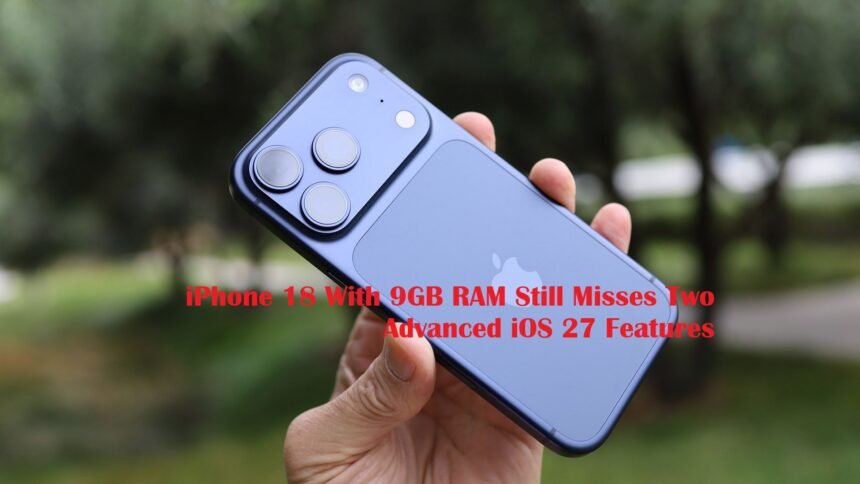
Apple continues to improve the iPhone every year. Better processors, smarter cameras, and faster memory often become the biggest selling points. The upcoming iPhone 18 is expected to continue that trend with 9GB of RAM, giving users smoother multitasking and stronger performance.
However, hardware upgrades do not always unlock every software feature. Reports suggest that two advanced capabilities in iOS 27 will remain unavailable on the standard iPhone 18, even with the increase to 9GB of RAM. This situation shows that memory size alone does not determine software compatibility.
More RAM Does Not Guarantee Every Feature
Many smartphone users believe that more RAM automatically means better software support. While RAM plays an important role, modern AI features depend on several hardware components. Apple designs many intelligent features to work with its latest chip architecture.
The Neural Engine, graphics processor, memory bandwidth, and overall system efficiency all contribute to AI performance. If one part cannot meet Apple’s requirements, some features may remain unavailable. For this reason, adding 9GB of RAM does not guarantee access to every iOS 27 capability.
Why Apple Sets Hardware Requirements?
Apple usually creates software that works across many devices. At the same time, some features demand higher processing power. Advanced AI tools often analyze large amounts of information in real time. They also generate text, summarize content, or process images directly on the device.
These tasks require more than additional memory. Apple focuses on delivering a consistent experience. If a device cannot provide smooth performance, the company may choose not to enable certain features. That approach helps maintain quality rather than offering features that perform more slowly.
The Role of Apple Silicon
Modern iPhones rely on Apple’s custom-designed processors. Every new chip introduces improvements in speed, efficiency, and machine learning performance. The Neural Engine has become one of the most important parts of Apple’s chips. It handles many AI workloads without relying on cloud processing. A newer processor can complete complex tasks much faster than an older one. As a result, software support often depends on processor generation rather than RAM capacity alone.
AI Features Continue to Raise Hardware Demands
Artificial intelligence has become one of the biggest priorities in mobile software. Users now expect their phones to write emails, summarize notifications, edit photos, organize information, and answer questions instantly. These experiences require enormous computing power. Developers continue to push hardware further every year. As AI grows more advanced, hardware requirements naturally increase. Even powerful smartphones may not receive every new capability.
Performance Matters More Than Specifications
Many buyers compare smartphones by looking at RAM numbers. While memory remains important, overall system performance matters more. Apple controls both hardware and software. This integration allows the company to optimize features for specific processors. Two phones may have similar RAM capacities but deliver different AI performance because their processors use different architectures. This explains why memory alone cannot predict feature availability.
Why Apple Limits Certain Features
Apple often introduces exclusive software features for newer devices. Several reasons support this strategy.
- First, newer processors complete demanding tasks faster.
- Second, battery efficiency remains higher during heavy workloads.
- Third, users receive a more reliable experience without noticeable slowdowns.
These decisions may disappoint some customers. However, Apple usually prefers stable performance over broader compatibility.
What This Means for iPhone 18 Buyers?
The standard iPhone 18 should still offer excellent performance for everyday use. Users can expect fast app launches, smooth gaming, responsive multitasking, and improved battery efficiency. Most iOS 27 features should work without problems. Only a small number of advanced capabilities may remain unavailable.
For many customers, those missing features may not affect daily use at all. People who mainly browse the web, watch videos, communicate, and take photos will likely enjoy the same premium experience they expect from Apple’s latest smartphones.
AI Is Becoming the New Upgrade Cycle
In previous years, buyers upgraded their phones for better cameras or brighter displays. Today, artificial intelligence has become a major reason to purchase new devices. Manufacturers now compete by offering smarter assistants, faster image generation, and better productivity tools. This trend encourages companies to develop more powerful chips every generation. Future smartphones will likely depend even more on specialized AI hardware.
Should Users Upgrade?
The answer depends on personal needs. Users who want a fast and reliable smartphone will probably find the iPhone 18 more than capable. The expected hardware improvements should deliver excellent performance for years. On the other hand, users who want every advanced AI capability may need to consider higher-end models that include Apple’s newest processor technology. Choosing a smartphone has become less about RAM numbers and more about the complete hardware platform.
Looking Ahead
The iPhone 18 demonstrates that smartphone performance involves much more than memory capacity. Although 9GB of RAM represents another meaningful upgrade, software support increasingly depends on processor design and AI acceleration. As iOS 27 introduces more intelligent features, Apple appears to prioritize devices that can deliver those experiences at the highest quality. This strategy reflects the growing importance of on-device artificial intelligence across the smartphone industry.
For consumers, the lesson is clear. Bigger RAM numbers no longer tell the whole story. Processing power, machine learning capabilities, and system optimization now play equally important roles. Buyers should evaluate the complete device instead of focusing on a single specification.
The iPhone 18 is still expected to provide fast performance, strong efficiency, and a premium user experience. However, its reported inability to support two advanced iOS 27 features highlights an important shift in smartphone development. Future software innovation will rely increasingly on specialized hardware, making the processor just as important as memory in determining what a device can truly accomplish.