



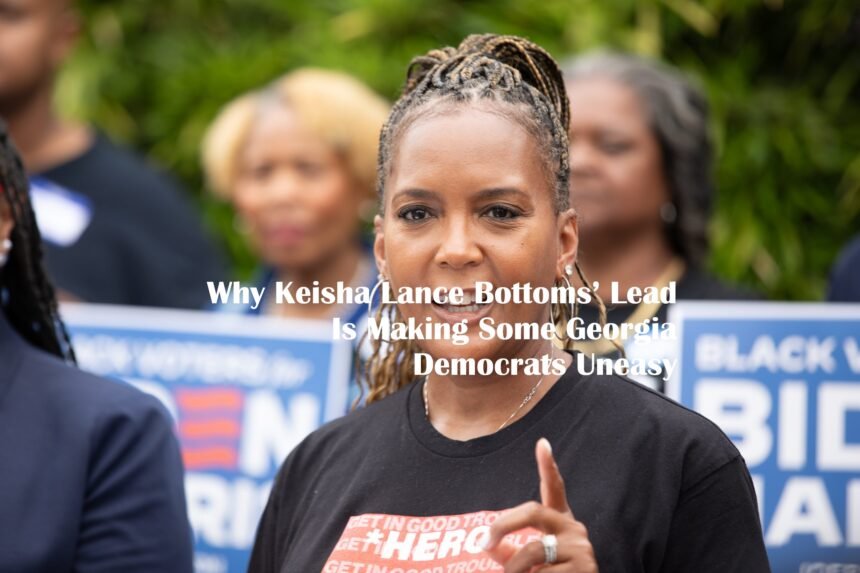
Former Atlanta mayor Keisha Lance Bottoms has emerged as the leading Democrat in Georgia’s 2026 governor race. Early polling, strong name recognition, and support from major party figures have pushed her ahead of several rivals. Yet her growing lead has not united Democrats across the state.
Instead, it has sparked concern among strategists, activists, and some voters who fear that her candidacy may weaken the party in the general election. Many Democrats agree that Georgia remains one of the nation’s most competitive battlegrounds. Republicans still hold statewide power, but Democrats have gained momentum in federal races during recent election cycles.
Due to this narrow political balance, party leaders seek a nominee who can appeal to moderates, suburban voters, and independents. Bottoms clearly appeals to many Democratic primary voters. However, critics inside her own party question whether she can build a broader coalition once the primary ends.
Strong Recognition Gives Bottoms an Early Advantage
Bottoms entered the race with national visibility. She gained attention during her term as mayor of Atlanta, especially during the COVID-19 pandemic and the protests that followed the death of George Floyd. Later, she joined the administration of former President Joe Biden and strengthened her ties to national Democratic leaders.
That experience helped her become the best-known Democrat in the field. Several high-profile Democrats decided not to run, which opened more space for Bottoms to dominate the early conversation. Her supporters describe her as experienced, battle-tested, and capable of energizing Black voters, especially in metro Atlanta.
They also believe her communication skills could help Democrats reconnect with frustrated voters across the state. Recent polling and political analysis show Bottoms leading many of her rivals by a comfortable margin.
Some Democrats Fear General Election Problems
Despite her lead, several Democrats remain uneasy about her ability to win statewide in November. Some party members worry that Republicans already have effective attack lines prepared against Bottoms. Critics point to her decision not to seek a second term as Atlanta mayor.
Others focus on rising crime rates during her administration and tensions that emerged during the pandemic years. Political observers also note that Atlanta politics often creates mixed reactions outside the city. While urban Democratic voters may support progressive policies, rural and suburban voters sometimes view Atlanta leaders with skepticism.
That dynamic matters in Georgia because statewide elections usually depend on swing voters in suburban counties. Democrats cannot rely only on a strong turnout in Atlanta. They also need support from moderates across the state.
Some Democrats believe another candidate might perform better in those areas. State Sen. Jason Esteves and former DeKalb County CEO Michael Thurmond have attracted attention from Democrats searching for a less polarizing option.
Questions About Electability Continue to Grow
Electability has become the central issue in the Democratic primary. Georgia Democrats remember past statewide defeats that came despite strong enthusiasm among core Democratic voters. Some party strategists fear the same pattern could repeat itself if the nominee fails to connect with independents.
Several online discussions among Democratic voters reflect those concerns. Some commenters argue that Bottoms carries too much political baggage from her mayoral years.
Others believe her leadership style could hurt Democrats in a closely divided state. Still, many Democrats reject those criticisms. They argue that Republican candidates will attack any Democrat, regardless of background or ideology.
Supporters also say Bottoms has already handled intense political pressure and media scrutiny on a national stage. That debate highlights a larger struggle inside the Democratic Party. Leaders continue searching for candidates who can energize progressive voters without alienating moderates.
Georgia’s Political Importance Raises the Stakes
The Georgia governor’s race carries national significance. Republicans view the state as essential to their future electoral strategy. Democrats see Georgia as proof that Southern battlegrounds remain competitive. Because Governor Brian Kemp cannot seek another term, both parties view the upcoming election as a major opportunity.
The next governor could also influence future redistricting battles, voting rights debates, and economic policy decisions. Those issues have increased pressure on Democrats to nominate a candidate who can survive a difficult general election. Bottoms has tried to present herself as a unifying figure.
She has focused on healthcare expansion, economic opportunity, education, and voting rights. Recently, she also promised to oppose political maps that weaken Black voting power. Her campaign hopes those positions will appeal to both progressive activists and mainstream voters.
Rivals Hope for a Runoff Opportunity
Georgia election law requires candidates to win a majority of votes in the primary. If no candidate reaches 50 percent, the top two finishers advance to a runoff. That possibility has become central to the Democratic race. While Bottoms leads in many polls, some analysts believe she may struggle to secure an outright majority.
Her opponents appear to recognize that challenge. Several campaigns now focus less on winning the first round and more on reaching a runoff against her. A runoff could reshape the race completely. Anti-Bottoms voters might unite behind a single alternative candidate.
Donors and party officials could also become more active if they believe the race remains competitive. At the same time, Bottoms continues to benefit from stronger statewide recognition than most of her rivals. That advantage could help her maintain momentum as the primary moves forward.
Democrats Face a Difficult Choice
The Democratic primary has become more than a contest between candidates. It now reflects broader disagreements about the party’s future in Georgia. Some Democrats want a bold, nationally recognized figure who can energize the party base. Others prefer a lower-profile candidate who may appeal more easily to moderates and swing voters.
Bottoms stands at the center of that debate. Her supporters see a proven leader with statewide potential. Her critics see a risky nominee in a race Democrats cannot afford to lose. The outcome of the primary may reveal which vision Georgia Democrats trust most as they prepare for another fiercely contested statewide election.