



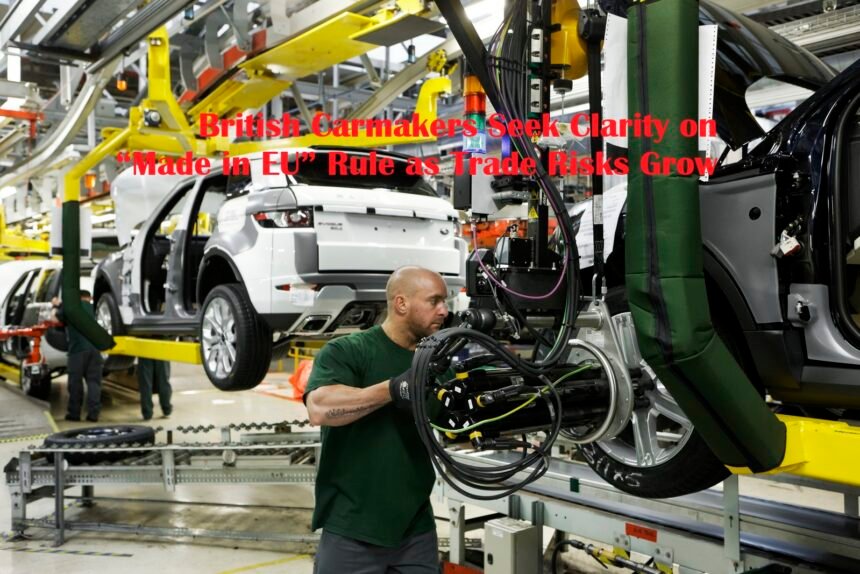
British carmakers are facing rising uncertainty. Trade rules between the United Kingdom and the European Union remain complex. A key issue now centers on “Made in EU” requirements. These rules affect tariffs, supply chains, and competitiveness. Automakers want clear guidance. Without it, planning future production becomes difficult. The stakes continue to rise as electric vehicles reshape the industry.
Understanding the “Made in EU” Rule
The “Made in EU” rule determines whether goods qualify for tariff-free trade. It focuses on where components originate. A product must meet specific thresholds to avoid duties. For carmakers, this rule carries major consequences. Vehicles often include parts from many countries. Batteries, electronics, and raw materials come from global suppliers.
British manufacturers rely heavily on European supply chains. Any disruption can increase costs. If cars fail to meet origin requirements, tariffs apply immediately. Clarity on these thresholds remains limited. Companies struggle to interpret evolving regulations.
Pressure from Electric Vehicle Transition
The shift to electric vehicles has intensified the issue. Batteries form the most expensive component in modern cars. Most battery materials come from outside Europe. This creates a problem for origin rules. If too many components come from non-European sources, cars lose tariff-free status.
British carmakers face higher risks than before. Investment in local battery production has increased. However, capacity still falls short of demand. Carmakers cannot easily replace global suppliers overnight. This mismatch adds urgency. Companies need clear rules to plan sourcing strategies.
Industry Concerns Grow
Executives across the automotive sector have raised concerns. They warn that uncertainty could damage competitiveness. Delayed decisions may lead to lost investment. Manufacturers want transitional arrangements. They argue that strict enforcement too soon could harm production. Many companies still depend on imported battery materials.
Costs could rise significantly. Tariffs on electric vehicles would make exports less competitive. This risk affects both large manufacturers and smaller suppliers. The industry seeks collaboration with policymakers. Clear communication could reduce uncertainty and support long-term planning.
Trade Risks Between the UK and EU
Trade relations between the United Kingdom and the European Union remain sensitive. Automotive exports represent a major economic link. Any disruption could affect jobs and investment. Tariffs on vehicles would create immediate challenges. European markets remain crucial for British carmakers.
Losing preferential access would weaken their position. Supply chains also cross borders frequently. Components move multiple times before final assembly. New barriers could slow production and increase costs. Companies must adapt quickly. However, unclear rules make adaptation harder.
Calls for Policy Flexibility
Carmakers are urging policymakers to act. They want flexibility in applying origin rules. Temporary adjustments could help the industry transition smoothly. Some propose extending current thresholds. Others suggest special treatment for electric vehicles. These measures could prevent sudden disruptions.
Policymakers face a balancing act. They must protect trade agreements while supporting industry growth. Decisions made now will shape the sector’s future. Clear timelines and consistent rules remain essential. Businesses need stability to invest confidently.
Competition from Global Markets
Global competition adds another layer of pressure. Automakers in other regions benefit from strong domestic supply chains. Some also receive government support for electric vehicle production. British carmakers must compete in this environment. Higher costs could reduce their global appeal.
Investors may shift focus to more stable markets. The race to build battery infrastructure has become critical. Countries that secure supply chains will gain an advantage. The United Kingdom risks falling behind without decisive action. This challenge extends beyond trade rules. It affects the entire industrial strategy.
The Role of Innovation and Investment
Despite challenges, opportunities remain. Innovation continues to drive the automotive sector forward. Companies invest in new technologies and production methods. Local battery production has gained attention. Several projects aim to strengthen domestic supply chains. These efforts could reduce reliance on imports over time.
Partnerships also play a key role. Collaboration between governments and industry can accelerate progress. Strategic investments could improve resilience. However, uncertainty still limits momentum. Clear policies would unlock further investment.
Looking Ahead
The automotive industry stands at a crossroads. Trade rules and technological change are reshaping the landscape. British carmakers must navigate both challenges at once. Clarity on the “Made in EU” rule will play a crucial role. Without it, risks will continue to grow.
Companies need predictable conditions to compete effectively. The outcome will affect more than just carmakers. Suppliers, workers, and investors all share the impact. A stable framework could support growth across the sector.