


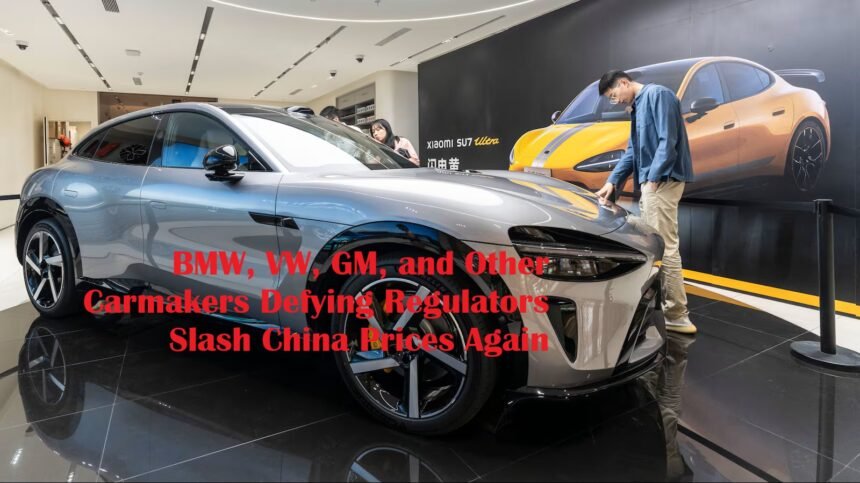
Global carmakers, including BMW, Volkswagen, and General Motors, have launched a new wave of price cuts in China, even as Beijing seeks to rein in a price war that has dragged on for years. The latest round of reductions highlights how intense competition and weak demand are prompting foreign automakers to take bold steps to safeguard sales in the world’s largest auto market.
These moves come amid regulatory warnings against selling vehicles at unsustainably low prices, yet brands continue to pursue aggressive pricing tactics to attract buyers.
Pricing Pressure Builds in China’s Auto Market
China’s auto market has experienced sluggish growth in recent months, with buyers holding back on purchases as consumer confidence has softened. Sales data showed a contraction in vehicle deliveries for consecutive months, leaving automakers with excess inventory and mounting pressure to stimulate demand.
To combat this, many foreign brands have introduced significant price adjustments to draw customers to showrooms. Analysts say these moves reflect a broader struggle to maintain relevance amid strong competition from domestic manufacturers.
The latest pricing adjustments include cuts on dozens of models from major manufacturers. For example, BMW lowered its official price guide for more than 30 vehicles sold in China. On some models, discounts reached hundreds of thousands of yuan.
Smaller electric and hybrid variants saw double‑digit percentage cuts as brands repositioned themselves to better compete against both domestic rivals and other foreign contenders. These reductions are one of the largest BMW has implemented in recent years.
How Price Cuts Spread Beyond Premium Brands
While BMW made headlines with steep reductions on its luxury models, other foreign carmakers have also stepped up pricing incentives. Dealers operating under joint ventures with Volkswagen and GM offered new discounts and “fixed‑price” deals on a range of vehicles in early 2026.
These offers extend beyond premium segments, signaling that competitive pressure now affects broader market tiers. Volkswagen, once a dominant brand in China, faces intense competition from agile local rivals. Its joint venture dealers reported that new pricing strategies are aimed at stimulating sales and clearing inventory.
GM’s joint venture partners also introduced renewed discounts on select vehicles, blending price cuts with additional purchase incentives. These shifts show that foreign brands are adapting their approach to the rapidly evolving Chinese consumer landscape. In some cases, price reductions are tied to bundling benefits such as low‑interest financing or added value features.
Although these incentives are not direct cuts to the sticker price, they effectively lower the overall cost of ownership for buyers. This multi‑pronged strategy is being used by several brands to counter declining foot traffic at dealerships and encourage buyers to make purchases before key sales deadlines.
Regulatory Pushback Meets Market Reality
Beijing has expressed concern about the ongoing price war and its potential impact on the broader industry. Draft guidelines issued by regulators aim to curb aggressive pricing practices that could harm supply chains and workforce stability. Authorities have warned against selling vehicles below production cost and banned dealer rebates that push transaction prices under cost.
These measures are meant to prevent a deflationary spiral in the auto sector. Despite these warnings, automakers have mostly ignored the regulatory pushback so far. They argue that pricing adjustments represent normal market management rather than a destructive price war.
Some firms have aligned official price guides more closely with the actual transaction prices buyers have secured after negotiation. In this way, companies maintain that they are not technically breaching regulatory red lines, even though final prices remain competitive.
Regulators fear that heavy discounting could force parts suppliers to cut costs, potentially affecting product quality and wages in the industry. A prolonged price war could destabilize smaller players in the auto ecosystem, leading to consolidation or exit by weaker firms. Therefore, authorities are watching market developments closely and may escalate enforcement if necessary.
Consumer Response and Market Demand
Chinese buyers are responding to price reductions with increased interest in certain segments of the market. Lower prices and enhanced financing options have made larger and more premium vehicles more accessible to a wider set of consumers.
Demand for electric vehicles (EVs) and hybrid models remains robust, as these powertrains benefit from national policy support and growing consumer preference. Even so, overall market demand has not rebounded strongly enough to avoid aggressive promotions by global brands.
Consumers have shown particular enthusiasm for models that offer strong value relative to features and technology. Brands that can balance affordability with performance and reliability tend to attract the most attention.
However, buyers remain price‑sensitive and are willing to delay purchases if promotional incentives do not meet their expectations. This dynamic has extended the pricing battle well into the new year.
Strategic Impacts on Automakers
For foreign automakers, China remains a critical market despite headwinds. It accounts for a large share of global sales for many major brands. A failure to respond effectively to local demand conditions could result in further market share erosion over time.
Companies that adjust pricing, offer flexible financing, and tailor products to local tastes may be better positioned to retain long‑term competitiveness. Some automakers are also reviewing their product portfolios to focus more on EVs and hybrid vehicles that better match Chinese consumer preferences.
With domestic brands rapidly expanding their electric offerings, international firms are under pressure to accelerate their own electrification strategies. This often includes both pricing and product placement adjustments to stay relevant in a shifting market.
At the dealer level, firms are adjusting operations to manage inventory more efficiently. Sales teams are being trained to communicate the value of promotions and provide tailored financing options. This dealer‑level flexibility supplements the broader pricing strategies of manufacturers and reinforces localized approaches to customer engagement.
What Lies Ahead for Price Wars in China
It remains uncertain how long price reductions will continue in China. If consumer demand strengthens in the coming quarters, brands might reduce the frequency or depth of discounts. However, in the near term, the expectation for additional promotions persists.
Many automakers aim to hit first‑quarter sales targets, encouraging them to maintain or expand incentives ahead of important shopping periods such as the Chinese New Year. Regulatory authorities may also refine their guidelines or enforcement actions to achieve a balance between fair competition and market stability.
A tightly controlled pricing environment could emerge if regulators perceive that discounts are damaging supply chains or workforce conditions. Automakers will need to navigate these policy developments carefully as they seek to protect their business interests in China.
In summary, the recent wave of price cuts by BMW, Volkswagen, GM, and other carmakers shows how global brands are adjusting to weak demand and fierce competition in China.
These moves demonstrate an ongoing tension between market realities and regulatory ambitions. How this tension plays out will shape the future of China’s auto sector and influence the strategies of international manufacturers in the largest automotive market in the world.