



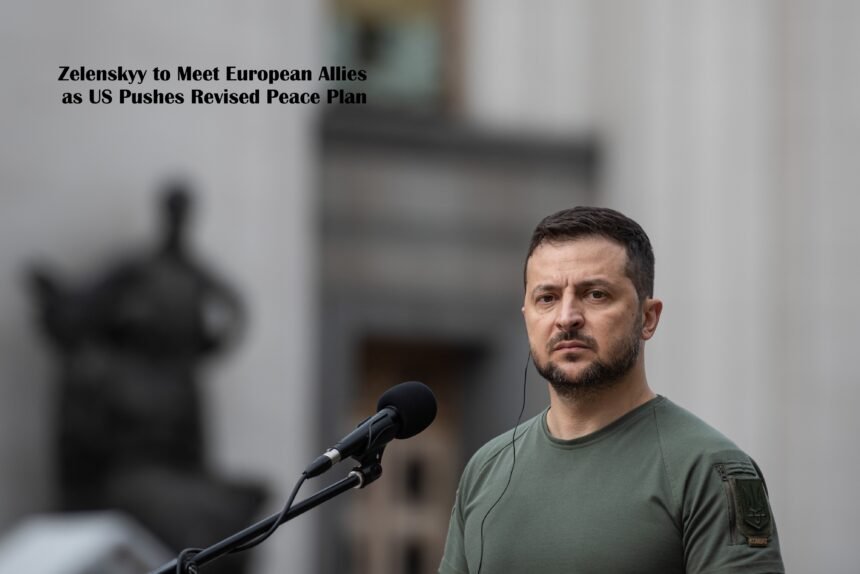
Ukrainian President Volodymyr Zelenskyy is scheduled to meet major European leaders in London amid mounting pressure on Kyiv to respond to a newly revised peace proposal from the United States. This diplomatic push by the U.S. is stirring deep concern in Europe and Kyiv, as the plan reportedly carries demands that could require painful concessions from Ukraine.Background: The
U.S. Peace Plan
A draft 28-point peace plan was delivered to Ukraine in November 2025. Although details have not been publicly disclosed, multiple media reports suggest that the plan includes proposals that would require Kyiv to cede territory, reduce its military forces, and forgo future NATO membership.In response to widespread concern, including from European leaders, the plan has been said to undergo revisions. Officials in Kyiv described the U.S. proposal as the “American side’s assessment,” designed to reinvigorate diplomacy.
Why Zelenskyy Is Reaching Out to Europe
Zelenskyy announced that consultations have begun with public officials in France, the UK, and Germany. He expressed appreciation for the “principled support” from these partners and underlined shared interest in achieving a real and dignified peace for Ukraine and for Europe.
The London meetings will focus on defence support, long-term security guarantees, and a collective European stance toward any peace settlement. The aim is to coordinate positions before Ukraine takes any decision on the revised U.S. plan.
European Response and Reservations
European leaders have pushed back on the U.S.-drafted plan. They cautioned that its current form could undermine Ukraine’s security and sovereignty. Concerns revolve around the proposed limitations on Ukraine’s military capacity and the demands for territorial concessions moves that could leave Ukraine vulnerable to future aggression.
Leaders from Germany, the UK, and France insisted that any peace plan must uphold the principle that borders cannot be changed by force. Rather than accept the U.S. draft outright, they called for further negotiations and a reworking of the terms.
The Bigger Picture: War Ongoing Despite Diplomacy
Meanwhile, the war continues. A massive wave of drone and missile attacks has been launched across Ukraine, hitting energy infrastructure and vital systems. These attacks highlight the urgency for Ukraine to secure strong defence and security guarantees, whether through external allies or a robust internal strategy.
Analysts in Russia have claimed that Kyiv is obstructing peace, while many Western observers argue that Moscow’s maximalist demands remain the core obstacle. The modified U.S. proposal is meanwhile described by some as flawed, because it still defers critical issues such as final territorial settlement and security guarantees issues which are deeply divisive.
What Zelenskyy and Europe Could Gain or Risk
By engaging European partners, Kyiv hopes to:
- secure coordinated military and financial backing, especially air-defence and long-term support.
- ensure any peace treaty preserves Ukraine’s sovereignty and prevents forced territorial concessions.
- maintain a united Western front to resist undue pressure from the U.S. or Russia.
However, risks remain. If pressure from Washington leads Kyiv to accept unacceptable terms, Ukraine could face long-term vulnerability. Moreover, fragmentation among European states could weaken collective leverage, particularly if some argue that Ukraine must capitulate to end the war quickly.
The war’s trajectory remains uncertain. Diplomacy is continuing, but so is fighting, and the human and infrastructural cost of continued conflict is mounting.
What to Expect in the Coming Days
The London meetings will be watched closely. European leaders will meet with Zelenskyy in hopes of shaping a common stance. Discussions are expected to include defence guarantees, long-term funding, and a possible European-led security arrangement to protect Ukraine if a ceasefire is agreed.
At the same time, Kyiv’s reaction to the revised U.S. peace plan will be pivotal. Acceptance might ease some pressures, but could also risk sovereignty and security. For now, Ukraine and its allies face a delicate balancing act, advancing diplomacy without compromising principle, while defending against ongoing aggression.