


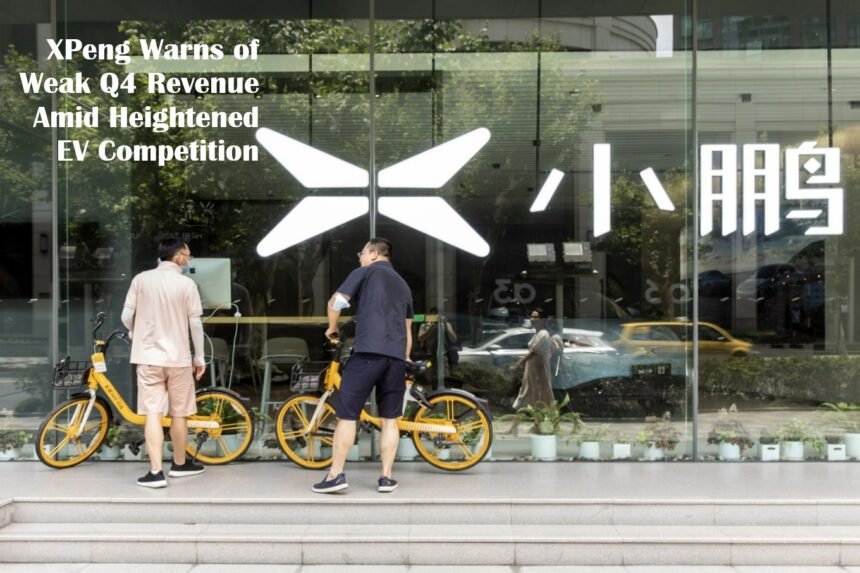
Chinese electric-vehicle maker XPeng has issued a cautious forecast for its fourth-quarter 2025 revenue, projecting a range of 21.5 billion to 23 billion yuan (~US$3.03–3.23 billion). This guidance falls significantly below analyst expectations, which had centered on roughly 26 billion yuan. Its US-listed shares reacted sharply to the forecast, sliding nearly 3 percent in premarket trading. The firm’s tone reflects deepening pressure from a fierce price war and intensifying competition in China’s EV space.
Pricing Pressures Weigh on Margins
XPeng says the weak outlook is driven by a “prolonged price war” and fierce rivalry in China’s crowded EV market. While XPeng and its rival NIO posted record deliveries in October, the company warns that profitability is under strain. The push into lower-end models appears to be denting its premium appeal.
In particular, XPeng’s Mona M03, developed in partnership with the ride-hailing giant DiDi, is central to its mass-market push. But according to Rosalie Chen, an analyst at Third Bridge, this shift has weakened XPeng’s brand resonance for higher-priced models. Additionally, XPeng’s reduced investment in intelligent driving systems is also being cited as a factor eroding its appeal among buyers in the premium segment.
Strong Deliveries But Fragile Revenue
Despite the downbeat outlook, recent performance has shown real strength in deliveries. In the third quarter, XPeng delivered 149.3% more vehicles year-over-year, driving its revenue to 20.38 billion yuan, in line with market expectations. Meanwhile, its net loss narrowed substantially, dropping to 380.9 million yuan from 1.81 billion yuan in the same quarter last year.
These results suggest that demand remains robust, even if margin pressures are mounting. However, XPeng’s guidance for Q4 already signals that it expects the harsher pricing environment to erode its top-line strength. The gap between its forecast and the consensus estimate implies uncertainty about its ability to convert volume into profits.
Big Bets on Futuristic Tech
XPeng continues to lean into long-term, high-technology bets. At a recent AI Day, it revealed work on next-generation flying car concepts and humanoid robots for industrial use. These R&D efforts could help it stand out in the crowded EV field, but they also carry significant near-term costs.
Heavy investment in such projects could undermine short-term financial performance, especially as the company grapples with thin margins in its core EV business. Analysts note that while these projects may pay off in the long run, they could be a drag on profitability in the near term.
Brand Repositioning Risks
XPeng’s strategy of targeting more affordable buyers has trade-offs. The Mona M03 plays a critical role in its effort to compete in the budget segment. But by shifting away from premium models, XPeng risks diluting its brand image at the high end. Rosalie Chen argues that this repositioning, combined with reduced spending on intelligent driving tech, has eroded XPeng’s “brand appeal in models priced above 200,000 yuan.”
That could hamper its ability to attract wealthier consumers who favor technology-rich, higher-margin vehicles. Meanwhile, XPeng’s rivals continue to pressure on both ends of the market, slashing prices on affordable models while also pushing advanced tech in the premium space. This dual-front competition makes sustaining profitability more difficult.
Investor Reaction and Outlook
The cautious Q4 forecast has rattled investor confidence. The stock drop in response to its guidance reflects concern over XPeng’s ability to maintain growth while dealing with margin compression. XPeng’s long-term ambitions are bold, but executing them amid a brutal pricing war may prove costly. Its efforts to scale via mass-market EVs and futuristic technology could redefine its future, but investors remain wary of near-term risks.
Conclusion
XPeng’s cautious fourth-quarter revenue outlook highlights a central tension: the firm is scaling rapidly, but profitability is under threat. Its strategy to lean into mass-market EVs and high-tech projects offers a bold vision yet navigating China’s brutal pricing environment could prove costly. As XPeng pushes forward with its long-term ambitions, its ability to maintain financial strength will depend on how well it balances volume growth, margin preservation, and R&D investment.