


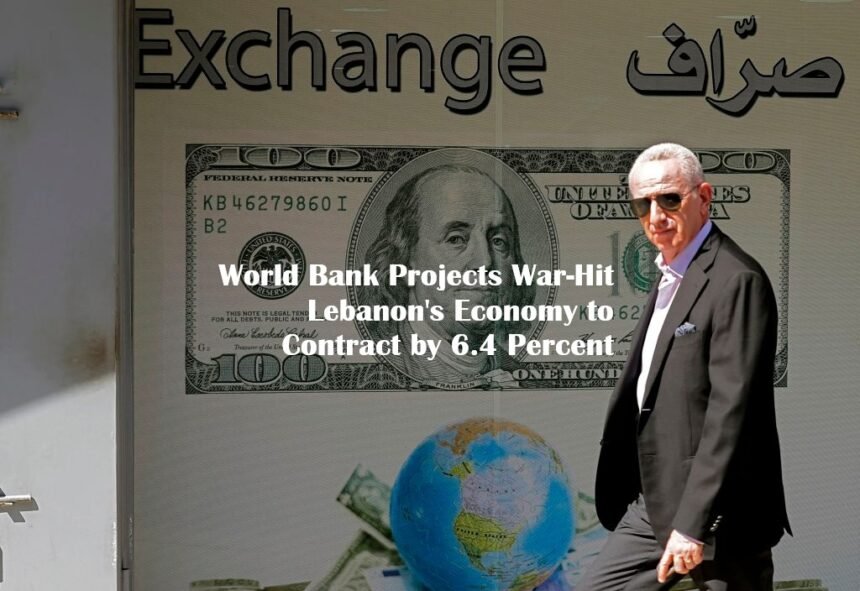
Lebanon’s economy faces a sharp downturn this year. The World Bank now expects the country’s output to shrink by 6.4 percent in 2026. Renewed conflict with Israel has reversed a fragile recovery that had only just begun to take hold after years of financial turmoil.
A Recovery Cut Short
Lebanon entered 2026 on relatively solid footing. The economy grew by 4.2 percent in 2025, marking its strongest expansion since the 2019 financial collapse. That momentum did not last. The World Bank’s Summer 2026 Lebanon Economic Monitor, titled A Conflict-Torn Economy, describes how the March 2026 escalation derailed this progress. Fighting damaged housing and infrastructure across several regions.
Communities were displaced, supply chains broke down, and both tourism and domestic demand weakened considerably. The report links the projected contraction directly to these disruptions. Collapsing tourism revenue, weaker household consumption, insecurity, and prolonged displacement all combine to pull real GDP sharply downward this year.
Inflation Adds to the Strain
Consumers face mounting pressure alongside the broader economic contraction. Inflation is expected to climb to 17.5 percent in 2026, driven by disrupted supply routes, higher shipping costs, and unstable fuel prices. Rising prices compound an already difficult situation for ordinary Lebanese households. Many families continue to grapple with the aftermath of the 2019 financial crisis, when much of the population lost access to savings held in local banks. The added burden of wartime inflation now threatens to deepen that hardship further.
Reform Efforts Remain Central
World Bank officials stress that structural reform remains essential to any recovery. Dahlia Khalifa, the institution’s division director for the Middle East department, emphasized that progress on banking sector restructuring and fiscal management will be critical for restoring confidence and unlocking the financing needed for reconstruction.
Lebanon’s parliament has taken a step in that direction. Lawmakers recently approved amendments to the bank resolution law, a measure intended to restructure failing financial institutions and establish a clearer framework for addressing the broader financial sector crisis. The International Monetary Fund welcomed this legislative move, describing it as a step that shows Lebanon aligning with international best practices.
The IMF has held ongoing talks with Lebanese officials over a potential bailout program and confirmed plans to send a technical team to Beirut next month. That visit will focus on evaluating additional structural policy measures the country might need to adopt.
Voices From Lebanon’s Economic Circles
Reactions from within Lebanon’s economic policy community reflect a mix of caution and guarded optimism. Alain Hakim, a former economy and trade minister, argued that stability remains achievable even amid regional turmoil, though he noted that politics and security will shape the timeline more than economic policy alone.
Hakim pointed to existing strengths as reasons for measured hope. He cited Lebanon’s constitutional institutions and signs of economic improvement recorded before the war began. According to Hakim, private sector activity and individual initiative should help drive a rebound once the conflict subsides.
Structural Challenges Predate the War
The current crisis did not emerge in isolation. Lebanon has struggled with economic instability since 2019, when a currency collapse wiped out much of the value of ordinary citizens’ savings. Years of political paralysis followed, slowing efforts to implement reforms that international lenders had long demanded. Bank depositors remain a visible symbol of that unresolved crisis.
Many still cannot access their foreign-currency savings, a grievance that continues to fuel public frustration and periodic demonstrations across the country. Against that backdrop, the 2025 growth figures had offered a rare bright spot. Confidence was beginning to return, and economic activity was picking up before the March 2026 escalation reversed those gains.
What Reconstruction Will Require
Rebuilding Lebanon’s economy will likely demand more than a ceasefire. The World Bank’s report suggests that meaningful recovery depends on a combination of security stabilization and sustained institutional reform. Key priorities identified in the analysis include the following:
- Completing the restructuring of Lebanon’s banking sector.
- Strengthening fiscal management and public finance oversight.
- Mobilizing international financing for reconstruction.
- Restoring investor and depositor confidence.
- Rebuilding damaged infrastructure and housing in affected regions.
Progress on these fronts will shape how quickly Lebanon can move past its current downturn. Delays in reform, by contrast, risk prolonging the economic pain even after active fighting ends.
A Fragile Outlook
The World Bank’s projection paints a sobering picture for the year ahead. A 6.4 percent contraction would erase much of the ground gained during 2025’s recovery and push Lebanon deeper into economic uncertainty. Much now depends on factors outside pure economic policy. Security conditions, political will, and the pace of institutional reform will all influence how quickly the country can stabilize. Officials and analysts alike agree that ending the conflict represents a necessary first step, but not a sufficient one on its own.
For now, Lebanon’s economic trajectory remains tied closely to developments on the security front. Until conditions on the ground stabilize, the reforms needed to unlock recovery may continue to move at a cautious pace, leaving households to absorb the combined weight of conflict, inflation, and years of unresolved financial crisis.