The automotive world is changing faster than ever. Electrification continues to expand, turbocharged four-cylinder engines dominate new vehicle launches, and emissions regulations push manufacturers toward smaller powerplants. In this environment, powerful six-cylinder engines are becoming increasingly rare.
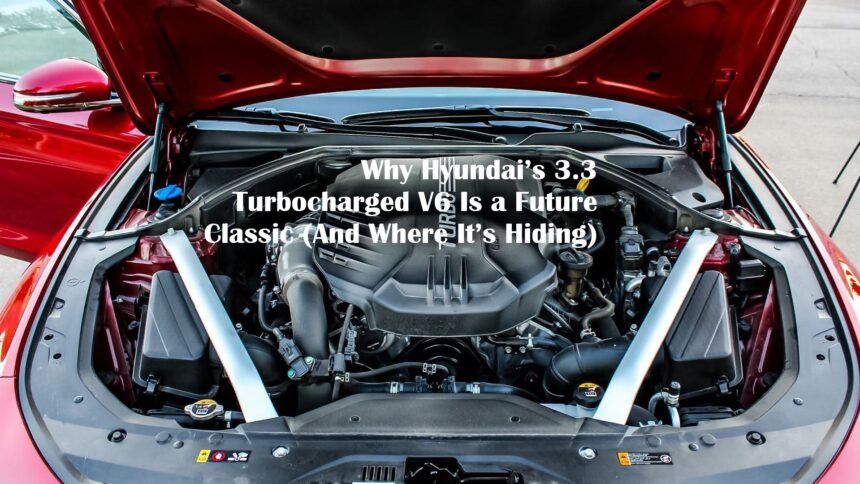
That reality is one reason Hyundai’s 3.3-liter twin-turbocharged V6 stands out today. The engine delivers strong performance, impressive tuning potential, and a driving experience that many enthusiasts believe will become harder to find in the coming years.
While it may not receive the same attention as some German performance engines, the 3.3T V6 has quietly built a loyal following. As more automakers move away from six-cylinder engines, Hyundai’s twin-turbo V6 is gaining all the ingredients needed to become a future classic.
The Engine That Changed Perceptions
When Hyundai introduced the 3.3-liter twin-turbocharged V6, it surprised many enthusiasts. The company had already improved its reputation for quality and value, but few expected it to create a performance engine capable of challenging established luxury brands. The 3.3T V6 produced impressive power figures from the beginning.
Depending on the application, output reached around 365 horsepower and 376 lb-ft of torque. Those numbers placed it directly against respected rivals from Europe. Performance was not the only strength. The engine delivered smooth power across the rev range and offered strong acceleration in everyday driving.
Twin turbochargers helped reduce lag while maintaining excellent responsiveness. Drivers quickly discovered that the engine felt refined during normal commuting and exciting during spirited driving. That balance remains one of its biggest strengths.
Built for the Enthusiast Crowd
Many modern performance engines focus heavily on efficiency targets. Hyundai’s 3.3T V6 took a different approach. It provided genuine performance without sacrificing comfort or reliability. Enthusiasts also appreciated the engine’s tuning potential.
Aftermarket upgrades unlocked substantial gains with relatively simple modifications. Owners often reported significant increases in horsepower through software tuning, intake upgrades, and exhaust improvements. The engine’s strong internal design contributed to its popularity among tuners.
It handled additional power well and earned a reputation for durability when properly maintained. That combination of factory performance and aftermarket flexibility often creates future collector interest. Many legendary engines earned their status by appealing to both casual drivers and hardcore enthusiasts. The 3.3T V6 follows a similar path.
The Timing Could Not Be Better
Future classics often emerge when an engine represents the end of an era. The automotive industry currently sits at exactly that point. Manufacturers continue replacing larger engines with smaller turbocharged units, hybrid systems, and electric powertrains. Several companies have already discontinued naturally aspirated V6 and V8 engines.
Others have announced plans to reduce their use dramatically. Even Hyundai and Kia have shifted attention toward four-cylinder turbo engines and hybrid technologies in newer products. Industry trends suggest that powerful six-cylinder engines will become increasingly uncommon over the next decade.
Recent vehicle updates across the segment show manufacturers replacing traditional V6 powerplants with smaller turbocharged alternatives. As supply decreases, enthusiast demand often increases. That pattern has repeated throughout automotive history. Vehicles equipped with memorable engines frequently become more desirable once production ends.
Where Is the 3.3 Turbo V6 Hiding?
Many buyers know the engine exists, but fewer know where to find it. The most famous application remains the Genesis G70. In this compact luxury sports sedan, the 3.3T V6 transforms the vehicle into a serious performance contender. Strong acceleration and rear-wheel-drive dynamics make the combination particularly appealing.
The engine also appeared in the Genesis G80. This larger sedan emphasizes refinement while still delivering impressive speed. Buyers receive luxury-car comfort without sacrificing performance. Another important application is the Genesis G90.
Hyundai originally developed the twin-turbo V6 to provide premium performance for its flagship luxury offerings. Early reports highlighted the engine’s strong torque output and smooth power delivery. The engine also found a home in the Kia Stinger.
Many enthusiasts consider the Stinger one of the most underrated performance cars of the last decade. The 3.3T V6 played a major role in that reputation. These vehicles often attract attention for their value proposition. Buyers receive premium performance at prices that traditionally undercut many European rivals.
Scarcity Is Becoming a Factor
Future classics usually benefit from scarcity. The 3.3T V6 faces that possibility today. Discussions among enthusiasts increasingly focus on the engine’s gradual disappearance from newer product lineups. Several manufacturers within the Hyundai Motor Group have introduced newer powertrains that shift attention away from the 3.3-liter unit.
As production numbers decline, surviving examples could become more desirable. The situation resembles many respected performance engines from previous decades. They often received limited recognition during production.
Enthusiast appreciation arrived later when buyers realized replacements offered different priorities. The automotive market frequently rewards uniqueness. A twin-turbo V6 from a manufacturer once known mainly for affordability certainly qualifies as unique.
Why Enthusiasts Love It?
Performance statistics tell only part of the story. Enthusiasts often describe the 3.3T V6 as an engine with character. It delivers strong acceleration, a satisfying power curve, and a driving experience that feels increasingly uncommon in modern vehicles. The engine also avoids some of the complexity associated with certain high-performance European alternatives.
Owners appreciate the balance between capability and usability. Another advantage comes from versatility. The 3.3T V6 works equally well in sports sedans, grand touring vehicles, and luxury applications. Few engines adapt so successfully across multiple segments. That flexibility strengthens its long-term appeal.
The Future Looks Bright
Predicting future classics always involves uncertainty. However, Hyundai’s 3.3-liter twin-turbocharged V6 checks many important boxes. It arrived during a transformative period in automotive history. It delivered performance that exceeded expectations.
It earned respect from enthusiasts and tuners. Most importantly, it represents a type of engine that manufacturers are rapidly abandoning. As electrification continues and six-cylinder engines become rarer, appreciation for the 3.3T V6 will likely grow.
For enthusiasts searching for tomorrow’s collectible powertrain, the answer may already be hiding in a Genesis sedan or a Kia Stinger. Today, it remains one of the automotive industry’s best-kept secrets. Tomorrow, it may become one of its most celebrated modern classics.