



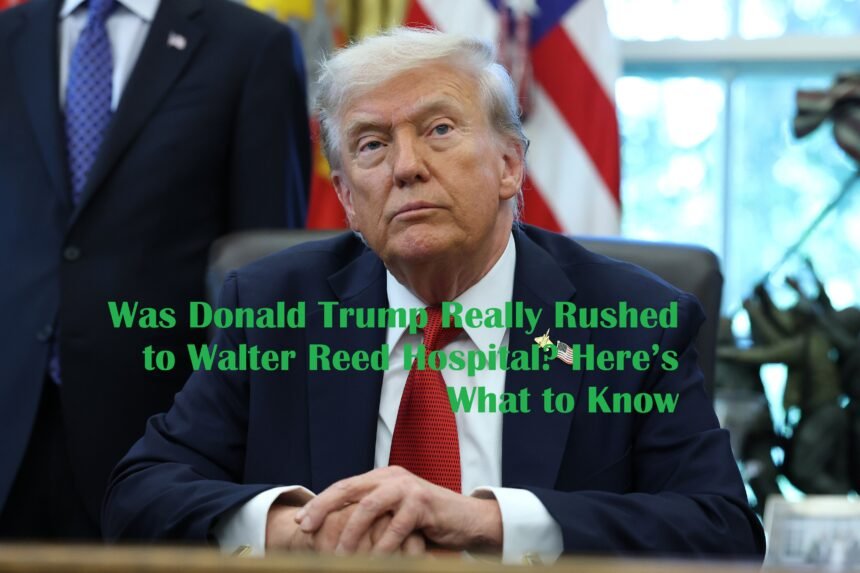
Recent speculation about President Donald Trump’s health spread rapidly online. Rumors claimed he had been rushed to the Walter Reed National Military Medical Center following an abrupt absence from public view.
Social media users shared theories, videos, and speculation about motorcades near the hospital. Officials, however, have strongly denied that the president was hospitalized. This article breaks down what happened, why the rumors started, and what the current facts show.
How the Rumors Started
Rumors began circulating after a sudden press conference was declared by the White House. A press lid is a standard communication term indicating that the president will not appear publicly for the rest of the day. On April 4, this lid was called unexpectedly in the morning.
Many observers saw this as unusual. At the same time, social media users noticed no new official photos, statements, or pool reports for hours. Some posts insisted that emergency vehicles or blocked roads near Walter Reed suggested a medical situation.
Videos began trending, and some claimed to show a motorcade heading toward the hospital. However, those clips were found to be unrelated to any recent event and instead were old or misidentified footage.
Official Responses to the Speculation
The administration responded quickly to quell the rumors. The White House’s communications team reiterated that the president was not hospitalized at any point that weekend. Officials emphasized that Trump had remained busy at the White House, working and handling his duties.
The press office specifically denied that Trump had been taken to Walter Reed National Military Medical Center as part of an emergency medical situation. They criticized social media speculation as unfounded and exaggerated.
The denial was accompanied by descriptions of Trump’s recent activity in Washington, where a Marine sentry was observed outside the West Wing, a typical indication that the president was present and working.
Officials also pointed out that past visits to Walter Reed were unrelated to this rumor. For example, previous hospital trips occurred for routine checkups or scheduled physical exams and were publicly acknowledged at the time.
Why People Believed the Rumors
A key reason the speculation spread was the information gap. When routine public appearances or communications stop unexpectedly, people often fill the void with assumptions. In this case, the lack of immediate updates and unusual procedural silence created fertile ground for speculation.
Many users also drew on a broader context of sensitivity about presidential health. In prior years, questions about Trump’s fitness and long‑term health have surfaced repeatedly in the media and public discourse. These unresolved perceptions can make rumor narratives seem more plausible to followers.
Another factor was the misinterpretation of unrelated visuals. Viral videos supposedly showing Trump being taken to the hospital were actually from earlier events. One such clip dated back to 2020 during the coronavirus pandemic, when Trump was indeed hospitalized as part of treatment. But that event was documented at the time and had no connection to the current rumors.
The Role of Social Media
Social platforms played a large role in amplifying the false claims. Once a story is shared widely, it can take on a life of its own, regardless of its factual basis. Conspiracy theories and dramatic interpretations spread faster than official statements can counter them.
Users quoted anonymous tips, blurry vehicle footage, and idle speculation as evidence. But none of these claims could be verified independently. No credible source confirmed that the president had been taken to a medical facility. Verified journalists noted that the presence of a press lid alone does not indicate a health crisis.
What Facts Are Confirmed
At this time, there is no verified evidence that President Trump was rushed to Walter Reed Hospital on April 4. The White House categorically denied the rumor and reaffirmed that he remained at the White House working through the weekend. The press release declared that the day was explained as a routine communication decision, not a signal of an emergency.
There was no medical evacuation, motorcade convoy, or official statement from military medical staff confirming any hospital visit. In addition, independent fact‑checking efforts found that the videos used as evidence were misattributed or from past periods. No real‑time footage or reliable reports tied any hospital activity to the president’s health.
Past Presidential Hospital Visits
It is important to note that presidents sometimes visit Walter Reed for non‑emergency reasons. Trump has been there before for scheduled physicals and checkups. For example, he received his annual examination in April and had routine visits several months ago.
These past visits were confirmed and not associated with any speculation at the time. However, those historical trips do not validate the recent rumors of an emergency hospitalization. They only contribute to why the hospital’s name tends to appear in health‑related speculation about presidents.
Impact of the Rumors
Rumors about a president’s health can have real consequences. They can affect public confidence, influence markets, and fuel political polarization. The rapid spread of the Trump hospitalization claim illustrated how unverified information can propagate, especially during tense political moments or when regular communications are paused.
In this case, officials moved to address the speculation promptly. Their swift denial aimed to reassure both national and international audiences that the president was not experiencing a hidden medical emergency.