



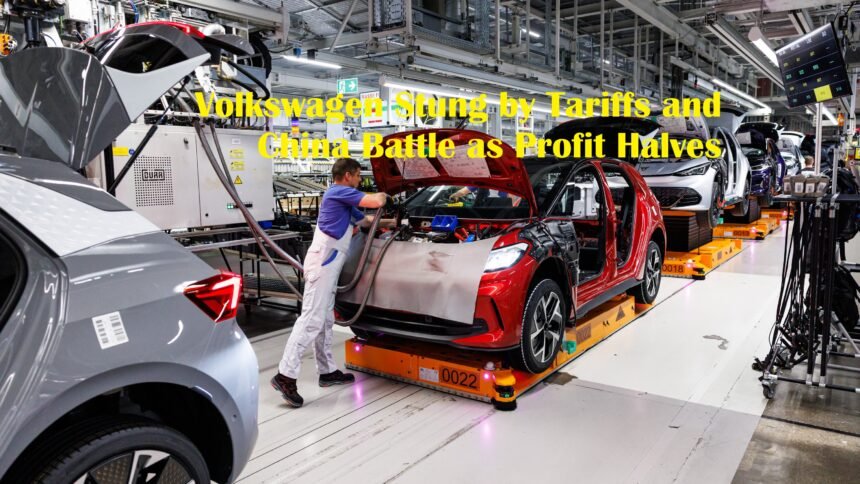
Volkswagen is entering another challenging year as global trade tensions and fierce competition in China put heavy pressure on its business. The German carmaker recently reported a sharp decline in profit, reflecting the challenging environment for the global automotive industry.
Tariffs, changing market dynamics, and strategic adjustments within the company have significantly affected its financial performance.
The company’s latest results reveal how international trade policies and shifting consumer preferences are reshaping the auto industry. As the world’s largest automakers race to adapt, Volkswagen faces the task of protecting its market share while restructuring its operations.
Profit Decline Signals Growing Pressure
Volkswagen’s operating profit declined significantly in 2025, underscoring the magnitude of the challenges it faces. The carmaker reported operating earnings of about 8.9 billion euros, representing a drop of more than 50 percent compared with the previous year. Analysts had expected stronger results, but the company missed those forecasts.
Despite the decline in profit, overall revenue remained relatively stable at around 322 billion euros. However, growth prospects appear limited in the near term.
The company expects revenue growth to remain between zero and three percent in the coming year. These numbers show that the automotive giant continues to generate large sales volumes. Yet profitability has become harder to maintain in an increasingly competitive and uncertain global market.
Tariffs Add Significant Costs
Trade tariffs have become a major burden for many global carmakers, and Volkswagen has felt their impact strongly. U.S. tariffs on imported vehicles and parts have cost the company billions of euros. These trade barriers have increased production costs and complicated global supply chains.
Tariffs have forced manufacturers to rethink where vehicles are built and how they move products across borders. For Volkswagen, this situation has reduced margins and created additional uncertainty in planning long-term investments.
Trade tensions have also affected pricing strategies. Higher import costs often translate into higher vehicle prices, which can weaken demand. As a result, automakers must balance cost increases with the need to remain competitive.
Competition Intensifies in China
China remains the world’s largest car market and a crucial battleground for global automakers. Volkswagen has long enjoyed strong sales in the country, but local competition has grown rapidly. Chinese manufacturers have expanded their presence with new electric models and aggressive pricing strategies.
These developments have gradually eroded Volkswagen’s market share. Domestic brands have become more innovative and quicker to launch new models. Many Chinese electric vehicles reach the market faster than those produced by traditional global carmakers.
As a result, Volkswagen must invest heavily in new technology and local partnerships to remain competitive. Regaining momentum in China has become one of the company’s top strategic priorities.
Strategic Challenges Within the Group
Internal restructuring has also played a role in the company’s profit decline. One major factor involves the luxury sports car brand Porsche, which belongs to the Volkswagen Group. The brand adjusted its strategy by slowing its transition toward fully electric vehicles. This shift created additional costs and reduced profitability within the group.
Weak demand for certain electric models further complicated the transition. Other premium brands under the Volkswagen umbrella, including Audi, have also faced pressure from changing consumer trends and global economic uncertainty. The combined effect has reduced the group’s overall profit performance.
A Fundamentally Changing Industry
Volkswagen’s leadership has acknowledged that the global auto industry is undergoing a major transformation. Chief Executive Oliver Blume noted that the company is operating in a “fundamentally different environment,” shaped by geopolitical risks, economic volatility, and technological disruption.
Electric vehicles, digital technology, and new mobility solutions are reshaping consumer expectations. Traditional automakers must invest billions in research and development to keep pace with these changes. At the same time, supply chain disruptions and trade disputes have created new risks. Companies must respond quickly to sudden policy shifts and market fluctuations.
Cost Reductions and Restructuring Plans
To strengthen its financial position, Volkswagen has launched an extensive cost-cutting program. The company plans to improve efficiency across its global operations while investing in future technologies. One of the most significant steps involves reducing the workforce in Germany over the coming years.
Approximately 50,000 jobs could be cut by 2030 as part of the restructuring effort. The company believes these measures will help restore profitability and support long-term competitiveness.
However, such decisions often generate tension with labor unions and employees. Volkswagen’s management argues that structural changes are necessary to adapt to the rapidly evolving automotive market.
Outlook for the Coming Years
Despite the current challenges, Volkswagen expects a gradual improvement in its financial performance. The company forecasts an operating margin between four and 5.5 percent in the coming year. Analysts estimate that margins may reach around 5.2 percent, near the upper end of the forecast range.
In the longer term, Volkswagen aims to achieve an operating margin of between eight and ten percent by the end of the decade. Achieving that goal will require successful cost reductions, stronger performance in China, and improved competitiveness in electric vehicles. New product launches and technological innovations will also play a key role in the company’s recovery strategy.