



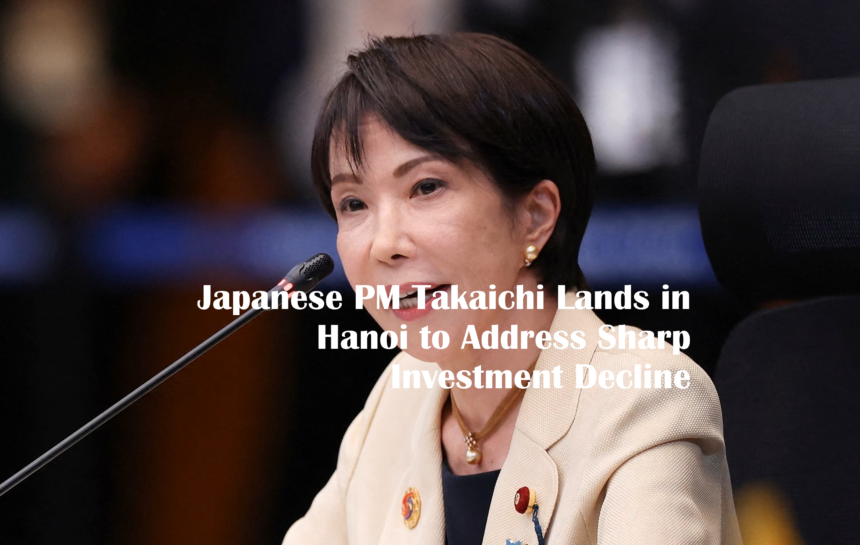
Japanese Prime Minister Sanae Takaichi arrived in Hanoi with a clear economic mission. A sharp decline in Japanese investment has raised concerns in both countries. Her visit aims to stabilize economic ties and restore investor confidence.
Background of the Visit
The visit was scheduled as part of a broader diplomatic effort. Stronger bilateral relations have been pursued since the Comprehensive Strategic Partnership was established in 2023. Cooperation in energy, technology, and regional security has been prioritized.
Japan remains one of the largest foreign investors in Vietnam. Thousands of Japanese companies operate in manufacturing and infrastructure sectors. However, recent data has highlighted a steep drop in new investment commitments.
Sharp Decline in Investment
A significant decline in Japanese investment has been recorded in early 2026. New investment pledges fell by around 75% year-on-year. The total reached only about $233 million in the first quarter. This decline has raised alarms among policymakers and business leaders.
Japan has long been viewed as a stable and reliable investor in Vietnam. The sudden drop suggests deeper structural concerns. Several factors have contributed to this downturn. Delayed payments for completed projects have been reported. Limited access to major infrastructure opportunities has also been cited.
Business Environment Concerns
Japanese firms have faced increasing challenges in Vietnam. Administrative delays and regulatory barriers have been highlighted. These issues have affected project timelines and profitability. Infrastructure access has remained a key concern.
Many companies have struggled to secure participation in large-scale projects. This has limited expansion opportunities. A nuclear power project was also abandoned by Japan. The decision was linked to strict construction timelines. This move signaled growing frustration with project conditions.
Strategic Economic Dialogue
During the visit, discussions are expected to focus on practical solutions. Improvements in the business environment are likely to be emphasized. Japanese companies seek clearer regulations and faster approvals. Energy cooperation has been placed at the center of talks. Vietnam’s growing demand for electricity offers opportunities for Japanese investors.
Renewable energy and LNG projects are expected to be explored. Technology collaboration is another priority. Digital transformation and semiconductor development have been highlighted. These sectors are seen as future growth drivers.
Trade Remains Strong
Despite declining investment, trade between the two countries has remained resilient. Bilateral trade increased by over 12% year-on-year in early 2026. The total reached approximately $13.7 billion. This growth reflects strong economic interdependence. Supply chains between Japan and Vietnam remain deeply integrated.
Manufacturing exports continue to drive trade expansion. The contrast between strong trade and weak investment is notable. It suggests that existing partnerships remain stable. However, new commitments have slowed significantly.
Policy Adjustments in Vietnam
Vietnamese authorities have started reviewing certain policies. A proposed ban on petrol-powered motorcycles in Hanoi has been reconsidered. The policy had faced criticism from Japanese firms. Such adjustments indicate responsiveness to investor concerns.
Policymakers aim to balance environmental goals with economic growth. Flexibility in regulation could help attract more investment. Efforts to improve infrastructure access are also being discussed. Greater transparency in project selection may be introduced. These steps could rebuild confidence among foreign investors.
Regional and Strategic Context
The visit also carries geopolitical significance. Japan has promoted its “Free and Open Indo-Pacific” strategy. Vietnam plays a key role in this regional vision. Security cooperation has been strengthened in recent years. Both countries share concerns about regional stability.
Economic collaboration supports broader strategic alignment. Takaichi’s trip includes meetings with top Vietnamese leaders. These discussions are expected to reinforce long-term cooperation. Economic issues remain at the core of the agenda.
Outlook for Future Investment
The decline in investment is not seen as permanent. Both sides have expressed commitment to reversing the trend. Structural reforms and policy adjustments are being considered. Japanese companies continue to view Vietnam as a key market. Its young workforce and strategic location remain attractive.
Manufacturing and technology sectors offer strong potential. Confidence could be restored if business conditions improve. Faster approvals and clearer regulations would play a crucial role. Stable policies are essential for long-term investment planning.