



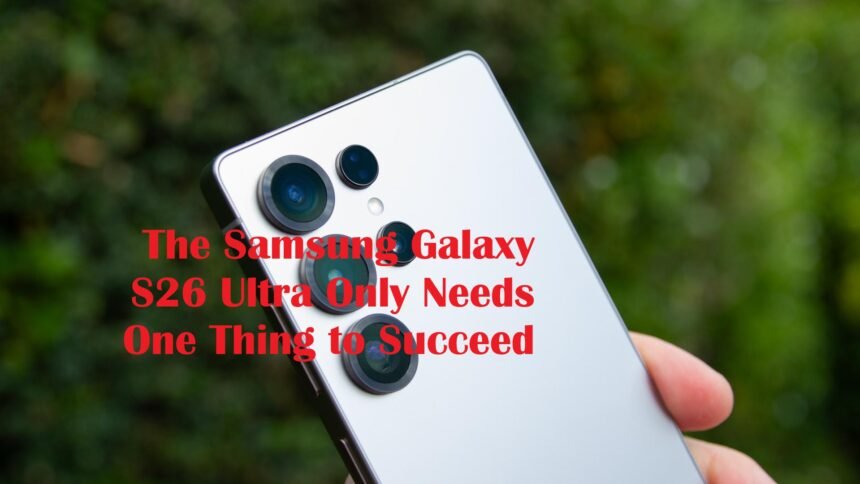
The Samsung Galaxy S26 Ultra is shaping up to be one of the most anticipated flagship phones of early 2026. Early reports and industry discussions indicate that while Samsung’s next Ultra model improves on many fronts, one key element could determine whether it truly succeeds in the flagship market.
Though the phone has multiple upgrades, critics and users alike point to one fundamental requirement that could elevate its appeal significantly. Rumors continue to swirl about the Galaxy S26 Ultra, and expectations are high. Some see this device as an opportunity for Samsung to reclaim perceived momentum against competitors.
Others feel the Ultra may fall short if it does not address a specific limitation. The conversation around this device reveals how flagship expectations have evolved in recent years.
What Samsung Has Changed So Far
Samsung has a tradition of refining its Ultra lineup with each generation. The Galaxy S25 Ultra, released in 2025, set a high bar for performance, display quality, and camera technology. For the S26 Ultra, leaks and reports suggest incremental improvements rather than a revolutionary overhaul.
Leaked specifications indicate the S26 Ultra will feature a refined design and stronger hardware. Reports point to a thinner chassis, enhanced brightness, and faster wired charging capabilities than its predecessor. These changes will help Samsung compete with rivals that have pushed for cutting-edge features.
Camera expectations are mixed. Early leaks claim most sensors will remain similar to the previous generation. However, slight tweaks such as a larger aperture on the main lens could improve low-light performance. If accurate, these changes represent modest enhancements.
Samsung is also expected to launch the S26 Ultra with a blazing-fast charging option. Charging power appears set to exceed the longstanding 45W standard, potentially reaching 60W in wired mode. Faster charging could reduce time spent tethered to a charger, which users increasingly demand.
In addition, software innovations and AI enhancements are likely. Galaxy AI features tied to the new One UI version may help distinguish the S26 Ultra from other flagship phones through smarter automation and better camera guidance.
With all these upgrades, the S26 Ultra seems positioned as a powerful and capable device. But the central debate continues: will these improvements be enough to draw buyers into a crowded flagship field?
The One Thing That Matters Most
Despite all rumored enhancements, many voices in the tech community argue that the S26 Ultra only needs one standout improvement to succeed. That key factor is battery life and charging performance that rivals or exceeds the competition. While Samsung continues to boost charging speeds, critics feel the company must go further if it wants the Ultra to truly shine.
Samsung’s conservative approach to battery technology has been noted by reviewers and enthusiasts alike. The S26 Ultra is expected to retain a battery capacity similar to the S25 Ultra around 5,000mAh. In comparison, some competitors now offer batteries with larger capacities and impressive, long-lasting performance.
Battery capacity alone, however, does not tell the whole story. Users increasingly care about how quickly a phone can recharge and how long it sustains performance under real-world conditions. Incremental increases in charging power represent progress, but analysts suggest Samsung could benefit from an even larger leap.
For many users, a flagship phone that struggles to sustain battery life across a full day under heavy use may feel outdated at launch. With constant social media scrolling, video playback, gaming, and navigation apps, battery demands continue to rise year after year. Flagship devices are expected to meet or exceed these expectations.
Moreover, charging convenience matters. Users no longer tolerate slow charging as standard. While 60W charging is a sizable step for Samsung, some competitors offer significantly faster wired and wireless charging speeds, including magnetic wireless standards. Samsung risks trailing if it does not fully embrace these advancements.
How the Competition Raises the Bar
Competitors in the flagship segment have raised the bar on battery and charging. Many brands now offer phones with larger battery capacities that maintain strong performance across heavy use. These competitors also introduce faster charging technology, sometimes exceeding 100W, which significantly reduces downtime.
Regardless of incremental hardware upgrades in other areas, battery performance and charging efficiency often become the decisive factors for many buyers.
Users want devices that last all day without a second thought and recharge quickly when needed. If Samsung can deliver an Ultra model that addresses these demands convincingly, it would solidify the phone’s position at the top of the market.
Other Areas That Still Matter
While battery and charging are frequently highlighted as the most crucial improvement area, other features also contribute to a flagship’s success. Display, camera performance, design, and software experience remain essential. Samsung’s rumored display enhancements, like increased brightness and privacy-oriented innovations, could enhance user satisfaction.
Camera upgrades, even if minor, may also attract users who prioritize photography. A wider aperture and performance tuned through software can deliver better results in challenging lighting. Some AI camera tools may further boost image quality and creative flexibility.
Finally, software and AI integrations in the Galaxy lineup are evolving rapidly. Galaxy AI features built into One UI promise more intelligent interactions, improved productivity, and new creative tools. These software enhancements, when paired with robust hardware, could compel more users to choose the S26 Ultra.