


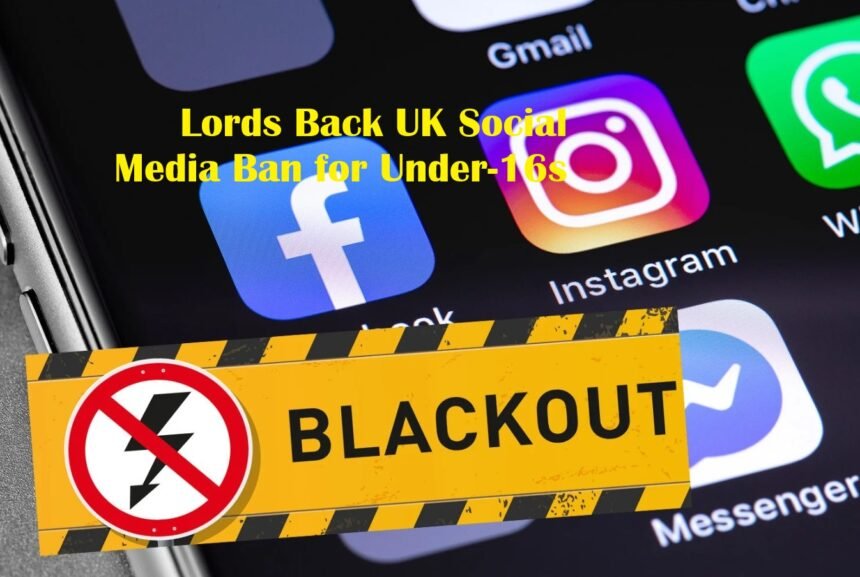
On 21 January 2026, the House of Lords voted in favour of a proposal to ban children under the age of 16 from using social media in the United Kingdom. This decision has set off a major political debate and signals a possible shift in how digital safety is regulated for young people.
What Happened in the House of Lords?
Peers in the UK’s upper chamber voted 261 to 150 in support of an amendment to the Children’s Wellbeing and Schools Bill that would introduce a social media ban for users under 16.
The move was backed by members from across the political spectrum, including Conservative, Labour and Liberal Democrat peers. This success is seen as a clear message to Parliament’s lower chamber, the House of Commons, to consider similar measures.
The amendment was sponsored by Lord John Nash, a Conservative peer, who argued that evidence about the harms of social media on children’s health and development was strong enough to justify decisive action. Peers who supported the amendment believe urgent reform is needed to protect children from online dangers.
Why Is the Ban Being Proposed?
Supporters of the ban point to growing concern over the impact of prolonged social media use on children’s mental health and behaviour. Studies and expert testimonies suggest links between social media and problems like anxiety, addiction, loss of concentration, self-harm, and other issues affecting young users.
Some speakers in the House of Lords described the situation as a public health risk that urgently needs addressing. These peers argue that social media platforms, with features like constant notifications and algorithms designed to keep users engaged, can be especially harmful for developing minds. They say parents often struggle to protect children on their own, making legislative action necessary.
Political Reaction and Government Response
The Government did not initially support the Lords’ amendment. Instead, a longer consultation period was proposed to examine the issue more fully before deciding on a ban. The consultation is expected to run for several months, with results due by summer. This has been criticised by some peers as a delay tactic that stalls action.
Prime Minister Sir Keir Starmer and members of the government have indicated that they are considering stricter regulation, including age limits, but have not committed to an outright ban yet. Starmer has said that “no option is off the table” as part of a broader discussion about online safety and ways to protect children.
At the same time, more than 60 Labour MPs have written to the prime minister urging support for a ban, reflecting pressure from within his own party. The aim is to follow a similar approach to a new policy introduced in Australia, where under-16s are already banned from holding social media accounts.
Public and Expert Views
Outside Parliament, many public figures and families affected by tragic events have spoken in favour of the ban. For example, the mother of a teenager who died in 2023 wrote to the prime minister, urging support for the measure, highlighting how her daughter’s use of social media allegedly worsened mental health challenges.
Actor Hugh Grant and others have signed letters backing the Lords’ amendment, saying parents need more help to control the online environment for children. Polls show strong parental support for restrictions, with many saying social media has negative effects on young users.
Meanwhile, some child welfare organisations and digital rights advocates caution that a blanket ban may not be the best solution. They argue that it could push children toward hidden or less regulated online spaces instead of resolving the core issues of platform design and online risk.
What Happens Next?
Because the House of Lords does not have the power to make law on its own, the amendment must now be considered by the House of Commons. If the Commons accepts the change, it could lead to a law that restricts social media access for under-16s. If it rejects the amendment, more negotiation between the Houses will take place before the final bill is passed.
The Government’s consultation may also influence how legislators decide next steps. Options under review include age verification systems, screen-time guidance, and restrictions on certain addictive features, alongside or instead of a full ban.
Broader Context
This debate in the UK forms part of a global conversation about children’s digital safety. Other countries, like Australia, have already enacted age restrictions, and similar proposals are being discussed in Europe and elsewhere.
The UK’s Online Safety Act already sets legal duties for platforms to protect children from harmful content, but the new amendment goes further by proposing an outright age-based ban.
The outcome of this legislative process will shape how young people interact with digital spaces in the future, and may influence policies in other nations as lawmakers weigh the benefits and drawbacks of age-based regulation of social media.
In summary, the House of Lords’ recent vote in favour of banning social media access for under-16s has intensified debate in the UK about online safety and children’s wellbeing.
The issue now moves to the House of Commons and into broader public and political discussion, as lawmakers, experts and families weigh the risks and responsibilities of regulating digital life for younger generations.