



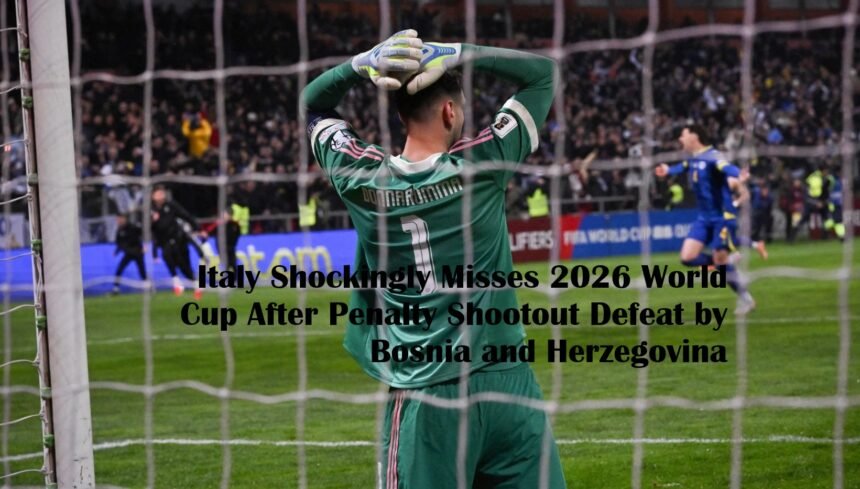
Italy’s hopes of qualifying for the 2026 FIFA World Cup were dashed in dramatic fashion on Tuesday night after a crushing penalty shootout loss to Bosnia and Herzegovina in their European playoff final. The result marks a stunning and historic failure for one of football’s most storied nations and raises pressing questions about the future of the national team.
First Half Promise Turns to Setback
The playoff final, held in Zenica, began with Italy taking an early lead. Moise Kean fired a precise strike into the net in the 15th minute, giving the visitors a momentary advantage and sparking hope among supporters. However, that momentum was short‑lived.
Just before halftime, Italy suffered a critical blow when defender Alessandro Bastoni was shown a straight red card for stopping a promising Bosnian attack. Reduced to ten men, the Azzurri were forced into a more defensive posture, spending much of the match under pressure from their hosts.
Bosnia Forces Extra Time
Despite playing with a numerical disadvantage, Italy held on through much of the second half. However, their resistance finally cracked in the 79th minute when Haris Tabakovic found the equalizer for Bosnia.
His goal leveled the score at 1‑1 and sent the match into extra time. Extra time saw chances decline for both sides, with fatigue becoming a factor. Neither team managed to break the deadlock, setting the stage for a decisive penalty shootout.
Penalty Shootout Heartbreak
In the shootout, Bosnia converted all four of their attempts with calm precision, while Italy faltered. Italian players Pio Esposito and Bryan Cristante both failed to score from the spot, putting their team on the brink of elimination. Bosnia’s flawless execution ensured a 4‑1 shootout victory, sealing Italy’s fate.
The result confirmed that Italy will not participate in the 2026 World Cup, extending their absence from the global tournament to at least three successive editions. Italy previously failed to qualify for the 2018 and 2022 World Cups, making this the first time a former World Cup champion has missed out on three straight tournaments.
Historic Decline for a Football Powerhouse
Italy’s World Cup pedigree is undeniable. The Azzurri have won the tournament four times, with their most recent triumph coming in 2006. Yet since then, their performances on football’s biggest stage have waned. The team hasn’t advanced past the group stage since that victory, and their failure to qualify again underscores a troubling long‑term trend.
The 2026 qualification campaign had offered some promise, but ultimately, Italy’s form unravelled at crucial moments. The red card and the pressure of defending with ten men contributed to an uphill battle that the team could not overcome.
National Shock and Reaction
Italy’s elimination sent shockwaves through the football world, particularly given the expansion of the World Cup to 48 teams for the 2026 edition in the United States, Canada, and Mexico. With more spots available than ever, the Azzurri’s failure to secure one is especially stark.
Fans and pundits expressed disbelief and disappointment across social media and in news outlets. Many pointed to structural issues within Italian football, from youth development to tactical decisions at the senior level. Critics argued that deeper reform may be needed to return Italy to competitiveness on the international stage.
Bosnia’s Historic Achievement
For Bosnia and Herzegovina, the victory marked a major milestone. The national team will make only its second appearance in a World Cup finals tournament, its first since 2014. Their performance demonstrated resilience and composure, particularly given their own history of playoff heartbreak in previous qualification campaigns.
Bosnia’s shootout heroics were led by young talents who showed maturity under pressure. Their success was celebrated passionately by local fans, who witnessed their team book a place in Group B of the 2026 World Cup alongside co‑hosts Canada, Qatar, and Switzerland.
What This Means for Italy
Italy’s absence from another World Cup raises important strategic questions for the national football federation. Debate has already raged over coaching decisions, player selection, and broader issues in Serie A’s role in nurturing domestic talent. Some commentators have suggested leadership changes both on and off the pitch may be necessary to reinvigorate the program.
Players and staff were visibly affected by the outcome, with coach Gennaro Gattuso acknowledging the emotional burden of the defeat and choosing not to focus immediately on his own future. The team’s next steps will be watched closely by fans and analysts alike as Italy begins the process of rebuilding after this historic setback.
Legacy and Looking Forward
Italy’s non‑qualification for the 2026 World Cup will be etched into football history. It is a rare moment of vulnerability for a country once regarded as an automatic presence on the world stage. As the football‑mad nation reflects on this loss, attention will turn to the 2028 European Championship and rebuilding efforts that could restore Italy’s standing.
For Bosnia and Herzegovina, qualification represents optimism and growth, while Italy faces a period of introspection and possible transformation. The contrast between the two nations’ trajectories in this playoff final highlights the unpredictable nature of sport and the ever‑evolving landscape of international football.