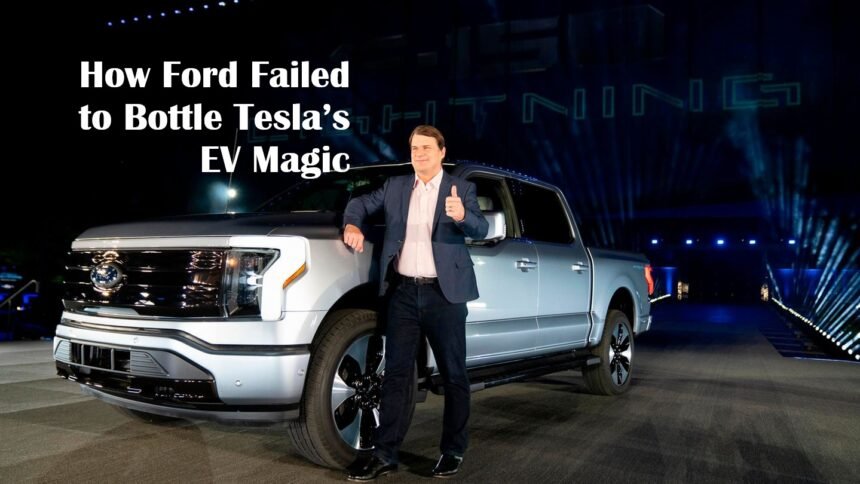
Ford once seemed poised to challenge Tesla’s dominance in electric vehicles. The automaker launched a bold plan built around the all-electric F-150 pickup. Early previews and reservations sparked widespread excitement.
Yet the result fell far short of expectations. The company is now retreating from its initial electric strategy and has taken huge financial hits. The story offers important lessons about innovation and market fit.
High Hopes for an Electric Future
Ford’s leadership believed the electric F-150 would change the industry. The truck was meant to be the next big thing in electrified pickups. At its unveiling, company executives showcased the vehicle with confidence. Built on Ford’s iconic F-Series legacy, the electric truck was positioned as a rival to Tesla and other electric competitors.
Reservations climbed quickly, and demand seemed strong. Ford even expanded production plans to meet projected orders. This optimism was rooted in the belief that buyers wanted full-size electric trucks. Yet the outcome was different. Almost from the start, the truck did not match key customer expectations.
The Expectation Gap
Early reviews praised the electric F-150 for its performance. It offered fast acceleration and respectable towing numbers on paper. Despite this, real-world ownership revealed a gap between promise and experience. Traditional truck customers placed high value on range and capability. Many buyers use trucks for work, hauling heavy loads and driving long distances.
When heavy towing reduced the range significantly, many owners were disappointed. As a result, a large segment of typical truck buyers chose to avoid the electric model.
Analysts found that roughly 35 % of initial buyers were former owners of traditional trucks. Yet these buyers reported dissatisfaction with the range and performance tradeoffs. Many customers did not see the electric F-150 as a true replacement for the gasoline-powered version.
The Tesla Advantage
Tesla had established a strong position in the broader electric vehicle market long before Ford’s major push. Its early models appealed to buyers because they combined innovation with range and performance that matched or exceeded gas vehicles. Instead of being known for “electric cars,” Tesla became known for top-tier vehicles of any kind that happened to be electric.
Its strategy centered on making electric automobiles that impressed buyers on all fronts. Tesla’s vehicles consistently offered long range, strong performance, and fast charging.
Its charging network gave buyers confidence for long trips. Tesla also developed software features that kept customers engaged with the brand. This combination gave Tesla an edge that proved difficult for legacy automakers to match.
Misreading the Market
One key issue was that Ford often marketed its electric pickup as a new kind of truck. Many truck buyers, however, still judged it against traditional benchmarks. They expected a range that matched gasoline equivalents. They also wanted consistent performance while towing heavy loads. When the electric truck fell short on those metrics, buyers expressed disappointment.
Meanwhile, smaller electric startups seemed to capture a different buyer mindset. Those owners often valued the novelty and environmental appeal of electric vehicles more than raw capability. The electric F-150 struggled between these two worlds. It did not fully satisfy core truck buyers, nor did it strongly appeal to early electric adopters. This mismatch proved costly.
Financial Consequences
The financial toll of this misstep was large. Ford announced a multibillion-dollar charge tied to its electric vehicle efforts and pulled back on key models. The company abandoned future generations of the electric pickup as originally planned. Leadership also acknowledged that its overall electric strategy required reevaluation.
These decisions came after years of investment and development costs. Losses on electric models are mounted over multiple years. Ford’s leadership had expected electric vehicles to become profitable sooner. Instead, they faced steep costs and slower demand. The retreat from earlier plans highlighted the challenges of competing in the EV market.
Structural and Strategic Challenges
Ford’s challenges were not just about one vehicle. They reflected deeper structural issues. The company’s design and manufacturing processes were built around internal combustion engines for decades. Transitioning to electric vehicles required new engineering systems and supply chains. Software and electrical architecture, once peripheral, became crucial.
Tesla’s early focus on integrated software and efficient design gave it an advantage. Ford’s legacy systems proved slower and more costly to adapt. The result was higher production costs and slower innovation cycles.
Even when advanced electric features were developed, they often lagged behind those of pure electric manufacturers. This situation made it harder for Ford to differentiate its products. As competitors advanced and costs remained high, the EV strategy lost momentum.
Consumer Behavior and Incentives
The timing of Ford’s struggles also intersected with changes in government policy. Incentives that had supported electric vehicle purchases were reduced. As subsidies ended, demand for higher-priced electric models softened. Buyers became more price sensitive, especially for large electric trucks.
In contrast, the cost of traditional gasoline vehicles remained familiar and predictable. For many customers, the financial calculus no longer favored electric alternatives. This shift in market dynamics made it tougher for Ford to justify its original strategy. Demand weakened before Ford could fully scale its electric offerings.
Lessons Learned
Ford’s pivot away from its initial electric plan offers important lessons for legacy manufacturers. First, understanding customer expectations matters. Early adopters and mainstream buyers can value different product attributes. Second, technological leadership matters in electric vehicles.
Range, efficiency, and integrated software are not optional. Third, timing and policy environments can shape market success. Ford’s initial plan did not fully anticipate rapid shifts in incentives and consumer priorities.