



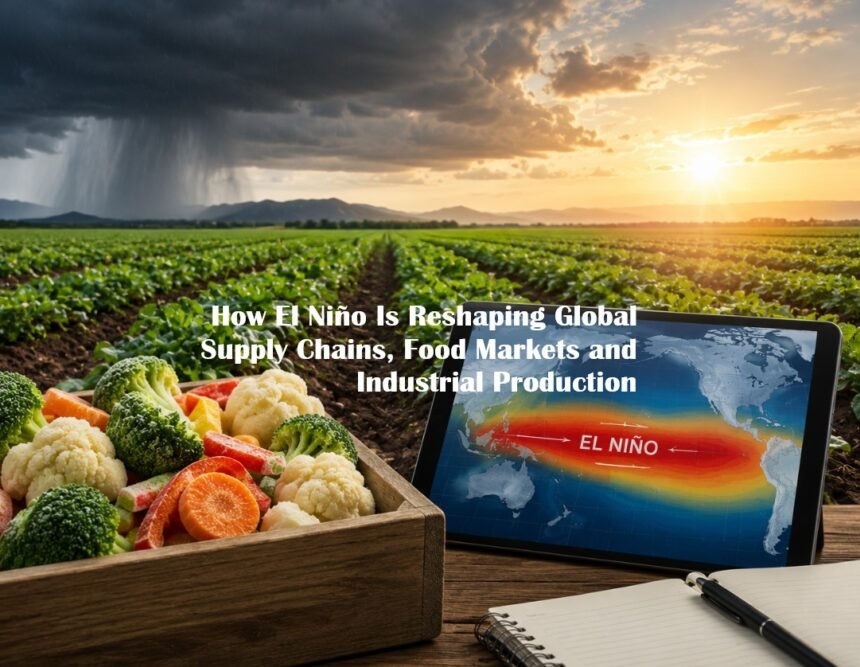
The latest El Niño is becoming more than a climate story. Its effects are increasingly visible in global trade, commodity markets and industrial activity as unusual weather disrupts production and transportation across several major economic regions. The weather phenomenon began drawing serious attention after scientists confirmed its development in June 2026.
Ocean temperatures in the Pacific have reached exceptionally high levels, while the resulting changes in rainfall and temperature are affecting countries far beyond the region where El Niño originates. For businesses operating across international supply chains, the timing is particularly challenging.
Shipping networks are already vulnerable to geopolitical disruptions, while manufacturers and food producers depend on a steady flow of raw materials from different parts of the world. The current El Niño could therefore create a chain reaction in which weather disruptions increase production costs, reduce supplies and eventually affect consumers.
Panama Canal Faces Another Supply Chain Challenge
One of the clearest examples can be found at the Panama Canal, a critical route for international shipping. The canal depends heavily on water stored in Lake Gatún. Every vessel crossing the waterway consumes a substantial amount of freshwater, meaning prolonged dry conditions can quickly limit the number of ships that can pass. El Niño has brought unusually dry conditions to Panama. Rainfall between May and August was reportedly 34% below the historical average, placing additional pressure on the canal’s water resources.
The reduced water supply has forced authorities to restrict vessel traffic. For shipping companies, fewer available transit slots mean greater competition and higher costs. This is particularly significant because the Panama Canal has become an important alternative route for companies attempting to avoid other global transportation bottlenecks.
Another disruption could therefore add pressure to an already complicated international logistics network. Higher shipping expenses can eventually move through the supply chain. Importers may pay more to transport goods, manufacturers can face higher input costs, and consumers may ultimately see those expenses reflected in retail prices.
Copper Supply Comes Under Pressure
El Niño is also creating problems for the mining industry, particularly in Chile. Chile is one of the world’s most important copper-producing countries. The metal plays a crucial role in electricity networks, renewable-energy infrastructure, electric vehicles and data centers. Demand for copper remains strong because many industries are investing heavily in electrification. Any significant reduction in supply can therefore have consequences far beyond the mining sector. Extreme snowfall affected operations at Antofagasta’s Los Pelambres mine in July.
Around five million cubic meters of snow reportedly accumulated in the area, disrupting production and forcing the company to reduce its output expectations. The incident demonstrates how El Niño can create unexpected industrial problems. Although the phenomenon is often associated with heat and drought, its influence varies across regions. Some areas experience dry weather, while others receive excessive precipitation or snowfall. For commodity markets, this unpredictability makes production planning more difficult.
Peru’s Fishing Industry Faces a Major Test
The consequences are also emerging in Peru, where El Niño is threatening the supply of anchovies. Peru is a major producer of fishmeal, which is widely used as feed in the global aquaculture industry. Anchovies are a key raw material for producing fishmeal, so any disruption to their availability can affect fish farming operations around the world. Concerns over the health of anchovy stocks prompted authorities to end this year’s fishing season earlier than expected. The resulting shortage has pushed fishmeal prices to record levels.
The impact has even created opportunities for alternative feed producers, including companies developing insect-based protein. For these businesses, the disruption illustrates how a shortage in one part of the supply chain can accelerate demand for substitutes. The development also highlights the broader economic role of climate events. A weather phenomenon does not have to destroy a factory or port to create economic consequences. Simply changing the availability of an essential raw material can be enough to alter prices and business strategies.
Asian Rice Markets Could Become More Vulnerable
Food markets are another major concern as El Niño continues. Asia is particularly exposed because the region is home to some of the world’s largest rice-producing and rice-consuming economies. India, one of the most important agricultural producers, has experienced weaker-than-normal monsoon rainfall. The country has reportedly recorded a 13% shortfall in monsoon rains, raising concerns about agricultural output. The situation is being closely watched because India’s agricultural decisions can influence global food prices.
In 2023, concerns over domestic supplies contributed to restrictions on rice exports, which helped push international prices higher. If unfavorable weather significantly reduces production again, governments could face pressure to prioritize domestic food security over international exports. That possibility could create another round of price increases, particularly for countries that depend heavily on imported rice.
Inflation Could Become a Bigger Problem
The economic impact of El Niño is not limited to individual commodities. The bigger concern is its potential contribution to inflation. Food and transportation costs influence consumer prices across many economies. When shipping becomes more expensive while agricultural production declines, companies may have fewer options for absorbing higher expenses. Emerging markets could be particularly exposed because food often represents a larger share of household spending. Central banks may also face a difficult policy environment.
If weather-related inflation persists, policymakers could have less room to reduce interest rates even if economic growth begins to weaken. The Philippines, for example, has already cited El Niño-related inflation risks among the factors behind monetary tightening. Its central bank raised rates for a third consecutive meeting while warning about potential pressure from higher rice prices and other costs. This creates a difficult combination weaker production can slow economic activity while higher prices simultaneously make inflation more persistent.
Not Every Industry Will Lose
Despite the widespread disruption, El Niño does not affect every sector negatively. Some industries can benefit from changes in weather patterns. European energy markets, for example, may experience different conditions that reduce certain heating requirements. Tourism-related businesses can also see opportunities when weather patterns create favorable conditions in particular regions. Alternative commodity producers may likewise benefit when conventional suppliers experience shortages.
The insect-protein industry provides one example. As fishmeal becomes more expensive, producers of alternative feed ingredients can become more competitive. This means El Niño creates both winners and losers rather than producing a uniform economic shock.
Businesses Are Preparing for a Longer Disruption
One of the biggest challenges is uncertainty. El Niño does not affect every country in the same way, and the timing of its economic consequences can vary considerably. Scientists expect the current event to persist into 2027, while 2027 is widely forecast to be another exceptionally warm year.
Companies therefore have incentives to strengthen inventories, diversify suppliers and identify alternative transportation routes. Food producers may seek additional reserves, manufacturers may look for substitute materials, and logistics companies could reconsider their dependence on vulnerable shipping corridors. For governments, the challenge is even broader. They must balance domestic food security with the need to keep international trade flowing.
A New Test for the Global Economy
The latest El Niño demonstrates how closely climate conditions are connected to the modern economy. A drought in Panama can affect shipping costs. Extreme weather in Chile can influence copper supplies. Changes in Peru’s marine ecosystem can affect global aquaculture. Reduced rainfall in India can raise concerns about rice prices.
These events may occur thousands of miles apart, but global supply chains connect them through trade, production and consumer demand. The biggest economic risk may therefore come not from one individual disruption but from several occurring simultaneously.
As El Niño continues to influence weather patterns, companies and governments will be forced to test how resilient their supply chains really are. The experience could also accelerate investment in alternative suppliers, strategic reserves and climate-resistant infrastructure. For the global economy, El Niño is no longer simply a seasonal weather event. It is becoming a major variable that businesses, investors and policymakers must consider when planning for the years ahead.