



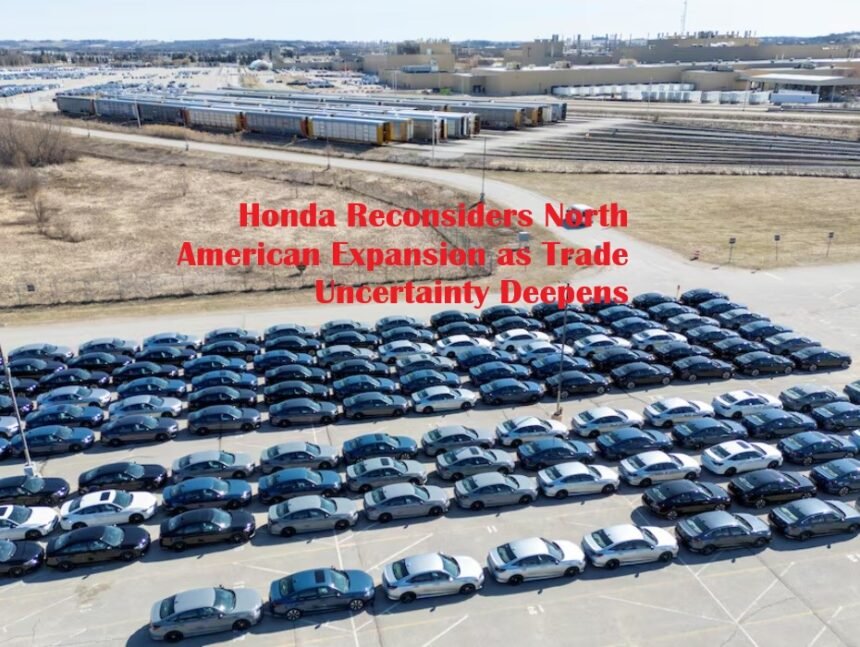
Honda is approaching a major decision about its future manufacturing footprint in North America, but the Japanese automaker says the next phase of its expansion could depend heavily on the future of regional trade rules. The company is nearing the limits of its existing production capacity and expects to need another assembly facility. However, Honda Executive Vice President Noriya Kaihara said the automaker could reconsider that investment if the United States, Mexico and Canada fail to provide sufficient long-term certainty through the USMCA trade framework.
Trade Policy Becomes a Factory Investment Factor
For Honda, the question is no longer simply whether North America needs another factory. The larger issue is whether the company can confidently commit billions of dollars to a facility while the rules governing cross-border automotive production remain uncertain. Honda currently operates seven assembly plants in the region and is approaching full production capacity. Kaihara said the company will need to make a decision about an additional facility within the next one or two years, with a potential new plant expected to begin operations around 2030.
That timeline makes the future of the United States-Mexico-Canada Agreement particularly important. A factory designed to operate for decades requires predictable conditions for sourcing components, moving vehicles across borders and managing production costs.
USMCA Uncertainty Complicates Long-Term Planning
The USMCA was created to establish a common trade framework between the United States, Mexico and Canada. The agreement has become especially important to automakers because modern vehicle production relies on supply chains that cross national borders several times. Honda’s warning illustrates how trade negotiations can influence corporate investment decisions well beyond tariffs on finished vehicles. The Trump administration is currently negotiating with Canada and Mexico over the future of the agreement.
At the same time, tensions between Washington and Ottawa have intensified, creating additional uncertainty for companies that depend on Canadian components and manufacturing operations. For Honda, an unclear trade environment could make a new assembly plant harder to justify. The company needs to estimate production costs years in advance, and changing tariff structures could significantly affect those calculations.
Tariffs Are Already Affecting the Automotive Industry
The broader trade dispute has created additional pressure across the North American automobile industry. On August 24, President Donald Trump threatened to impose a 50% tariff on Canadian-made cars, trucks and auto parts beginning January 1, 2027, following the breakdown of U.S.-Canada trade negotiations. Such measures could disrupt established automotive supply chains because manufacturers frequently source engines, components and other parts from multiple countries before completing vehicles at assembly facilities.
Honda has so far absorbed higher tariff expenses rather than immediately passing the entire cost to consumers. However, prolonged trade restrictions could eventually force automakers to reconsider pricing, sourcing and manufacturing strategies. The uncertainty is therefore not limited to Honda’s potential factory. It could influence where the company produces vehicles, where it purchases components and how it allocates future capital spending.
Honda Is Already Adjusting Its Investment Strategy
Honda’s reconsideration of a new North American factory comes after several significant changes to its broader automotive strategy. The automaker recently abandoned a planned $11 billion electric-vehicle project in Canada and has scaled back some of its earlier EV ambitions.
It has also canceled several electric models intended for the U.S. market while redirecting production resources toward hybrids. This shift reflects changing consumer demand and market conditions. Instead of relying as heavily on battery-powered vehicles, Honda plans to introduce 15 hybrid models by 2030. The strategy could allow Honda to respond more quickly to customers who want improved fuel efficiency without fully committing to battery-electric vehicles.
Strong Hybrid Demand Gives Honda More Flexibility
Honda’s renewed focus on hybrid vehicles comes at a time when high fuel prices are encouraging consumers to seek more efficient transportation. The company’s sales performance also provides a reason for maintaining investment in North America. Honda reported a 36% increase in July vehicle sales, marking its strongest July performance in seven years.
Strong demand creates a compelling case for additional production capacity. If sales continue growing, Honda could eventually face pressure to expand its manufacturing network regardless of trade conditions. However, the company must balance that demand against the risks associated with committing capital under uncertain trade rules. A new plant would require a substantial investment and could remain operational for decades.
North American Production Has Strategic Importance
Building vehicles closer to their largest markets can help manufacturers reduce transportation costs and improve supply-chain efficiency. Local production can also provide greater flexibility when consumer preferences change. For Honda, another North American factory could strengthen its ability to respond to demand in the United States, Canada and Mexico.
Yet the benefits depend on stable trade arrangements. If components repeatedly cross borders during production, sudden tariffs can increase the cost of every stage of manufacturing. Automakers therefore need predictable rules before approving major long-term projects. Honda’s position demonstrates that trade agreements are now part of corporate investment calculations rather than simply government policy issues.
The Decision Could Influence the Wider Auto Industry
Honda is not the only manufacturer watching developments around the USMCA. Other automakers are also concerned that changes to North American trade rules could increase costs and complicate production strategies. Industry groups have previously urged the U.S. administration to maintain stable trade arrangements with Mexico and Canada because the automotive sector depends heavily on integrated regional supply chains. The outcome of the negotiations could therefore influence future factory investments across the continent.
Companies may delay projects, redirect production or increase domestic sourcing if they cannot obtain sufficient confidence in the existing framework. For governments, this creates a difficult balancing act. Trade policies designed to encourage domestic manufacturing can also increase costs for companies that rely on integrated regional production.
Honda’s Next Move Will Depend on Policy Stability
Honda still expects to need another North American assembly plant, but the company is signaling that the project is not guaranteed. The next one to two years will be crucial as Honda evaluates production capacity, vehicle demand, tariffs and the future of the USMCA. A stable agreement could support the company’s expansion plans and provide the confidence needed for a factory targeting operations around 2030. Without that certainty, Honda could redirect capital toward other priorities. The situation highlights a broader transformation in the automotive industry.
Factory decisions are increasingly shaped not only by consumer demand and technology but also by geopolitics, tariffs and trade agreements. For Honda, the future of North American manufacturing may ultimately depend on whether policymakers can provide the long-term stability required to justify its next major investment.