



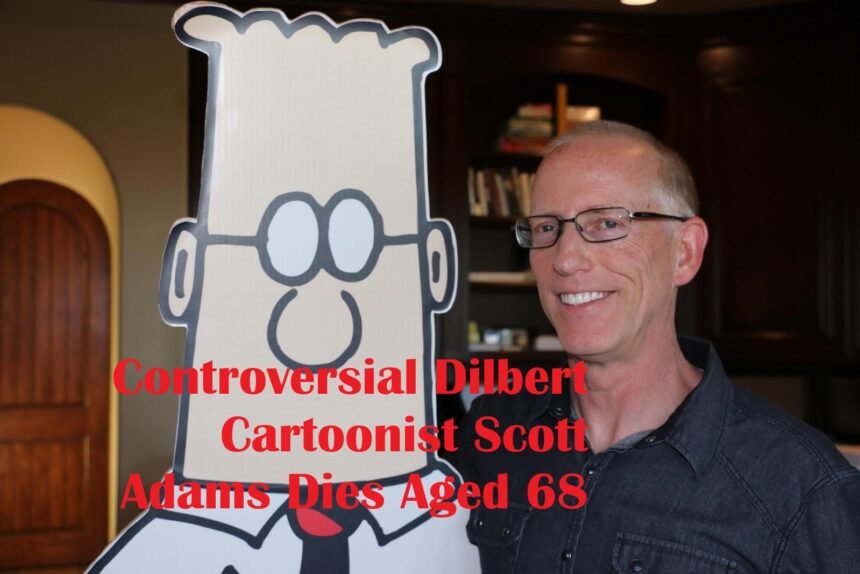
Scott Adams, the American cartoonist best known for creating the long-running comic strip Dilbert, has died at the age of 68. His death was confirmed on Tuesday by his former wife, Shelly Miles, during an emotional livestream. Adams had been battling aggressive prostate cancer, and his passing marks the end of a career that was both influential and polarizing.
A Life in Satire and Comics
Scott Raymond Adams was born on June 8, 1957. He grew up in Windham, New York, where his early interest in drawing eventually led him to pursue cartooning. Before becoming a full-time artist, Adams worked a series of corporate jobs, including positions in banking and telecommunications.
His day-to-day experience in office environments gave him the inspiration for Dilbert, a comic strip that would later make him a household name. In 1989, Adams published his first Dilbert comic. The strip’s setting was the modern office, full of cubicles, jargon, and bureaucratic absurdities.
Its dry humor and sharp satire quickly struck a chord with readers who recognized their own workplace frustrations in the characters. At its peak, Dilbert appeared in more than 2,000 newspapers worldwide, reaching tens of millions of daily readers.
The strip centered on its titular engineer, Dilbert. Surrounded by clueless managers and surreal corporate policies, Dilbert became a symbol of the frustrated employee. The cast also included his cynical dog, Dogbert, and a boss with an eternally pointed hairdo. These characters became cultural icons, emblematic of late 20th-century office life.
Success and Cultural Impact
As Dilbert grew in popularity, Adams expanded his work into books, speeches, and media. His 1996 book The Dilbert Principle became a bestseller by offering humorous insights into corporate culture. Around the same time, he won the prestigious Reuben Award from the National Cartoonists Society, one of the highest honors in the profession.
His creation even inspired an animated television series that aired in the late 1990s. For years, Adams was widely admired for his ability to transform office toil into sharp, accessible humor.
Many readers saw Dilbert strips tacked up in cubicles, shared online, or discussed in workplaces. The comic’s success highlighted universal themes of bureaucracy, mismanagement, and the everyday absurdity of corporate life.
Shift to Controversy
In the mid-2010s, Scott Adams began to move beyond workplace satire and into the realm of political commentary. He became known for commentary on social and political topics, often expressing views that divided opinion among his audience. His social media presence grew, and he hosted a regular online podcast where he discussed current events and culture.
The turning point for his public reputation came in 2023. On a livestream, Adams made remarks about race that were widely condemned as racist. He described Black Americans in inflammatory terms and suggested that white people should distance themselves.
Many newspapers and syndicates responded by dropping the Dilbert strip from their pages, effectively ending its decades-long run in mainstream publications. His distributor also cut ties with him amid the backlash. That controversy marked a major shift in how Adams was perceived.
Where once he had been celebrated as a humorist with broad appeal, he was now a polarizing figure. Some supporters defended his intent as criticism of media and cultural trends. Others saw his comments as harmful and divisive. Regardless of position, his reputation had undeniably changed.
Final Years and Battle With Cancer
In May 2025, Adams publicly revealed that he had been diagnosed with prostate cancer that had spread to his bones. He shared updates on his health through his podcast and social media, telling followers that his prognosis was poor and that recovery was unlikely. In several episodes, he spoke candidly about the progression of his illness.
As his condition worsened, Adams entered hospice care at his home in Northern California. In his final weeks, he continued to engage with his audience, even as his physical health declined. On January 1, 2026, he wrote what would become a final message.
That statement was read aloud by his former wife during her livestream announcing his death. In it, Adams reflected on both his accomplishments and his struggles, expressing gratitude for his life and a desire for others to “be useful” and carry forward lessons he valued.
Reactions and Legacy
News of Adams’ death drew responses from figures across the political spectrum. Former President Donald Trump paid tribute, describing Adams as a “Great Influencer” who bravely fought his illness. Tech leader Elon Musk also voiced admiration, calling Adams a significant voice in public discourse. Such reactions underscored how his influence extended far beyond the world of comics.
However, public reaction was mixed. For many, Dilbert remains a beloved piece of cultural history that captured office life with wit and honesty. For others, Adams’ later years are remembered for controversy and statements that overshadowed his earlier achievements. His career illustrates how a creator’s legacy can be shaped by both their art and their public voice.
Experts in media and culture note that Dilbert fundamentally changed how cartoons reflected everyday life. It brought workplace humor into the mainstream and influenced generations of artists and writers. Even as the comic’s print run declined, its impact on popular culture persisted, with many fans revisiting classic strips that still resonate with the daily grind of office work.
Closing Thoughts
Scott Adams’ life was marked by creativity, success, and conflict. He bridged classic cartooning and modern media, creating a comic strip that became a global phenomenon.
Yet his later years showed how public figures can be celebrated and contested in equal measure. His story is a reminder of the power of art to connect with audiences and the complex ways in which creators interact with the culture around them.
As the world remembers Scott Adams, it does so with varied emotions: admiration for his comic genius, and reflection on the controversies that shaped his later life. His legacy, like that of many influential artists, will continue to be debated and discussed for years to come.