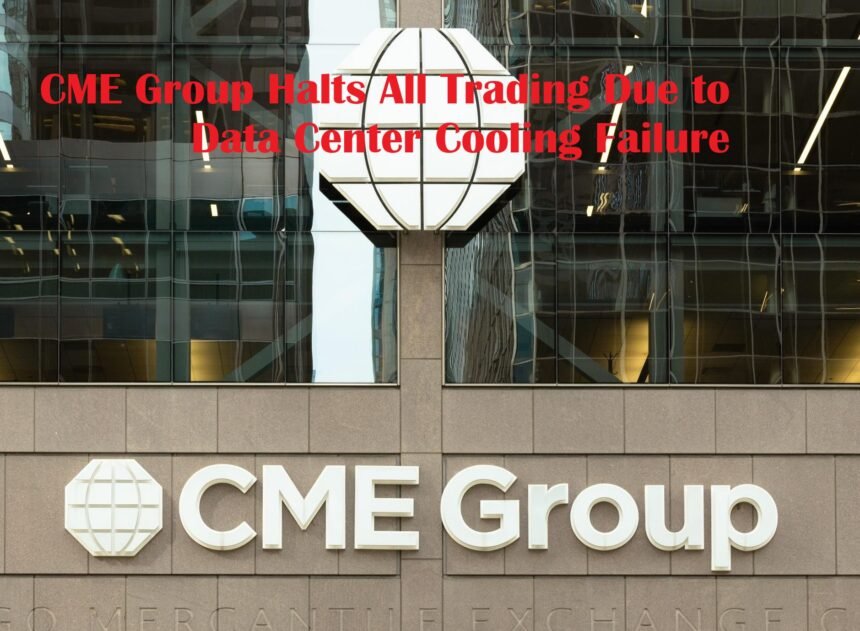
The CME Group suspended trading operations after a cooling system malfunction at a critical data center. The fault occurred at a CyrusOne facility that hosts infrastructure vital to CME’s electronic trading platforms.
The outage forced a freeze across a wide range of markets: futures and options on equities, commodities, currencies, and treasury products. CME confirmed the issue via official notice. All affected platforms remain offline until further resolution.
Scope of the Freeze: Platforms and Assets Affected
The disruption impacted several of CME’s core platforms, including its Globex futures and options system, the EBS foreign exchange platform, and BMD markets. Key benchmark contracts saw their prices freeze. These included crude oil (WTI), U.S. 10-year Treasury futures, major U.S. equity index futures such as the S&P 500 and Nasdaq 100, among others.
FX markets were disrupted, especially major pairs that typically trade on the EBS platform (e.g., EUR/USD, USD/JPY). Because CME handles a vast volume of derivatives contracts across energy, commodities, treasuries, equities, agriculture, and metals, the halt had broad global implications.
Why the Cooling Malfunction Caused a Market Freeze
The outage was not caused by software bugs or cyberattacks, but by a physical malfunction: a cooling system failure inside the CyrusOne data center. That center hosts the servers responsible for CME’s trading and data-distribution infrastructure. When temperatures exceeded safe operating thresholds, systems automatically shut down to prevent overheating and hardware damage.
With trading servers offline, order matching and price dissemination ceased, forcing CME to suspend all trading. This incident highlights how even non-cyber, physical infrastructure failures can bring global financial markets to a halt. The reliance on centralised data centers creates a single point of failure.
Market Reaction: Disruption, Uncertainty, and Risk
The freeze happened amid thin liquidity. The session followed the U.S. Thanksgiving holiday, and many markets were set to close early. As futures prices froze, traders and brokers lost real-time quotes for critical instruments. Some brokers pulled contracts entirely, while others tried to rely on internal pricing models, increasing risk and uncertainty.
For hedgers and speculators, the inability to access live prices disrupted position management. For investors watching opening-night benchmarks, the freeze clouded expectations and raised the potential for heightened volatility once trading resumes.
Infrastructure Weakness and Broader Implications
The outage exposed a fundamental vulnerability: financial markets depend heavily on centralised data centers whose physical environment must be maintained to strict standards. Systemic risk emerges not only from cyber threats, but from basic infrastructure failures such as cooling.
As a result, stakeholders across exchanges, brokers, and regulators may face growing pressure to demand more resilient, redundant systems, including distributed or decentralized infrastructure. This event may accelerate discussions on infrastructure risk and backup mechanisms in global markets.
In the short term, exchanges and data-center operators will likely review contingency protocols, redundancy in power and cooling systems, and backup trading workflows. The hope is to prevent a full freeze if a single facility fails again.
What CME Says — And What Comes Next
CME issued a public statement acknowledging the “cooling issue” at the CyrusOne data center and confirming a trading halt across its platforms. It said support teams were working to restore functionality and pledged to inform clients about pre-open details once systems are stable.
Clients were warned that updates and price-feeds for affected contracts could take time after trading resumes. It remains unclear how long the outage will last. Until operations restart, price discovery and hedging around many asset classes remain suspended, prolonging uncertainty and potential risk for market participants.
Conclusion: A Clear Warning for Market Infrastructure
The recent suspension of trading by the CME Group reveals how fragile even the most centralised, high-tech market systems can be. A simple cooling malfunction at a key data center brought trading to a standstill across commodities, currencies, treasuries, and equity futures.
This event underscores the importance of robust physical infrastructure, not just reliable software or cybersecurity. It shows that data centers remain critical systemic nodes; their failure can stall global financial markets.
Going forward, exchanges, data-center operators, and regulators may need to rethink resilience, redundancy, and disaster-recovery strategies. The freeze should prompt an industry-wide reflection on dependencies, safeguards, and contingency planning to prevent similar disruptions in the future.