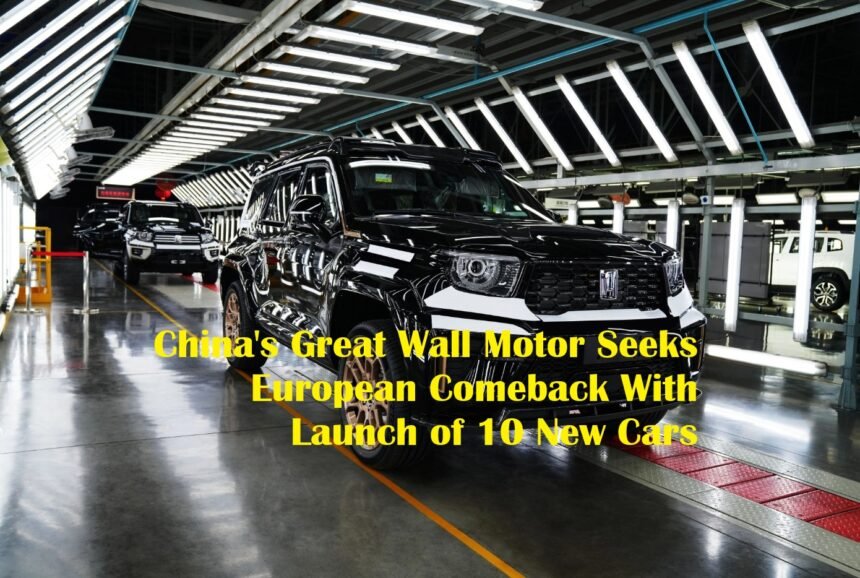
China’s automotive industry continues to expand beyond domestic borders. Among its key players, Great Wall Motor (GWM) has renewed its ambitions in Europe. A major comeback strategy has been introduced through the planned launch of at least ten new vehicles over the next two years. This move reflects both urgency and confidence as the company attempts to regain momentum in one of the world’s most competitive automotive markets.
A Second Attempt in a Challenging Market
GWM previously entered the European market with high expectations. Its debut at the 2021 Munich auto show garnered attention with a strong lineup of electric vehicles. However, success was not achieved as expected. Market traction remained limited, and competition proved intense. European consumers had already been loyal to established brands.
At the same time, other Chinese automakers began entering the region with aggressive strategies. As a result, GWM’s earlier expansion struggled to deliver a strong sales performance. Lessons were learned from this experience. A new approach has now been developed, focusing on flexibility and broader appeal.
Diversified Product Strategy
A key weakness in the earlier attempt was identified. The product lineup had been heavily focused on electric vehicles. This narrow approach limited market reach in regions where charging infrastructure varied widely. The new strategy has been redesigned. A diversified portfolio will be introduced, including electric, hybrid, and internal combustion engine models.
Among the upcoming vehicles are models such as the Ora 5 city car, the Jolion Max SUV, and the H7 off-road vehicle. These options are expected to appeal to a wider range of consumers. By offering multiple powertrain choices, GWM aims to adapt to different market conditions across Europe. This flexibility is considered essential for long-term success.
Expansion Across European Markets
The comeback strategy is not limited to product launches. A broader geographic expansion has also been planned. Currently, GWM operates in several European countries. However, its presence remains relatively limited. New markets such as Italy and Spain are scheduled for entry, followed by Poland shortly after.
Within a year, operations are expected to expand into more than ten additional countries. This aggressive rollout demonstrates the company’s determination to scale quickly. A wider distribution network is also being developed. Dealer coverage will be increased to improve accessibility and customer experience.
Long-Term Investment Plans
The European comeback is supported by long-term investment goals. One of the most significant plans involves building a manufacturing facility in Europe. The proposed factory is expected to have an annual production capacity of around 300,000 vehicles. Although the location has not yet been finalized, the project signals a strong commitment to the region.
Local production could provide several advantages. Costs may be reduced, supply chains could become more efficient, and regulatory challenges might be easier to manage. This investment aligns with GWM’s broader global ambition. The company aims to double its total vehicle sales to one million units by 2030.
Competitive Pressure in Europe
The European automotive market remains highly competitive. Established manufacturers dominate the landscape, and new entrants continue to emerge. Chinese automakers are expanding rapidly in the region. Companies such as BYD and others have already gained attention with competitive pricing and advanced technology.
This environment creates both opportunities and risks for GWM. On the one hand, demand for alternative brands is increasing. On the other hand, competition is becoming more intense. Analysts have noted that a broader product range could improve GWM’s chances. However, success is not guaranteed in such a crowded market.
Shifting Industry Dynamics
The global automotive industry is undergoing rapid transformation. Electrification, digitalization, and changing consumer preferences are reshaping the market. Chinese automakers have gained strong momentum in recent years. Innovation and cost efficiency have allowed them to compete effectively with traditional brands.
In Europe, demand for electric vehicles continues to grow. However, hybrid and conventional models still play an important role. GWM’s multi-powertrain strategy reflects this reality. At the same time, geopolitical factors and trade policies influence market dynamics. These challenges require careful navigation by all global manufacturers.
Learning from Past Mistakes
GWM’s renewed strategy shows a clear shift in thinking. The earlier approach was considered too narrow and ambitious without sufficient adaptation. This time, a more balanced plan has been introduced. Product diversity, market expansion, and local investment have been prioritized.
Customer preferences are being studied more closely. Vehicles are being designed to meet regional expectations rather than relying on a one-size-fits-all approach. Such adjustments could improve the company’s ability to compete effectively in Europe.
Outlook for the Comeback
The success of GWM’s European comeback will depend on several factors. Product quality, pricing, brand perception, and distribution will all play critical roles. If the new models meet consumer expectations, market share could gradually increase. The planned expansion into multiple countries may also accelerate growth.
However, challenges remain significant. Competition from both European and Chinese brands will continue to intensify. Despite these risks, GWM’s renewed push demonstrates strong determination. The company has made it clear that it does not intend to retreat from global competition.