


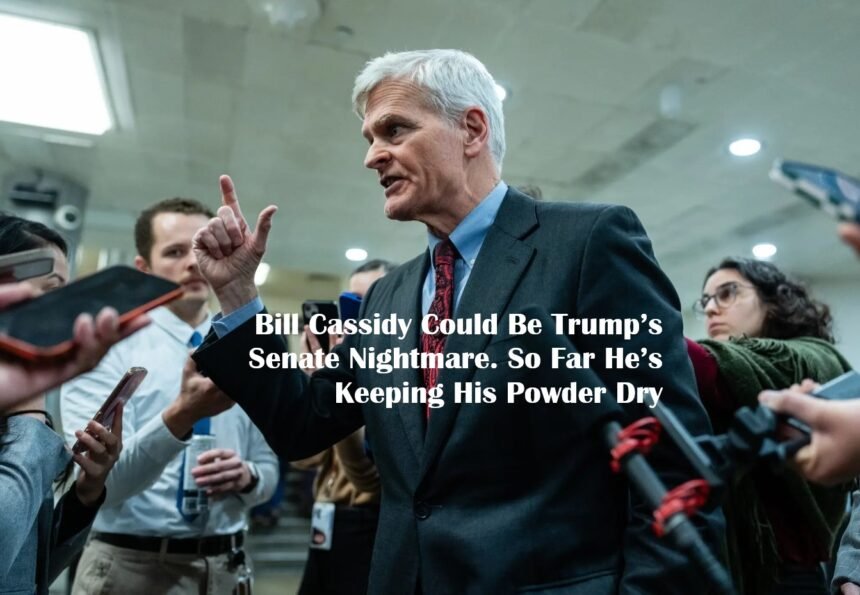
Senator Bill Cassidy has long occupied a difficult position inside the Republican Party. He supports conservative policies and often votes with Republicans. Yet his willingness to challenge Donald Trump has made him one of the GOP’s most unpredictable figures.
Cassidy became a national target after he voted to convict Trump during the former president’s second impeachment trial in 2021. That decision transformed him into a symbol of Republican resistance, even though he rarely presents himself that way in public. Years later, the political consequences remain severe. Trump-backed forces continue to pressure him, while many conservative voters still distrust him.
Despite those tensions, Cassidy has avoided open warfare with Trump. Instead, he has chosen a quieter strategy. He criticizes carefully, avoids dramatic headlines, and waits for moments when his influence can have the greatest impact. That restraint may become extremely important inside the Senate.
A Republican Willing to Break Ranks
Cassidy’s impeachment vote separated him from most Republican senators. Only a handful of GOP lawmakers supported convicting Trump after the January 6 Capitol riot. Since then, many of those Republicans have retired, lost elections, or faded from influence. Cassidy survived longer than many expected. His political balancing act became increasingly complicated.
Cassidy often supported Trump-backed legislation and nominees after the impeachment vote. He also attempted to reconnect with conservative voters in Louisiana. However, many Republicans never forgave his decision. Trump repeatedly reminded voters about Cassidy’s impeachment stance. The attacks damaged Cassidy’s standing inside the state Republican base.
Trump eventually endorsed Representative Julia Letlow against him, turning the Louisiana race into a test of loyalty inside the GOP. Cassidy’s defeat in the Republican primary showed how powerful Trump’s influence remains. Yet the loss may also create a new political reality in Washington.
Why Cassidy Still Matters
Even after losing his primary, Cassidy remains a sitting senator until the end of his term. That gives him months of influence inside a narrowly divided Senate. He also serves as chairman of the Senate Health, Education, Labor, and Pensions Committee, one of the chamber’s most significant committees.
This position allows Cassidy to shape hearings, delay nominations, and pressure administration officials. Because he no longer faces reelection, political threats carry less weight than before. That possibility worries many Republicans. Several reports suggest Senate Republicans fear Trump’s aggressive campaign against incumbents could weaken party unity before the midterms.
Some senators believe internal battles drain money and create instability. Cassidy now represents a different type of challenge. He understands Senate procedure, possesses strong healthcare expertise, and no longer needs to satisfy primary voters. That combination could make him harder for Trump allies to control.
Healthcare Could Become the Main Battleground
Healthcare policy may become the center of Cassidy’s influence. As a physician, Cassidy has built a reputation as a policy-focused senator rather than a media personality. He often approaches legislation through technical details instead of partisan slogans. That style sometimes puts him at odds with Trump-aligned populists.
Cassidy famously expressed concerns about Robert F. Kennedy Jr.’s views on vaccines and public health. Although he eventually supported Kennedy’s nomination, tensions reportedly remained behind the scenes. Future healthcare nominations could reopen those conflicts. Some analysts already believe Cassidy’s primary defeat complicates efforts to fill major public health positions.
Since he will soon leave office, he may feel less pressure to support controversial nominees. That scenario creates a serious political risk for Trump’s allies. A senator with committee authority and little electoral fear can slow the confirmation process dramatically.
The Senate Is Different From the House
Trump dominates Republican politics partly because many lawmakers fear primary challenges. House members especially remain vulnerable because elections arrive every two years. The Senate operates differently. Senators hold longer terms, possess more procedural tools, and often protect institutional traditions.
Cassidy belongs to a shrinking group of Republicans who still value Senate independence. That independence explains why some GOP senators quietly worry about Trump’s pressure campaigns. Public loyalty remains common, but private frustration appears to be growing. Several reports describe tensions between Senate Republicans and Trump over endorsements and political strategy.
Cassidy could become an important figure in that struggle. He understands the cost of opposing Trump. He has already experienced political punishment firsthand. That experience may give him greater freedom than senators who still fear retaliation.
Keeping His Powder Dry
So far, Cassidy has avoided becoming a full-time Trump critic. He rarely dominates cable news. He does not lead anti-Trump coalitions. Instead, he chooses selective moments to push back. That approach reflects political calculation. Open rebellion would likely reduce his influence inside Republican circles.
Quiet resistance, however, allows him to preserve relationships while maintaining leverage. Senate veterans often understand that power depends on timing as much as public attention. Cassidy appears to recognize that reality. His recent statements after losing the primary hinted at frustration with modern political culture.
He defended democratic norms and criticized personal attacks without directly targeting Trump by name. Those comments suggest he may still play a larger role before leaving office.
Trump’s Remaining Republican Critics
Cassidy’s situation also highlights a broader transformation inside the Republican Party. Most Republicans who openly challenged Trump have disappeared from national politics. Senators like Susan Collins and Lisa Murkowski remain exceptions rather than the rule. That shrinking opposition strengthens Trump’s control.
However, it also increases pressure on the few remaining dissenters. Cassidy may no longer face voters, but he still holds institutional power. In a closely divided Senate, even one determined senator can create major complications for a president’s agenda. For now, Cassidy continues to operate carefully. He has not launched a political crusade.
He has not attempted to become the face of Republican resistance. Yet his experience, committee authority, and independence make him a potentially dangerous obstacle for Trump’s allies. The nightmare scenario for Trump may not involve loud public attacks. It may involve a quiet senator who understands exactly how the Senate works and knows he has little left to lose.