



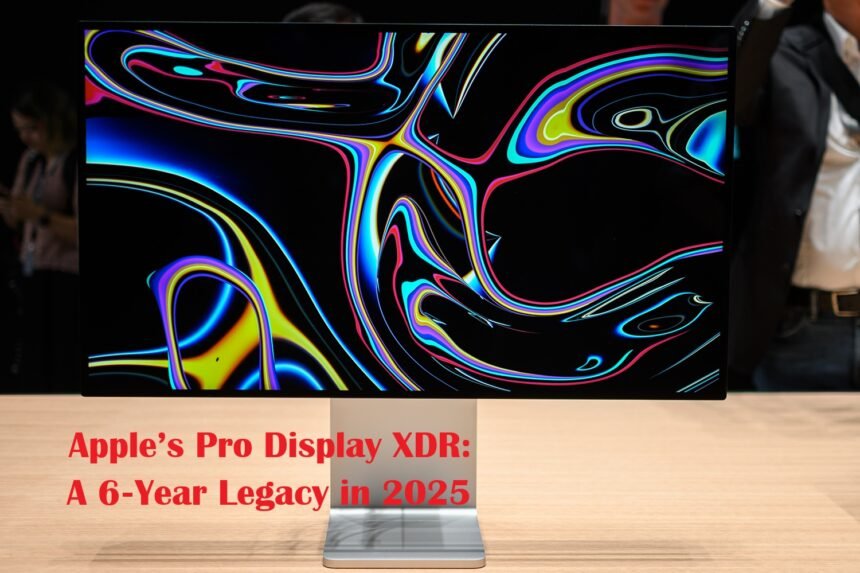
Apple’s Pro Display XDR has quietly reached its sixth year since launch, a milestone worth noting as the monitor remains largely unchanged. The display still stands as Apple’s flagship external monitor. Its endurance highlights both the display’s engineering and the uncertain future of a successor.
Origins, Launch, and What Pro Display XDR Brought
The Pro Display XDR debuted on 10 December 2019, launched alongside the third‑generation Mac Pro (2019). The monitor was Apple’s re‑entry into the standalone display market, after a multi‑year gap following the discontinuation of earlier displays.
With a 32‑inch panel and 6K resolution (6016×3384), the Pro Display XDR delivered more screen space and detail than Apple’s previous displays. It employed a custom LED backlighting system, enabling 1,000 nits of sustained brightness across the full screen and up to 1,600 nits at peak.
A wide P3 color gamut, 10‑bit color depth (over a billion colors), and a contrast ratio of 1,000,000:1 completed the package, ideal for professional workflows that require precise color accuracy, such as video editing, photography, and graphic design.
Furthermore, advanced thermal management was built into its aluminum lattice back panel, allowing the display to maintain high brightness levels without overheating. Optional “nano‑texture” glass was offered to reduce glare, giving users a matte alternative for environments prone to reflections.
The starting price when it launched was steep, $4,999 for the standard glass version. If users wanted the adjustable Pro Stand (height, tilt, and rotation adjustments), that added another $999, sold separately.
Half a Decade and More of Stability and Stasis
Over the years, the Pro Display XDR has remained largely unchanged. As of 2024, a major tech site described it as “five years old” with “no update in sight.” By early 2025, rumors continued to swirl about a possible next‑generation version, but concrete details remained scarce.
Some expectations for an updated model include a built‑in Apple silicon chip (like in the lower-cost Studio Display), possibly adding features such as speakers, a microphone, webcam, and more modern connectivity.
Other speculations point to potential improvements such as higher refresh rate, updated connectivity standards (e.g. Thunderbolt 5), or newer display technologies (e.g. quantum‑dot or OLED). Without an official update, the original 2019 model continues to represent Apple’s top offering for external monitors in 2025.
Why Does It Still Matter and Why Is It Still a Relevant Force?
Professional‑Grade Display Quality
The 6K resolution, wide color gamut, deep contrast, and high brightness levels remain competitive even by 2025 standards. For creative professionals, video editors, photographers, and color graders, the Pro Display XDR still offers reference-level color accuracy and dynamic range. The thermal design and LED backlighting ensure stable performance, even under long usage hours.
Longevity Through Design
The separation of the Pro Stand (sold separately) gives flexibility, users can choose between an Apple stand, third‑party mounts, or custom setups. That modular approach resonates with the intended audience, professionals who may have varied workspace needs.
The optional nano-texture glass allows adaptation to different lighting environments, an advantage for studios or offices with overhead lighting.
Niche but Consistent Market Position
Because the Pro Display XDR targets a niche of high-end creative and professional users, demand remains modest. That may partly explain why Apple has not rushed a replacement. With low volume but high quality, the monitor remains a premium, albeit expensive, option.
The Uncertain Road Ahead and What Does 2025 Mean for the Pro Display XDR?
As of early 2025, there is no officially confirmed successor. Rumors exist and point to potential upgrades, but none have matured into announced products. The industry-wide push toward OLED, mini‑LED, higher refresh rates, and integrated features may pressure Apple to update.
Still, the lack of leaks or rumors specific to Pro Display XDR suggests either caution or a longer development timeline. If a new model appears, it may address features that some users currently find limiting, no built-in webcam, no speakers or mic, and no modern silicon inside for smart features.
The move could bring the monitor more in line with modern external displays, but at the cost of complexity and perhaps a different price point. Until that happens, the original Pro Display XDR remains a high‑end, specialized tool especially for creatives and professionals who value accuracy, consistency, and build quality over bells and whistles.
Conclusion: A Six-Year-Old Monitor That Still Commands Respect
In an industry where devices often become outdated within 2–3 years, the Pro Display XDR’s six-year tenure feels remarkable. It remains relevant because it was built from the start as a professional tool, not a mass‑market product.
Its display quality, build design, and modular flexibility keep it useful in 2025 even as display trends evolve around it. The absence of a successor only underscores its niche purpose and the careful balancing of demand vs. innovation from Apple’s side.
For professionals needing a reliable, color‑accurate, high‑dynamic‑range monitor, the Pro Display XDR continues to deliver. Whether it will stay at the top or be succeeded remains to be seen, but for now, it stands as a testament to what a premium external display can be.