



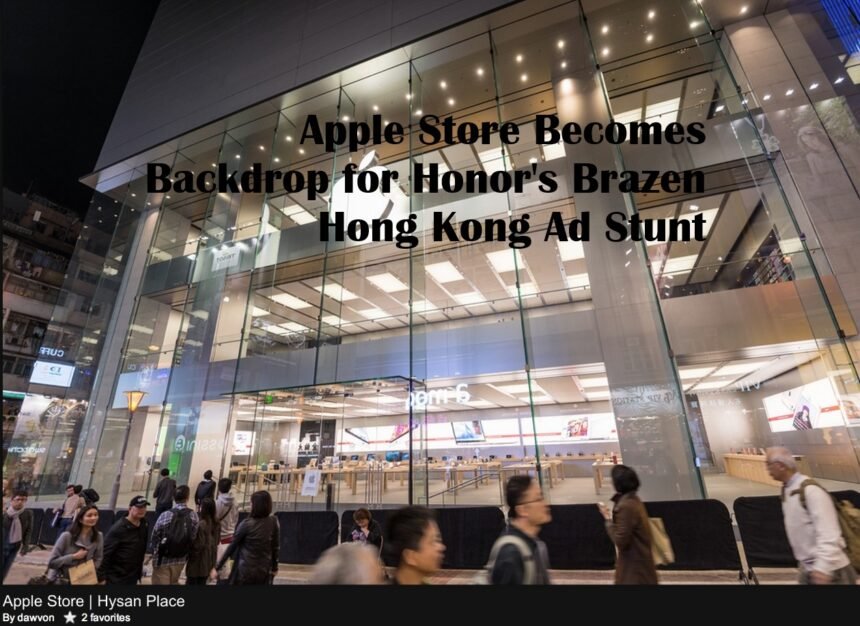
A marketing stunt in Hong Kong recently drew global attention after an Honor promotional campaign inadvertently used an Apple Store as its visual backdrop. The incident sparked discussion about brand rivalry in the smartphone industry. It also highlighted how far companies are willing to go for visibility in crowded markets. The event was widely reported by technology news outlets. Apple’s retail presence was central to the visual contrast.
The Setting of the Campaign
The stunt took place outside an Apple Store in Hong Kong. Honor positioned its promotional materials and filming setup in a way that placed the Apple retail space prominently in the background. The scene created a strong visual comparison between the two smartphone brands.
Passersby and online viewers quickly took notice of the composition. Many interpreted it as a deliberate marketing move. The Apple Store’s clean glass design and iconic logo made it an instantly recognizable backdrop. This amplified the impact of the campaign.
Honor’s Marketing Strategy
Honor has been known for bold promotional tactics in competitive smartphone markets. The Hong Kong stunt aligned with its broader strategy of high-visibility advertising. The company often emphasizes innovation, design, and performance in its messaging.
In this case, the use of a well-known retail location increased attention. The contrast between the brand’s advertisement and Apple’s store reinforced competitive positioning. The campaign aimed to capture consumer curiosity in a saturated tech environment.
Marketing stunts like this are not new in the smartphone industry. Competitors frequently seek attention near rival locations. The strategy relies on visual association and public engagement. It also benefits from social media amplification.
Public and Industry Reactions
Reactions to the stunt were mixed. Some observers saw it as clever guerrilla marketing. Others viewed it as an unnecessary provocation. The presence of the Apple Store intensified debate. Online discussions focused on originality and brand rivalry. Many users noted how similar marketing styles have become across smartphone companies.
The stunt quickly circulated on social platforms, increasing visibility for Honor. Industry analysts often view such tactics as part of broader competitive branding. In highly competitive markets, attention can matter as much as product features. The Hong Kong incident reflected this dynamic clearly.
Apple’s Role as an Unintended Stage
Apple did not participate in the campaign. However, its retail store became the visual centerpiece of the stunt. Apple Stores are designed with minimalist architecture and strong branding presence. This makes them recognizable even in crowded city environments. The store’s appearance unintentionally strengthened the campaign’s visual message.
It created a contrast that drew attention to both brands. The location itself became part of the storytelling. Apple’s global retail footprint often places it at the center of urban commercial activity. This visibility can sometimes lead to situations where its stores become part of external marketing narratives.
Competitive Branding in Hong Kong
Hong Kong is a major hub for technology marketing in Asia. Many global smartphone brands compete for consumer attention there. Retail spaces, billboards, and street-level campaigns are common battlegrounds. Honor and Apple both maintain strong brand recognition in the region.
This increases the impact of any visual overlap. Marketing strategies often rely on location-based visibility to gain traction. The stunt reflected how physical retail spaces still play a role in digital-era branding. Even in a social media-driven world, location-based advertising remains powerful.
Social Media Amplification
The stunt gained momentum after images circulated online. Users shared and commented on the visual composition. The Apple Store backdrop became the focal point of discussion. Social media platforms helped transform a local campaign into a global talking point.
Engagement increased as users debated intent and creativity. The conversation extended beyond Hong Kong. This amplification shows how modern marketing can escalate quickly. A single visual decision can become international news within hours.