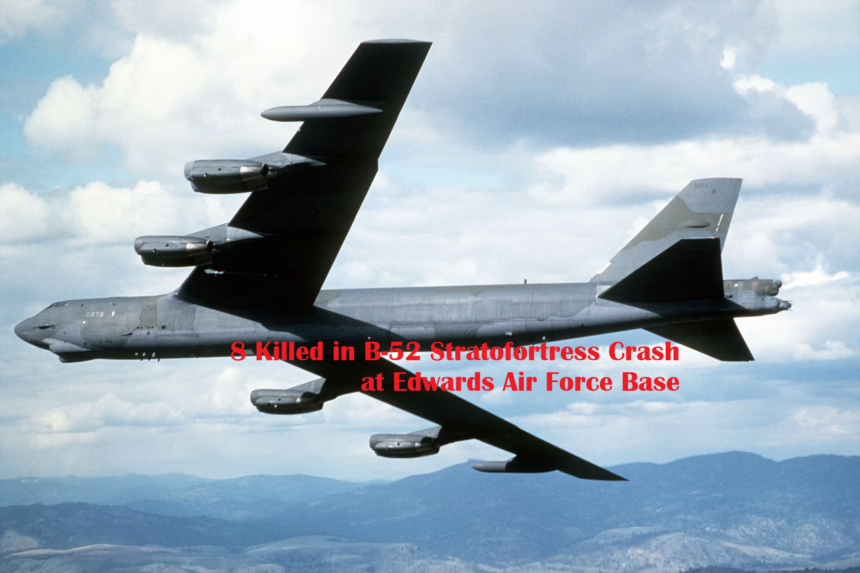
A tragic military aviation accident claimed eight lives after a B-52 Stratofortress bomber crashed shortly after takeoff from Edwards Air Force Base in California. The incident occurred during a routine test mission and has shocked the military community, aviation experts, and families connected to the victims.
Officials confirmed that all eight people aboard the aircraft died in the crash. Emergency responders rushed to the scene, but the severity of the accident left no chance of survival. The Air Force has launched a full investigation to determine what caused the deadly crash.
Crash Occurred Shortly After Takeoff
The B-52 Stratofortress took off from Edwards Air Force Base on the morning of June 15. According to military officials, the aircraft crashed at approximately 11:20 a.m. local time.
Witnesses and aerial footage showed thick black smoke rising from the crash site near the runway. The bomber burst into flames moments after going down in the Mojave Desert. Emergency teams responded immediately. Firefighters and rescue crews secured the area and worked to contain the fire.
Military officials later stated that initial evidence indicated the crash was unsurvivable. The accident happened within the boundaries of the base, preventing damage to nearby communities. Authorities reported no injuries on the ground.
Eight Lives Lost in the Tragedy
The aircraft carried a crew of eight people. The group included military personnel, government civilians, and contractors involved in the test mission. Officials confirmed that two employees from Boeing were among those killed. Military leaders expressed deep sorrow following the tragedy.
They described the victims as dedicated professionals who contributed to national defense and aviation advancement. Family notifications began shortly after authorities confirmed the fatalities.
Officials withheld the names of the victims until relatives received formal notification. The loss has deeply affected the Air Force test community, which relies on skilled crews to evaluate aircraft systems and new technologies.
Aircraft Supported a Test Mission
The B-52 was participating in a routine test mission when the crash occurred. Reports indicated that the flight supported a radar modernization program. The aircraft reportedly carried equipment connected to ongoing upgrades for the bomber fleet. Testing missions often involve complex procedures.
Crews gather critical data that helps improve aircraft performance and mission effectiveness. Although routine, test flights can involve additional risks because crews evaluate new systems and technologies. Investigators have not confirmed whether the modernization equipment played any role in the accident. Officials stressed that it remains too early to conclude the cause.
The Importance of the B-52 Stratofortress
The B-52 Stratofortress remains one of the most recognizable military aircraft in history. The bomber entered service during the 1950s and continues to play a major role in U.S. military operations. Despite its age, the aircraft remains a critical part of the nation’s strategic capabilities.
The B-52 can carry both conventional and nuclear weapons. It also supports long-range missions across the globe. Military planners continue upgrading the aircraft because they expect it to remain operational for decades.
Modernization efforts include improved engines, advanced radar systems, updated communications equipment, and enhanced navigation technology. The aircraft involved in the crash formed part of those ongoing modernization efforts.
Edwards Air Force Base’s Historic Role
Edwards Air Force Base has a long history of aviation innovation. Located in California’s Mojave Desert, the installation serves as one of the world’s most important flight-testing centers. Engineers, pilots, and researchers conduct advanced aircraft evaluations at the facility.
Many groundbreaking aviation achievements occurred at Edwards. The base gained international recognition when legendary test pilot Chuck Yeager broke the sound barrier in 1947.
Since then, the installation has supported countless military and aerospace programs. Because of its specialized mission, Edwards regularly hosts experimental flights and technology demonstrations. The base plays a crucial role in ensuring that military aircraft meet safety and performance standards.
Investigation Underway
Investigators have begun examining every aspect of the crash. Specialized teams will analyze flight data, maintenance records, mission planning documents, and physical evidence from the wreckage. Experts will also review video footage and witness accounts.
Military officials explained that a complete investigation could take several months. Aviation accident investigations often require extensive technical analysis before authorities conclude. At this stage, officials have not identified a specific cause.
Investigators must determine whether mechanical failure, equipment malfunction, human factors, environmental conditions, or another issue contributed to the accident. The Air Force emphasized that accuracy remains more important than speed during the investigation process.
Impact on Air Force Operations
The crash prompted immediate operational changes at Edwards Air Force Base. Officials temporarily closed the airfield following the accident. Incoming aircraft received instructions to divert while emergency crews managed the situation. The base also suspended visitor access to allow personnel to focus on emergency response efforts.
Military leaders continue assessing how the accident may affect ongoing testing programs. The Air Force routinely reviews safety procedures after major incidents. Those reviews help identify lessons that could prevent future accidents. Although flight testing involves risk, military organizations work continuously to improve safety standards and operational procedures.
Support for Families and Colleagues
The tragedy has generated an outpouring of support for the families of the victims. Military leaders, government officials, and industry representatives offered condolences following the accident.
Support teams have begun assisting affected families with counseling, resources, and communication throughout the investigation process. Colleagues across the aviation community also expressed grief over the loss. Test pilots, engineers, contractors, and support personnel understand the challenges involved in aviation testing.
Many described the victims as highly skilled professionals dedicated to advancing aerospace technology. The accident serves as a reminder of the risks that aviation personnel face while supporting military missions and technological progress.
Looking Ahead
The B-52 crash at Edwards Air Force Base stands as one of the deadliest military aviation accidents in recent years. Eight people lost their lives while participating in a mission designed to improve the future capabilities of an iconic aircraft. Their work contributed to efforts that support national security and military readiness.
As investigators continue their work, many questions remain unanswered. The aviation community will closely follow the findings to understand what happened and how similar tragedies can be prevented. For now, the focus remains on honoring the eight individuals who died and supporting the families, friends, and colleagues affected by this heartbreaking loss.