



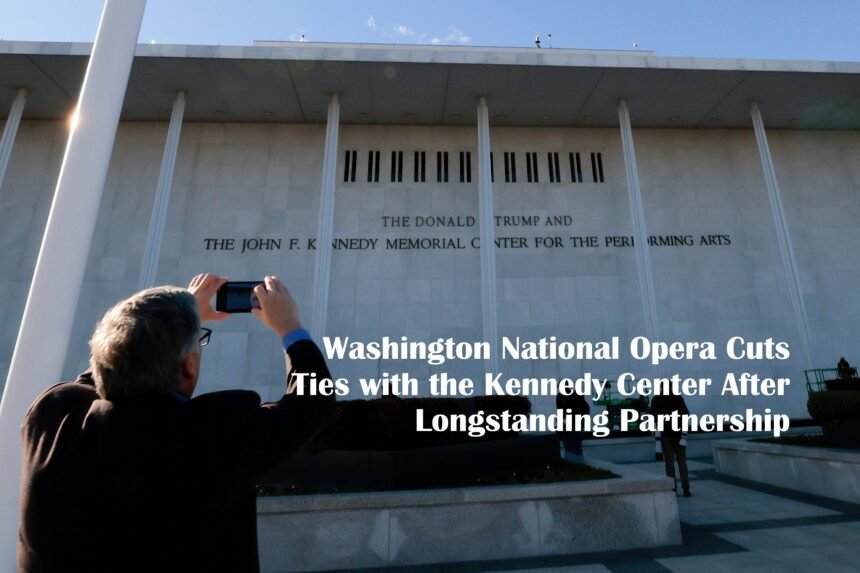
The Washington National Opera (WNO) announced that it would end its long partnership with the Kennedy Center for the Performing Arts. The opera company had been associated with the center since the 1970s, making the split a significant shift in the cultural landscape of the U.S. capital.
The decision was disclosed on a Friday, when opera officials revealed that their affiliation contract with the Kennedy Center would be terminated. The WNO said it planned to resume operations as a fully independent nonprofit once the split was finalized.
This move marks one of the most prominent departures from the Kennedy Center amid major leadership and organizational shifts there in recent years.
Reasons Behind the Departure
In its announcement, the Washington National Opera cited multiple challenges that influenced its decision. Opera leaders pointed directly to a significant decline in ticket sales and a decrease in donor contributions. These trends were linked to damage to confidence among audiences and supporters.
The opera’s artistic director stated that the changes made by the Kennedy Center’s new leadership had created conditions that were incompatible with the opera’s financial model. In particular, the center adopted a requirement that performances must be fully funded in advance, a practice that opera companies rarely rely on.
Since opera productions typically cover part of their costs through ticket sales and depend on donations and grants for the rest, this new funding rule was described as unsustainable.
Leadership changes at the Kennedy Center also contributed to instability. The center’s board was reconfigured, and a controversial renaming of the institution was implemented. These developments were widely criticized and triggered nationwide debate.
Political Context and Cultural Backlash
The Kennedy Center had long stood as a symbol of national artistic excellence. Its connection with the Washington National Opera helped reinforce that reputation. But major shifts in the center’s political environment set the stage for discontent.
The then‑recent appointment of a new board and renaming of the venue were seen by many as politicized moves that diverged from the center’s traditional mission. Artists and performers began distancing themselves from the center. Several notable musicians and cultural figures withdrew from scheduled appearances in protest.
This pattern of cancellations was cited as a factor in declining audience interest and public engagement with performances at the venue. Although the WNO did not explicitly name political leadership in its official statements, observers linked the cultural and economic challenges to broader institutional changes.
Financial Pressures and Operational Strain
For decades, the Washington National Opera relied on both ticket revenue and patron support to sustain its programming. Its unique financial model allowed it to produce ambitious works, including large‑scale operas that draw significant artistic acclaim.
However, the combination of a stricter funding policy at the Kennedy Center and reduced financial contributions placed acute pressure on the opera’s operations. The requirement for fully pre‑funded productions meant that securing sufficient backing years ahead became extremely difficult.
The opera company also noted that losses were growing larger over time. Rising costs paired with reduced funding made the partnership increasingly unsustainable. As a result, the board determined that independence was the best path forward to preserve the art form and maintain financial health.
Additionally, the opera announced it would scale back its upcoming spring season. This was seen as an effort to maintain fiscal responsibility while the organization transitioned away from the Kennedy Center.
Plans for the Future
Once the separation is finalized, the Washington National Opera intends to relocate performances to venues outside of the Kennedy Center. These locations have not yet been publicly detailed, but officials said announcements would be made in the coming weeks.
Reducing the scale of its season will give the opera more flexibility to plan its future schedule. The company also stated it would continue to present a wide range of works, from classical staples to contemporary pieces that appeal to diverse audiences.
Despite the upheaval, the WNO reaffirmed its commitment to artistic innovation and to serving the nation’s capital as a major cultural institution. The opera’s leadership emphasized that independence would allow more control over creative direction and financial decisions.
Reactions from the Kennedy Center
Officials at the Kennedy Center described the end of the partnership as a mutual and pragmatic choice. They stressed that financial instability resulting from the exclusive affiliation with the Washington National Opera had played a central role in the decision.
A spokesperson for the center framed the split as an opportunity to broaden programming options and stabilize long‑term finances. This could allow the center to invite a wider array of opera companies from across the country and around the globe.
Center representatives also highlighted that the opera contract’s financial impact had been significant, making flexibility a priority in future planning.
Significance for U.S. Cultural Life
The Washington National Opera’s departure from the Kennedy Center has broad implications for the performing arts community. After more than five decades of residency, this historic partnership had become synonymous with Washington’s cultural identity.
Opera enthusiasts view this decision as a turning point for both the WNO and the Kennedy Center. For supporters of the opera company, independence could yield new artistic opportunities. For proponents of the Kennedy Center’s new direction, the split may reflect changing priorities in national cultural policy.
The split also underscores how financial realities intersect with artistic operations. Major performing arts organizations rely on stable partnerships, donors, and audience engagement. When those elements shift, the effects ripple across the cultural ecosystem.
Looking Ahead
As the Washington National Opera prepares for this next chapter, its leadership faces the challenge of redefining its role outside the Kennedy Center’s walls. The company’s ability to remain vibrant and relevant will depend on securing new performance spaces and restoring audience confidence.
This moment could signal a broader evolution in how major arts organizations operate within the United States. The choices made by the WNO and the Kennedy Center may inspire similar evaluations by other cultural institutions in the years ahead.
Whatever the future holds, the Washington National Opera’s decision to part ways with its longtime home marks a significant and historic shift in American cultural life.