



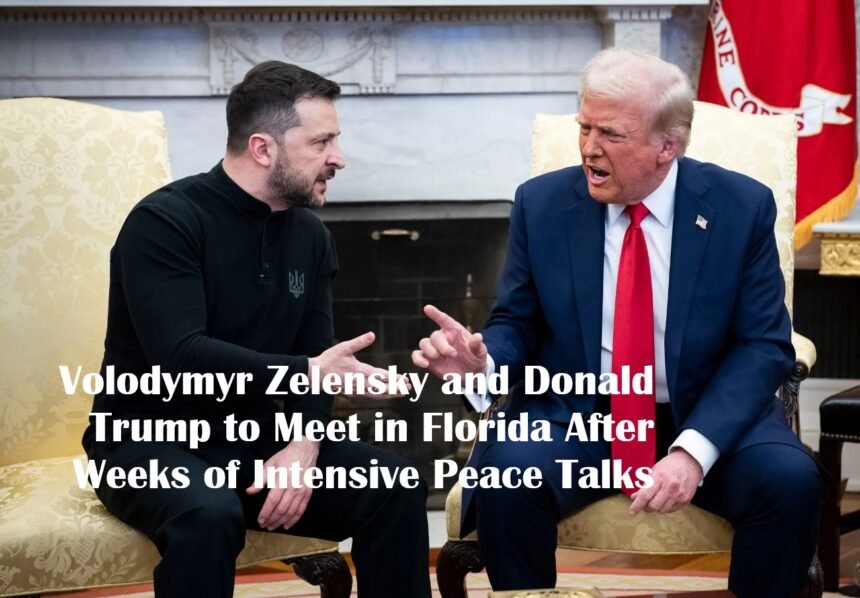
In late December 2025, Ukrainian President Volodymyr Zelensky is scheduled to meet with United States President Donald Trump in Florida, marking a critical moment in efforts to end the nearly four-year war between Ukraine and Russia.
After weeks of intensive negotiations and diplomatic engagement, this summit aims to bring the two leaders closer to a formal agreement that could shape the future of European security and global diplomacy.
Long Journey Toward a Peace Framework
The meeting follows an extended period of negotiations between Ukrainian and American officials, as both sides have worked to craft a comprehensive peace proposal. Senior negotiators from both governments have spent weeks discussing key issues, including territorial arrangements, security guarantees, and economic cooperation.
Zelensky and Trump have expressed that progress has been made, but significant differences remain on some core points. Officials from the United States have indicated that a significant portion of the framework has been agreed upon, with approximately 90 percent of the proposed peace plan finalized.
Zelensky echoed this assessment, noting that the draft document is nearing completion and that the Florida meeting provides an essential opportunity to address the remaining disagreements.
Core Issues on the Negotiating Table
Several contentious matters have dominated discussions and will likely feature prominently in the Florida talks. One of the most complex issues is the status of the Donbas region in eastern Ukraine, a territory that has been contested since the beginning of Russia’s full-scale invasion.
Russia has insisted on control of much of the region, while Ukraine continues to assert its right to maintain sovereignty over its internationally recognized borders. Another unresolved question concerns the Zaporizhzhia nuclear power plant, the largest nuclear facility in Europe.
Currently under Russian control, its future governance and safety arrangements remain unclear. Zelensky has proposed that the plant operate under joint management between Ukraine and the United States. However, Russia’s stance on this issue remains unconfirmed. Security guarantees are also at the forefront of discussions.
Ukraine seeks strong assurances against future aggression similar in scope to collective defense agreements like NATO’s Article 5. Discussions in Berlin earlier in December resulted in proposals for robust security mechanisms aimed at deterring further military action by Russia and providing monitoring systems to uphold any peace agreement.
Diplomacy Amid Continued Violence
The diplomatic push toward peace comes at a time of renewed hostilities on the battlefield. Just ahead of Zelensky’s departure for Florida, Russia launched a massive missile and drone assault on Kyiv and the surrounding regions.
This bombardment, which lasted for hours, resulted in multiple civilian casualties and extensive infrastructure damage. Zelensky publicly condemned the attack, describing it as evidence that Russian President Vladimir Putin is opposed to genuine peace efforts.
Despite these challenges, Zelensky has maintained that diplomacy must continue. He highlighted that ongoing violence underscores the urgency of finding a sustainable end to the conflict, even as Russian forces continue military operations. This dual approach, advancing negotiations while contesting Russian offensives on the ground, has defined Ukraine’s strategy in recent weeks.
Florida, A Strategic Locale
The choice of Florida as the meeting site is significant. President Trump has spent the holiday period at his Mar-a-Lago resort in Palm Beach, and his decision to interrupt his break to meet Zelensky underscores the importance of the talks.
Trump has previously stated that direct engagement would occur only when a meaningful agreement was within reach, signaling his belief that the negotiations had progressed to a substantive stage. Unlike previous high-level meetings, this summit is expected to involve only Trump and Zelensky directly, without European leaders present.
However, diplomats from allied nations have been engaged through other channels. European officials have described the current dynamic between the United States and Ukraine as more cooperative than in past sessions, emphasizing that shared goals for peace and security remain aligned.
Balancing Domestic and International Expectations
Domestically, both leaders face pressure from their political bases and global partners. Zelensky must navigate Ukrainian public opinion, which remains wary of territorial concessions and insists that any changes to Ukraine’s borders be subject to national approval, potentially through a referendum.
This requirement is embedded in Ukraine’s constitution and reflects the deep sensitivity surrounding sovereignty and national identity. In the United States, Trump’s approach to the peace talks reflects his broader foreign policy priorities.
While advocating for a negotiated resolution, he has also emphasized that any final agreement will require his formal approval. Observers note that Trump’s stance may influence how far concessions are considered acceptable, particularly on issues related to security guarantees and economic cooperation.
International Perspectives
Although European leaders will not be present in person at the Florida meeting, their voices continue to influence the backdrop of these negotiations. European nations have consistently supported Ukraine and contributed to diplomatic efforts.
Some have expressed cautious optimism about the prospects for peace, while also urging that any agreement uphold Ukraine’s territorial integrity and long-term security. The broader international community is watching closely. Global reactions to the proposed framework and its potential implications will likely shape diplomatic relations for years to come.
For Ukraine’s allies, the success of these talks could signal a new phase in international cooperation against aggression. For Russia, the outcome may determine its strategic position in Eastern Europe and beyond.
Looking Ahead
As Zelensky and Trump prepare to meet, uncertainty remains high. The peace plan draft is nearly complete, but the final details will require careful negotiation. Both leaders have emphasized that the work ahead is difficult and that a durable agreement must be built on shared understanding and mutual concessions.
Observers note that even if a formal agreement is not reached in Florida, the meeting itself represents a significant milestone after weeks of intense diplomatic efforts.
Should progress be achieved, it could lay the groundwork for further negotiations with Russia and other international partners. Conversely, if talks falter, the conflict could enter yet another phase of diplomatic complexity and military tension.