



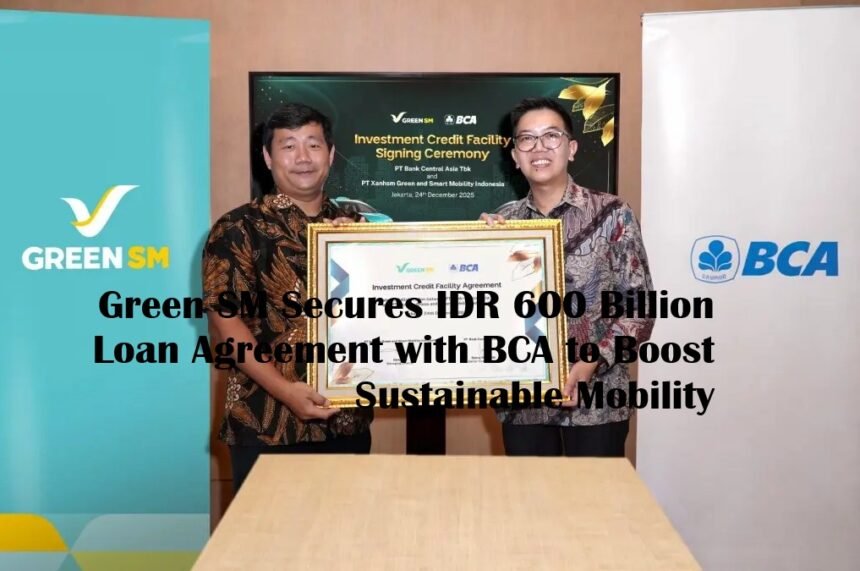
Green SM Indonesia has taken a major step in strengthening its financial foundation. The company recently signed a five-year investment loan agreement worth IDR 600 billion with Bank Central Asia (BCA). This milestone reflects a deepening partnership between the two organizations and highlights growing confidence in sustainable urban mobility solutions.
The agreement signals a long-term commitment to support cleaner transportation in Indonesia. It also demonstrates how financial institutions are backing environmentally responsible business models.
Strengthening a Strategic Financial Partnership
The loan agreement formalizes a relationship that has been developing since Green SM entered the Indonesian market. The partnership began when the company launched its services in Jakarta in December 2024. Since then, both parties have collaborated on initiatives that enhance service accessibility and promote sustainable transportation.
This new financing arrangement marks a transition from collaboration to structured financial support. It shows that trust has been built through consistent cooperation. The move also reflects BCA’s confidence in Green SM’s governance and operational model.
The investment loan spans five years. It provides a stable funding structure for the company’s long-term plans. The agreement is expected to enhance business continuity and support the company’s expansion strategies.
Supporting Operational Readiness and Growth
The funding will play a key role in enhancing Green SM’s operational readiness. It will ensure that the company can maintain consistent service quality across its network. A stable financial structure allows the company to scale responsibly. Growth will be supported without compromising service standards.
This approach is critical in the urban mobility sector, where reliability is essential. Green SM has already established operations in several major cities. These include Jakarta, Makassar, Bekasi, Surabaya, and Bali. Each of these locations faces increasing demand for efficient and sustainable transportation solutions.
The company’s focus remains on disciplined growth. The loan helps ensure that expansion aligns with operational capacity. It also supports long-term planning in a rapidly evolving market.
Advancing Sustainable Urban Mobility
Sustainable transportation is becoming a priority in Indonesia’s urban development. Cities are experiencing higher population density and increased mobility needs. At the same time, environmental concerns are growing. Green SM addresses these challenges by offering all-electric taxi services. These services reduce emissions and noise pollution.
They also provide a cleaner alternative to traditional transport systems. The partnership with BCA aligns with broader efforts to promote sustainability. Financial backing is essential for companies that aim to transform urban mobility. Without strong funding, scaling green solutions would be difficult.
This agreement highlights the role of financial institutions in driving environmental change. It shows how banks can support businesses that contribute to long-term sustainability goals.
Leadership Perspectives on the Agreement
Executives from both organizations have emphasized the importance of this collaboration. A representative from BCA noted that sustainable transportation plays a crucial role in urban development. The bank aims to support businesses with long-term potential and responsible practices.
Meanwhile, Green SM’s leadership highlighted the significance of the loan in strengthening the company’s financial base. The agreement reflects recognition of the company’s disciplined approach and long-term vision.
Both sides share a common perspective. Sustainable mobility requires more than just technology. It also needs strong governance, reliable funding, and consistent execution.
Building a Future-Ready Mobility Ecosystem
Green SM is part of a broader effort to create a future-ready mobility ecosystem. The company operates electric vehicle-based ride-hailing services. Its model focuses on safety, reliability, and environmental responsibility. The use of electric vehicles supports Indonesia’s transition toward cleaner energy.
It also aligns with global trends in transportation. Many countries are shifting toward low-emission mobility solutions. Green SM’s approach combines technology with service quality. Drivers are trained to maintain professional standards.
The company also emphasizes customer experience and operational efficiency. The loan agreement with BCA will help strengthen this ecosystem. It ensures that the company can continue investing in infrastructure and service improvements.
The Role of Financial Institutions in Sustainability
The agreement highlights a broader trend in the financial sector. Banks are increasingly supporting businesses that contribute to sustainability. This shift reflects changing priorities in global and local markets. Sustainable investments are no longer seen as optional. They are becoming essential for long-term economic resilience.
Financial institutions are recognizing the value of supporting environmentally responsible industries. BCA’s involvement demonstrates how banks can drive positive change. By providing funding, they enable companies like Green SM to scale their impact. This creates a ripple effect across the economy.
Implications for Indonesia’s Urban Transport Landscape
Indonesia’s urban mobility landscape is evolving rapidly. Cities are facing challenges related to congestion, pollution, and infrastructure. At the same time, demand for efficient transport continues to grow. Electric vehicle-based services offer a viable solution.
They reduce environmental impact while meeting transportation needs. Green SM’s expansion reflects this shift in consumer preferences. The loan agreement will help accelerate this transition.
It provides the resources needed to expand services and improve accessibility. It also supports innovation in the mobility sector. As more companies adopt sustainable models, the overall transport ecosystem will improve. This benefits both the environment and urban communities.