



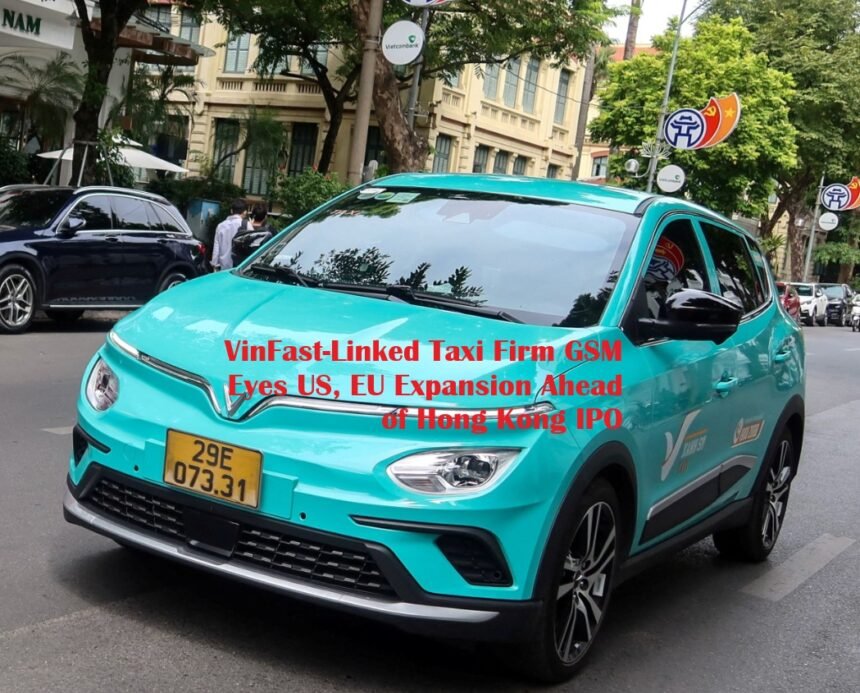
Vietnam’s electric mobility industry is preparing for a potentially significant international push as Green and Smart Mobility, better known as GSM, prepares to take its electric taxi business beyond Southeast Asia. The company plans to enter the United States and parts of Europe while building a longer-term strategy that could culminate in a Hong Kong stock market listing in 2028.
GSM’s expansion reflects a broader ambition to turn an electric taxi operation developed in Vietnam into an international mobility platform. The company is closely connected to VinFast, Vietnam’s largest automaker, whose electric vehicles form the foundation of GSM’s fleet.
From Vietnamese Taxi Operator to Global Mobility Business
GSM began operating in Vietnam in 2023 and quickly established itself as a major player in the country’s growing electric transportation sector. Instead of relying primarily on independent drivers using their own vehicles, the company built its service around company-owned electric cars and employed drivers. That model gives GSM greater control over vehicle standards and customer experience. It also creates a direct connection between the mobility business and VinFast’s vehicle production.
The company now intends to test whether that formula can work in significantly larger and more competitive international markets. GSM plans to launch operations in the United States, Sweden and the Netherlands by the end of 2026. A wider European expansion is expected to follow in 2027, potentially giving the company a presence across several major EV markets.
VinFast Could Become a Major Beneficiary
The international ambitions of GSM are closely tied to VinFast’s production strategy. GSM expects to purchase as many as one million VinFast vehicles between 2026 and 2030. That would make the taxi operator an extremely important customer for the Vietnamese automaker and provide a large potential source of recurring vehicle demand.
VinFast already receives a significant portion of its sales from GSM. The relationship therefore creates a feedback loop in which VinFast supplies electric vehicles while GSM uses those vehicles to expand its transportation network. The arrangement could help VinFast increase vehicle volumes while giving GSM access to a dedicated supply of electric cars.
A Different Approach to Ride-Hailing
GSM’s business model also sets it apart from companies such as Uber and Grab. Traditional ride-hailing platforms generally operate with an asset-light structure, allowing drivers to provide their own vehicles. GSM instead has historically invested heavily in vehicles and employed drivers directly.
That strategy can provide greater operational control, but it also requires considerably more capital. Purchasing large numbers of electric vehicles, maintaining fleets and paying drivers can create substantial financial pressure when a company expands rapidly. GSM is therefore expected to introduce a hybrid employment model as it grows internationally. The company plans to apply a similar phased approach in new markets, potentially reducing some of the costs associated with a fully company-operated fleet.
Expansion Comes With Financial Challenges
The scale of GSM’s international plan raises questions about how the company will finance its growth. GSM remains unprofitable, while its expansion strategy requires substantial investment in vehicles, personnel, technology and market development. The company has not publicly disclosed detailed information about its debt position or a final valuation for the planned listing.
Advisers have previously suggested that GSM could potentially command a valuation of around $20 billion, although the eventual figure would depend on market conditions and the company’s financial performance. The financial position of its wider corporate ecosystem will also attract attention. Vingroup, the parent group associated with VinFast and GSM, has carried substantial liabilities, making capital discipline increasingly important as the businesses expand.
Why Hong Kong Is Important to GSM
GSM’s proposed Hong Kong IPO is more than simply a fundraising exercise. A successful listing could provide the company with access to international investors while raising its profile outside Vietnam. The planned 2028 offering would come after GSM has had time to establish operations in the U.S. and Europe.
That timeline could allow investors to assess whether the company’s international expansion is generating sustainable revenue rather than simply increasing its geographic footprint. Hong Kong could also provide GSM with a strategic financial platform as it seeks to position itself as a global electric mobility company.
The Next Test Is International Execution
GSM’s expansion represents an ambitious attempt to export Vietnam’s electric transportation model to developed markets. Success will depend on several factors, including regulatory approval, consumer demand, charging infrastructure, fleet economics and competition from established ride-hailing companies. The company must also demonstrate that its relationship with VinFast can produce commercial advantages without creating excessive financial dependence.
If GSM can establish a scalable business across Europe and the United States, its planned Hong Kong IPO could become a major milestone for Vietnam’s emerging electric mobility sector. The next few years will determine whether GSM can transform its domestic success into a genuinely international transportation business.