



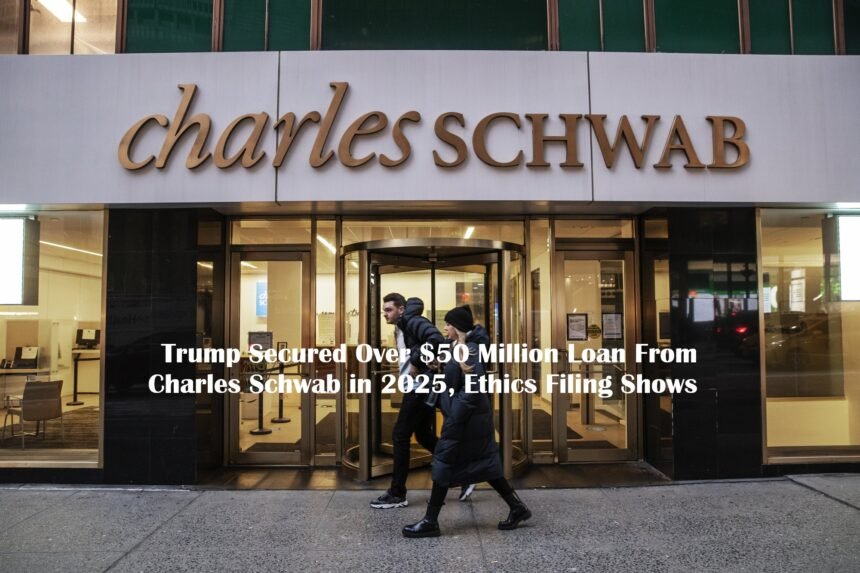
A newly released ethics filing has revealed that U.S. President Donald Trump secured a loan worth more than $50 million from financial services giant Charles Schwab during 2025. The disclosure offers fresh insight into Trump’s personal financial activities while he serves in office.
The filing forms part of the financial transparency requirements that apply to senior government officials. These reports provide the public with information about assets, liabilities, income, and significant financial transactions. The newly disclosed loan has attracted attention because of its size and timing.
It also raises questions about how public officials manage large financial obligations while overseeing government responsibilities. Although the filing confirms the existence of the loan, it does not indicate any violation of federal ethics rules. Instead, it presents information that ethics regulations require public officials to disclose.
Details of the Loan
According to the ethics filing, Trump obtained financing that exceeded $50 million from Charles Schwab during 2025. The report classifies the obligation within the highest reporting category required under federal disclosure rules. The filing does not provide every detail surrounding the agreement.
It does, however, identify the lender and confirms the substantial value of the borrowing. Large loans often support refinancing efforts, investment strategies, or property-related financial planning. The disclosure itself does not specify the exact purpose behind the financing. Financial disclosure reports generally summarize assets and liabilities rather than explain every business decision connected to them.
Transparency Requirements for Public Officials
Senior government officials must submit annual financial disclosure reports to promote accountability and public confidence. These reports help identify potential conflicts of interest by revealing significant financial holdings and obligations. Ethics officials review the filings under established federal guidelines. Disclosure requirements extend beyond salaries and investments. Officials must also report qualifying loans, business interests, income sources, and other financial relationships.
The latest filing involving Trump follows the same reporting framework applied to many high-ranking federal officials. Public access to these documents allows voters, watchdog organizations, and ethics experts to examine financial relationships that may deserve closer attention.
Charles Schwab’s Role
Charles Schwab ranks among the largest financial services companies in the United States. The company provides investment management, brokerage services, wealth planning, and lending products to millions of clients. Large financial institutions frequently extend sizable loans to individuals with substantial assets.
These arrangements often involve real estate, investment portfolios, or other forms of collateral. The ethics filing identifies Charles Schwab as the lender but does not suggest that the company received any special treatment. The disclosure also does not indicate that the loan influenced government policy or official decision-making.
Trump’s Business Interests
Trump continues to maintain an extensive portfolio of business assets that includes commercial real estate, golf properties, hospitality operations, licensing agreements, and other investments. His financial disclosure reflects income generated across multiple business sectors.
Many of these assets have remained valuable despite changing market conditions. They also contribute to Trump’s overall financial position, which includes substantial holdings and liabilities. Large business organizations often rely on refinancing strategies to manage debt, improve cash flow, or adjust financial structures.
Such transactions commonly occur regardless of changes in political leadership. The ethics filing provides transparency regarding one significant borrowing arrangement without offering additional operational details.
Public Interest and Ethics Oversight
Financial disclosures involving presidents routinely attract close public attention. Ethics experts, lawmakers, journalists, and government oversight groups examine these reports for potential conflicts of interest. Their reviews focus on whether financial relationships could influence public policy decisions.
Current ethics laws require disclosure rather than prohibit every financial obligation. Public officials may continue to own businesses and carry qualifying debt provided they comply with applicable legal requirements. The latest filing adds another document to the public record, allowing independent observers to conduct their own evaluations. Transparency remains one of the central goals of the federal ethics system.
Broader Financial Picture
The newly disclosed loan represents only one element of Trump’s overall financial portfolio. His ethics filing also lists numerous assets, investment interests, licensing revenue, and business income streams across several industries. Together, these entries provide a broader picture of his financial position during the reporting period.
Financial disclosure forms categorize values within reporting ranges instead of providing exact dollar amounts for every asset. This reporting structure balances transparency with standardized disclosure requirements established under federal law. As a result, readers receive a comprehensive overview rather than a detailed accounting statement.
Why the Filing Matters
Annual ethics disclosures serve an important public purpose. They strengthen confidence in government by allowing citizens to understand the financial interests of elected leaders. Open reporting also helps ethics officials monitor potential conflicts before they become larger concerns.
The disclosure involving Trump’s loan demonstrates how these reporting rules function in practice. Rather than relying on speculation, the public gains access to official documentation submitted under federal requirements. Such transparency contributes to informed public discussion about financial accountability in government.
Looking Ahead
The ethics filing does not conclude any investigation or establish wrongdoing. Instead, it provides financial information that federal law requires public officials to report each year. Additional disclosures will likely appear in future reporting cycles as financial positions evolve.
Observers may continue reviewing the filing alongside future business transactions, investment changes, and other financial updates. Government ethics offices will also continue administering disclosure requirements under existing regulations. Financial transparency remains an important feature of public service.
Annual disclosure reports give citizens valuable insight into the financial activities of senior government officials while supporting accountability through established reporting standards. The newly released filing confirms that Donald Trump secured a loan exceeding $50 million from Charles Schwab during 2025.
Although the report leaves many business details undisclosed, it fulfills an important transparency function by documenting a significant financial obligation.
As public interest continues surrounding financial ethics in government, these filings will remain an essential resource for understanding the financial relationships of elected leaders and maintaining confidence in the integrity of public institutions.