



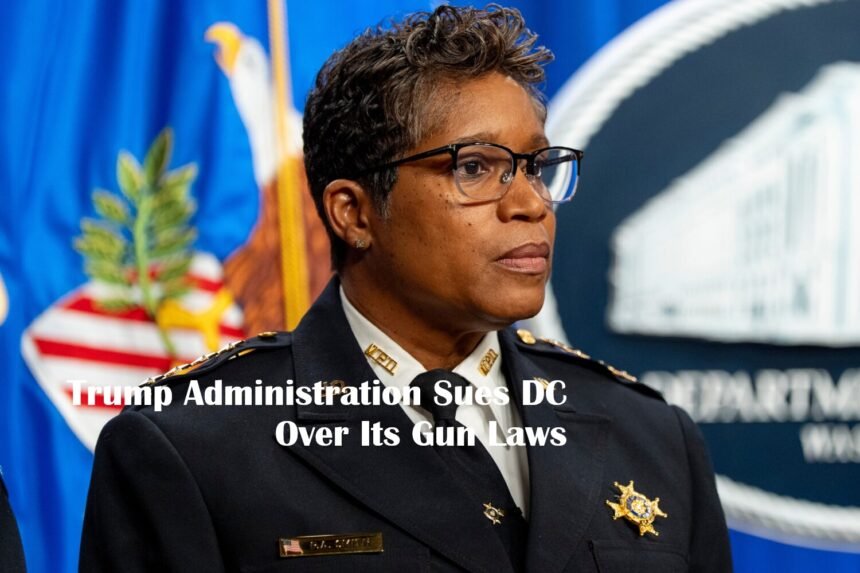
In a significant legal action, the Trump administration filed a lawsuit against the District of Columbia, challenging the city’s gun laws as unconstitutional.
The U.S. Department of Justice (DOJ) alleges that local restrictions on firearms, especially semiautomatic weapons, violate the Second Amendment of the U.S. Constitution. This lawsuit marks another major clash between federal authority and local governance in the nation’s capital.
Background of the Legal Challenge
The lawsuit was filed in the U.S. District Court in Washington, D.C., and targets specific provisions of the District’s gun code. The Department of Justice argues that laws banning the registration and possession of commonly used semiautomatic firearms conflict with constitutional protections.
In particular, restrictions on weapons such as AR-15 style rifles are cited as examples where the city’s laws go too far. The DOJ asserts that these firearm bans deny law-abiding citizens the ability to register widely used guns.
According to the lawsuit, this situation subjects residents to criminal penalties for possessing unregistered weapons. In the view of the administration, the city’s approach is overly restrictive and not justified by historical or constitutional precedent.
Constitutional Arguments
The central argument lies in the interpretation of the Second Amendment. The DOJ emphasises the 2008 Supreme Court decision in District of Columbia v. Heller, which held that individuals have the right to possess firearms commonly owned for lawful purposes, such as self-defence within the home. The lawsuit contends that current D.C. laws do not properly consider this precedent.
Officials from the Trump administration argue that the District’s bans are based on superficial features of the firearms and not on lawful, historical restrictions. For example, many semiautomatic rifles are described as being banned due to cosmetic characteristics instead of their capacity for lawful use. According to the DOJ, this reasoning fails to align with constitutional protections.
Tactical Legal Strategy
Unlike Heller, the current lawsuit does not include individual plaintiffs challenging the laws. Instead, the Department of Justice claims the regulatory provisions can be challenged directly under a 1994 federal crime law that gives the federal government authority to challenge unconstitutional local regulations.
This strategy reflects an attempt to broaden the enforcement of constitutional rights by the federal government. This approach also highlights a renewed focus on gun rights by the Trump administration’s Justice Department.
Officials have been outspoken about expanding protections for firearm owners and limiting local restrictions that are viewed as infringing constitutional freedoms.
Reactions from the District of Columbia
Local officials in Washington have pushed back against the lawsuit. The mayor and representatives of the city argue that strict gun laws are necessary to reduce gun violence and protect community safety. They maintain that the city’s regulations are justified, especially considering public safety concerns in urban environments.
In response to federal action, the city’s leaders emphasise the importance of local governance and the responsibility they hold to protect residents. In their view, measures aimed at reducing gun violence should remain rooted in local authority, where experts and community members can directly influence policy outcomes.
Broader Implications for Gun Policy
Legal experts predict that this suit could have far-reaching effects beyond Washington, D.C. If the federal government succeeds, similar laws in other cities and states could be challenged on constitutional grounds. Advocates for gun rights argue that this lawsuit could set a national precedent.
Many gun rights supporters see the lawsuit as a necessary step to reaffirm the protections guaranteed under the Second Amendment. They argue that current interpretations of firearm restrictions have extended beyond what was originally intended and need judicial scrutiny.
On the other hand, gun control advocates caution that a ruling in favour of the DOJ could weaken local efforts to address gun violence. Urban areas often face unique safety challenges, and many policymakers believe that stricter local laws are crucial to managing these issues.
National Political Context
The lawsuit also reflects broader political tensions between the federal government and Democratic-led jurisdictions. Over the past months, various policy disagreements have intensified, particularly around crime policy and public safety. This gun law dispute is only one of several high-profile conflicts between the Trump administration and local leadership in Washington.
For example, earlier actions by the federal government included a federal intervention aimed at reducing crime in the nation’s capital. These interventions have been controversial and often opposed by local authorities who see them as federal overreach.
Ongoing Legal Process
The case will likely move through several rounds of court proceedings. Initial motions and arguments are expected in the coming weeks, with each side presenting legal interpretations of constitutional rights and local legislative authority.
Because the suit involves constitutional questions, it is possible that the case could eventually reach higher federal courts. While the timeline remains uncertain, legal scholars are watching closely to see how the judiciary balances long-standing interpretations of the Second Amendment against contemporary local lawmaking.