



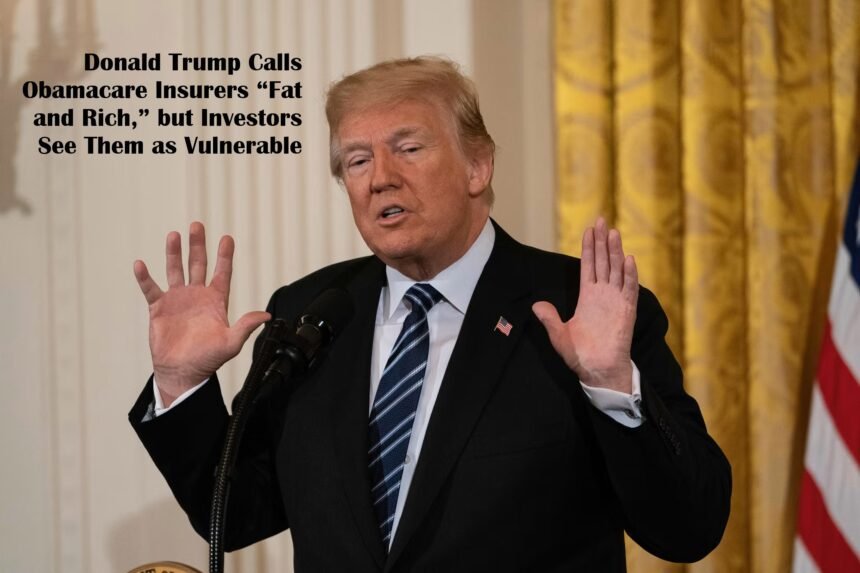
President Donald Trump has renewed his criticism of Obamacare insurers, labeling them “big, fat, rich” and calling for a restructuring of how federal health subsidy dollars are distributed. While this political rhetoric reflects longstanding grievances, investors appear to see a very different reality, one marked by financial stress and shrinking prospects in the ACA (Affordable Care Act) marketplace. The divergence between Trump’s narrative and Wall Street’s assessment has sparked concern across the health insurance sector.
Trump’s Provocative Rhetoric
Donald Trump recently escalated his attacks, accusing Obamacare insurers of profiting excessively. He urged Congress to redirect health-care subsidies away from insurance companies and send the money directly to consumers. According to him, insurers have “made trillions” while policyholders continue to struggle.
This line of criticism aligns with his broader argument that the ACA system disproportionately rewards insurance intermediaries rather than patients themselves.
Investor Sentiment: A Stark Contrast
Despite Trump’s harsh words, many investors are deeply worried about insurers’ profitability. According to analysts, the ACA marketplace is now seen as one of the weakest segments in the managed-care business. Strong headwinds are being reported for 2025: rising medical costs, sicker customers, and fewer enrollees are squeezing margins.
One analyst went so far as to call it “the worst of the five businesses managed-care companies participate in.”
Underlying Financial Pressures
Much of the deteriorating financial picture stems from a shift in the risk profile of enrollees. Insurers are now treating a larger share of very ill patients, many transitioning from Medicaid, which is driving up overall medical costs. In response, many insurers have proposed significant premium increases for 2026. But even with these hikes, the business is viewed as unattractive by many investors, especially as subsidy uncertainty looms.
Subsidy Expiration Looms
A critical factor exacerbating the strain is the impending expiration of Biden-era enhanced ACA subsidies. Without an extension, the outlook for insurers could worsen sharply.
Donald Trump and some Republicans have floated redirecting these soon-to-lapse subsidies into health savings accounts (HSAs) instead of sending them to insurance companies. However, that proposal has added to market anxiety not just because of its mechanics, but because it complicates bipartisan compromise.
Market Fallout
The financial toll is already evident. Centene, one of the largest carriers in the ACA marketplaces, has lost more than 40 percent of its value so far this year. Molina Healthcare has dropped over half of its market capitalization. Meanwhile, some larger, more diversified insurers such as CVS Health’s Aetna have chosen to exit the ACA exchanges entirely due to weak profitability prospects.
Structural Challenges in the ACA Market
Part of the problem lies in the nature of the ACA individual market itself. Compared to employer-based insurance or Medicare Advantage, the exchanges are small, volatile, and populated by lower-income policyholders. Price competition is intense: consumers compare plans carefully online and often switch carriers to save money.
There is also a risk-adjustment mechanism built into the ACA that limits profits: payments are shifted from insurers with healthier enrollees to those with sicker ones.
Political Risk and Long-Term Viability
Decades of political uncertainty have also weighed on insurers. Repeated attempts to repeal or modify the ACA, followed by ad-hoc policy tweaks, have made the individual market less predictable. This instability has discouraged many national insurers from fully participating in the exchanges or has prompted them to exit altogether.
What Comes Next?
Looking ahead, the road to stability seems narrow. Without a consensus solution to the subsidy expiration, premiums could jump sharply in 2026, possibly triggering enrollment losses or even causing some participants to drop their insurance altogether. Some analysts believe a stabilization at a lower base is the most realistic outcome: fewer people insured, more “bronze” level plans, and diminished risk pools.