


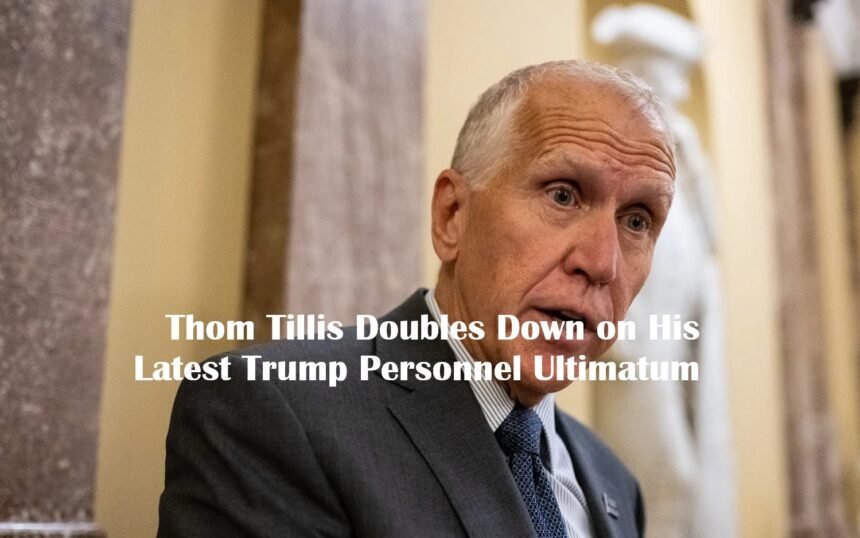
Senator Thom Tillis has taken a striking position in recent political battles. His latest move reinforced an ultimatum directed at Donald Trump and his administration. The stance centers on personnel decisions and institutional independence. It also reflects a broader tension inside the Republican Party. This article explores the context, motivations, and implications of Tillis’s decision. It draws on reporting from a major U.S. political outlet.
A Clear Warning to the White House
Tillis made his position unmistakable. He warned that support for key nominations would be withheld. That threat was tied to concerns about government conduct. The focus rested on actions affecting the Federal Reserve and the Justice Department. The ultimatum was not symbolic. It carried real legislative consequences.
As a member of the Senate Banking Committee, Tillis holds influence over confirmations. His refusal to cooperate could stall nominations entirely. The message was direct. Tillis signaled that institutional independence must be respected. If not, political cooperation would be limited.
The Federal Reserve Dispute
At the center of the conflict was the Federal Reserve. The controversy involved an investigation into Jerome Powell. The probe raised alarms among lawmakers. Critics feared it could be used as political pressure. Tillis reacted strongly. He argued that the investigation threatened the Fed’s independence.
He then escalated his response. Any nominee tied to the situation would face opposition. This stance effectively created a blockade. Without his support, progress on nominations slowed. His leverage became clear in a closely divided Senate.
Doubling Down on the Ultimatum
Rather than soften his position, Tillis reinforced it. He repeated that no nominee would move forward under current conditions. This marked a significant escalation. The ultimatum was framed as a defense of institutions. Tillis emphasized credibility and trust. He suggested that political interference would damage both.
His language showed urgency. Concerns were not presented as theoretical. They were described as immediate risks requiring action. This approach separated Tillis from many in his party. While others aligned with Trump, he adopted a more independent posture.
Political Context Behind the Move
Tillis’s stance did not emerge in isolation. Several political factors shaped his decision. First, he had already announced he would not seek reelection. That reduced political pressure. It allowed him to act without concern for primary challenges. Second, tensions with Trump had been building.
Disagreements over policy and personnel had surfaced before. The ultimatum reflected a continuation of that trend. Third, institutional concerns played a role. Tillis has often supported bipartisan measures. His focus on governance and stability influenced his actions. Together, these elements created the conditions for a bold stance.
Impact on Trump’s Agenda
The ultimatum had immediate consequences. It complicated the administration’s ability to secure confirmations. Key nominations faced delays. One notable example involved the Federal Reserve leadership. Tillis’s opposition initially blocked progress. Movement only resumed after changes in the investigation’s status.
This demonstrated the power of a single senator. In a narrowly divided chamber, one vote can shift outcomes. The situation also highlighted internal divisions. Not all Republicans were aligned on strategy. Tillis’s approach exposed those differences.
Balancing Loyalty and Independence
Tillis’s position reflects a delicate balance. He has supported Trump on many issues. At the same time, he has shown a willingness to dissent. This dual approach is not unique. However, it is rare in highly polarized environments. Many lawmakers avoid direct confrontation.
Tillis chose a different path. He combined criticism with continued engagement. His ultimatum targeted specific actions, not the entire agenda. This strategy allowed him to maintain credibility across factions. It also reinforced his image as an independent voice.
Broader Implications for Governance
The episode carries broader significance. It raises questions about the relationship between politics and institutions. The Federal Reserve operates independently by design. Interference risks undermining economic stability. Tillis’s stance emphasized that concern.
The Justice Department also plays a critical role. Its credibility depends on impartiality. Any perception of political influence can weaken trust. By linking nominations to these issues, Tillis highlighted their importance. His ultimatum was not only political. It was institutional.
A Shift in Republican Dynamics
Tillis’s actions signal a shift within the Republican Party. Internal disagreements have become more visible. Loyalty to Trump is no longer uniform. Some lawmakers remain fully aligned. Others, like Tillis, are willing to challenge decisions.
This creates a more complex political landscape. The shift may influence future debates. It could affect how nominations and policies are handled. It may also shape party identity moving forward.