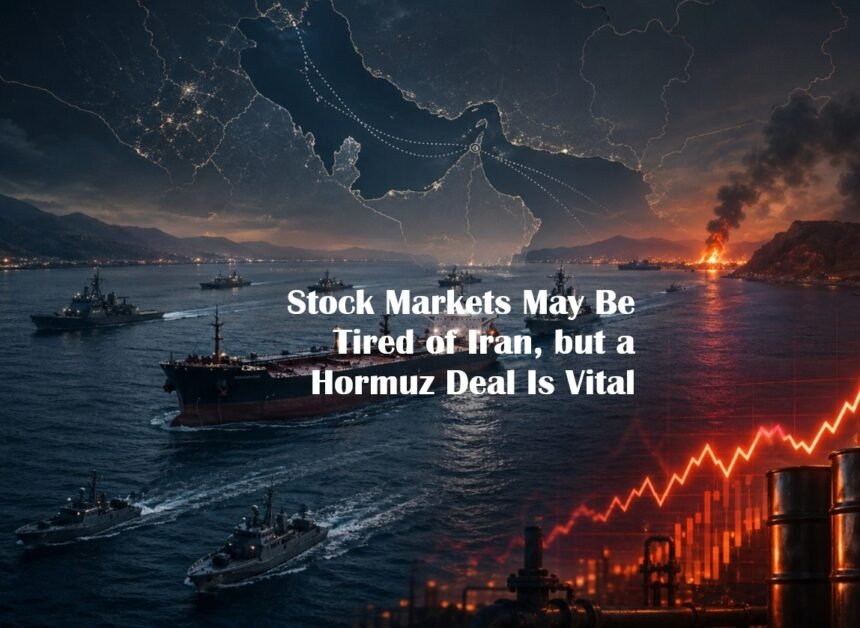
Global stock markets are displaying noticeable headline fatigue regarding ongoing tensions involving Iran. Investors have grown increasingly accustomed to recurring military threats, diplomatic posturing, and sanctions rhetoric across the Middle East. Initial market sell-offs now give way to swift equity rebounds as Wall Street shifts its focus toward corporate earnings, artificial intelligence investments, and central bank interest rate policy. However, beneath this apparent market apathy lies a stark economic reality.
Underlying financial stability and global supply chain health still depend heavily on a single critical waterway, the Strait of Hormuz. Wall Street traders may feel exhausted by the headline cycle, but securing a binding diplomatic agreement to keep the strait open remains vital for long-term equity market growth.
Headline Fatigue Meets Market Realities
Equity markets regularly experience fatigue when geopolitical conflicts persist without immediate resolution. When conflict headlines erupt repeatedly, algorithmic trading models and human investors slowly desensitize to the noise. Major stock benchmarks often shrug off geopolitical alerts within hours, choosing instead to focus on quarterly earnings reports and economic data releases. This desensitization can create a dangerous sense of complacency among market participants.
While stock indexes can temporarily ignore geopolitical noise, physical supply chains cannot ignore blocked sea lanes. The Persian Gulf region remains the world’s most critical energy export zone. Complacency in equity valuations risks blinding investors to severe potential shocks in the physical economy.
- Desensitization Trend: Markets react less aggressively to repetitive geopolitical headlines over time.
- Earnings Priority: Quarterly financial results often overshadow foreign policy developments.
- Physical Disconnect: Paper stock markets can decouple temporarily from physical shipping constraints.
- Volatile Reversals: Sudden physical disruptions quickly erase built-up stock market gains.
The Critical Importance of the Strait of Hormuz
The Strait of Hormuz serves as the ultimate choke point for international energy trade. Roughly twenty percent of the world’s total petroleum supply passes through this narrow maritime channel daily. Major Middle Eastern oil producers rely almost exclusively on the strait to deliver crude oil and liquefied natural gas to global buyers in Asia, Europe, and North America. Even minor disruptions to commercial transit through the strait create immediate global ripples.
Insurance companies sharply increase war-risk premiums for oil tankers operating in the region during periods of heightened tensions. Tanker operators often delay shipments or reroute vessels around longer ocean paths, instantly restricting global energy supplies and pushing spot prices higher.
- Massive Volume: Millions of crude barrels transit the channel every twenty-four hours.
- Limited Alternatives: Pipelines cannot fully replace maritime transit capacity through the gulf.
- Insurance Costs: Elevated security threats drive shipping insurance rates through the roof.
- Supply Bottlenecks: Delays at the strait create cascading backlogs at global discharge ports.
Diplomatic Breakthroughs and Oil Price Volatility
Energy markets act as the primary transmission mechanism connecting Middle Eastern geopolitics to global stock markets. Whenever news spreads regarding potential diplomatic progress or an interim agreement to keep the Strait of Hormuz open, crude oil prices drop rapidly. Conversely, rumors of military escalation or transit restrictions cause oil benchmarks to surge sharply. A formal, lasting agreement covering maritime transit through the strait provides immediate price relief for energy buyers.
Lower crude oil prices directly reduce raw material and operational costs across heavy industries, automotive sectors, and chemical manufacturing. Stable energy pricing restores cost predictability, enabling corporate leaders to execute long-term capital expenditure plans with confidence.
- Crude Sensitivity: Oil prices swing by several dollars per barrel on diplomatic updates.
- Input Relief: Falling oil prices lower fuel costs for industrial manufacturers.
- Planning Confidence: Stable energy markets allow executives to forecast capital budgets accurately.
- Margin Expansion: Lower energy expenses boost corporate profit margins across diverse sectors.
Inflationary Pressures and Central Bank Decisions
Central banks around the world keep a close watch on energy markets when determining monetary policy trajectories. High crude oil prices feed directly into consumer price indexes by raising retail gasoline, heating fuel, and utility expenses. Furthermore, elevated transportation costs force retailers to raise prices on everyday consumer goods. A persistent energy spike complicates central bank efforts to tame inflation.
Policymakers may feel compelled to maintain higher interest rates for longer periods if energy-driven inflation remains elevated. A verifiable, long-term deal to secure the Strait of Hormuz removes a primary source of supply-side inflation. Lower inflation pressures give central banks greater flexibility to ease interest rates, providing a powerful tailwind for stock valuations.
- Direct Inflation: Elevated oil prices increase retail fuel and utility costs for households.
- Indirect Costs: Higher freight rates raise the final price of groceries and retail goods.
- Policy Resistance: Persistent energy inflation prevents central banks from cutting interest rates.
- Valuation Lift: Reopening sea lanes helps suppress inflation, encouraging interest rate cuts.
Broad Market Impact Across Key Corporate Sectors
A secured Strait of Hormuz produces clear winners across global equity sectors. Commercial airlines and logistics providers experience immediate financial relief when fuel costs fall, as jet fuel represents one of their largest operating expenses. Lower shipping costs also benefit global retail giants that rely on international ocean freight to stock store shelves.
Similarly, consumer discretionary companies gain strength when gas station prices fall. When consumers spend less money filling up their fuel tanks, they retain more disposable income for shopping, dining, and travel entertainment. On the flip side, major oil exploration companies may see profit margins moderate from peak levels, but overall market health improves significantly.
- Airlines & Logistics: Reduced jet fuel expenses instantly strengthen quarterly cash flow.
- Retail & Commerce: Lower freight costs protect gross profit margins on imported inventory.
- Consumer Spending: Cheap gasoline leaves extra discretionary income in consumer pockets.
- Broader Participation: Non-energy equities rally broadly as economic uncertainty subsides.
The Path Forward for Institutional Investors
Investors cannot afford to treat Middle Eastern geopolitical developments as mere background noise forever. While short-term headline fatigue is understandable, institutional capital requires predictable global trade routes to thrive. A temporary truce or partial solution offers brief relief, but only a comprehensive, verifiable agreement regarding the Strait of Hormuz ensures lasting financial stability. Moving forward, portfolio managers must balance optimism surrounding corporate innovation with prudent risk management regarding energy markets.
Maintaining exposure to energy hedges while monitoring diplomatic negotiations allows investors to navigate ongoing market shifts effectively. Ultimately, a diplomatic breakthrough that permanently opens the Strait of Hormuz remains the single most important geopolitical catalyst for a sustained global stock market rally.