


Global financial markets experienced significant turbulence on Wednesday, July 8, 2026, as geopolitical tensions spilled into Western Europe. Spanish stocks and government bonds faced immediate selling pressure following unexpected public statements from United States President Donald Trump.
During an ongoing North Atlantic Treaty Organization (NATO) summit in Ankara, Turkey, the American president demanded that the United States immediately cut off all commercial trade ties with Spain. This severe declaration marks a sharp escalation in a long-running dispute over international defense spending and military operations.
Investors reacted swiftly to the aggressive rhetoric, triggering a broad selloff across Madrid’s primary financial exchanges. The unexpected development disrupted an otherwise quiet trading session in Europe, reminding global market participants of the persistent risks inherent in modern international diplomacy.
The sudden confrontation did not entirely surprise seasoned geopolitical observers. President Trump has repeatedly targeted the Spanish government over its defense policies throughout the year. On Wednesday, the American leader explicitly labeled Madrid a “terrible partner” within the Western military alliance.
The dispute centers on Spain’s ongoing refusal to meet the newly proposed defense spending benchmark of five percent of gross domestic product (GDP). Additionally, severe friction remains regarding the conflict involving Iran. Earlier in March 2026, the United States president threatened a comprehensive trade embargo against Spain.
That initial anger arose after the Spanish government blocked the American military from utilizing joint airbases for deployment missions against Iranian targets. While bilateral trade between the two nations continued normally after that spring dispute, the renewal of the threat has clearly rattled investor confidence.
Stock Exchanges Register Severe Losses Led by Major Corporate Heavyweights
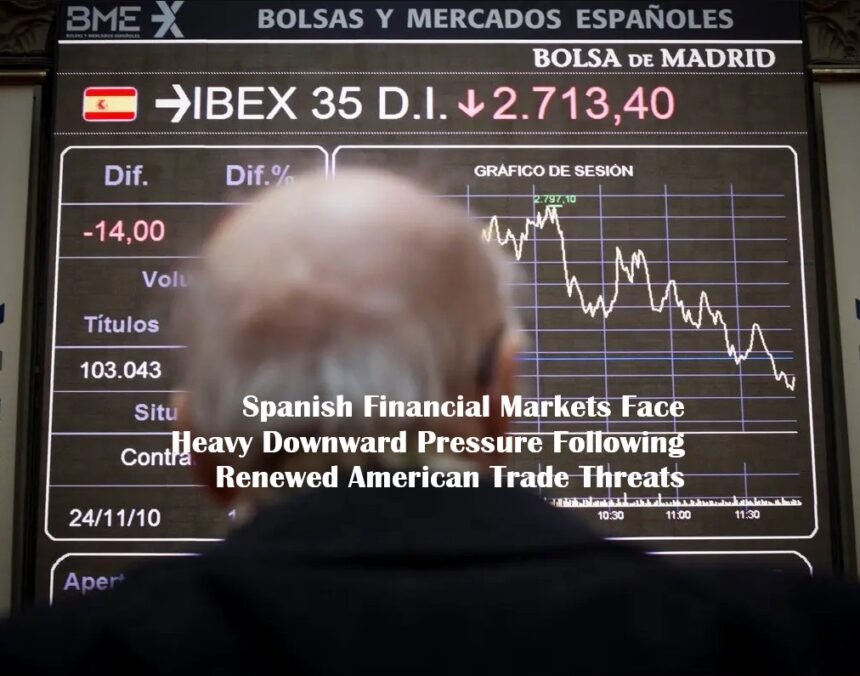
The immediate impact of the political rhetoric manifested clearly across Spain’s primary equity index, the IBEX 35. The benchmark index plummeted by 2.6 percent during afternoon trading sessions, marking its worst single-day performance since the initial dispute in early March.
This sharp decline positioned Madrid as the worst-performing major equity market in Europe on Wednesday. The broader pan-European market also felt the shockwave, though to a lesser degree. The region-wide STOXX 600 index registered a more moderate loss of 1.6 percent.
Equity traders adjusted their risk profiles rapidly, fearing potential disruptions to transatlantic commerce and corporate revenue streams. Major Spanish multinational corporations suffered the most significant blows during the daily session. Banking heavyweights, which maintain substantial global exposures, led the downward charge.
Shares in Banco Santander fell sharply by 4.3 percent as investors weighed potential regulatory and commercial challenges in North America. Its primary domestic rival, BBVA, also experienced a painful session, shedding 3.0 percent of its market value. The retail sector offered no refuge for investors either.
Inditex, the massive retail conglomerate that owns the popular fashion brand Zara, saw its shares tumble by 3.6 percent. Meanwhile, telecommunications provider Telefonica lost 1.1 percent of its share price before the closing bell. These widespread losses among blue-chip companies demonstrate how deeply political risks can penetrate core corporate valuations.
Fixed Income Assets and Debt Insurance Costs Adjust to Elevated Risks
The negative sentiment quickly spread beyond the equity markets, infecting Spain’s sovereign debt instruments. Spanish ten-year government bond prices declined steadily throughout the day. This domestic movement occurred alongside a broader global selloff in sovereign debt markets.
Yields on the benchmark ten-year Spanish Bono climbed by nine basis points to reach 3.565 percent. This figure represents the highest borrowing cost for the Mediterranean nation since the middle of May. For comparison, benchmark German Bund yields rose by eight basis points during the same trading period.
Consequently, the closely watched borrowing premium that Spain pays over Germany expanded to 49.2 basis points. This yield spread marks the highest level recorded this month, approaching the peak levels observed during the March diplomatic crisis. A wider spread indicates that international investors demand higher returns to hold Spanish debt relative to safer German assets.
Furthermore, the derivatives market reflected this rising anxiety. Spanish five-year credit default swaps, which measure the cost of insuring national debt against default, climbed to a one-month high of 15.6 basis points. However, this metric remained safely below the four-month high of 21 basis points recorded during the height of the spring dispute.
Understanding the Geopolitical Core of the Transatlantic Disconnect
The escalating tension between Washington and Madrid stems from fundamental disagreements regarding military commitments and national sovereignty. The United States government is aggressively pushing all NATO members to accelerate their defense expenditures significantly. Spain increased its defense allocation from 1.42 percent of GDP in 2024 to 2.0 percent in 2025.
Despite this improvement, Madrid intends to cap its future defense budget at 2.1 percent of GDP. This target falls well short of the five percent goal that President Trump demands from alliance members. The American administration views this hesitation as a failure to contribute fairly to collective Western security.
The disagreement over the military conflict with Iran adds another complex layer to the bilateral strain. Prime Minister Pedro Sanchez leads a leftist minority coalition government in Madrid.
Sanchez has consistently maintained a defiant stance against aggressive unilateral military actions outside the framework of the United Nations Charter. When the United States initiated military strikes against Iran earlier this year, Spain refused to grant access to joint military installations on its soil.
Spanish officials argued that the military actions violated international law, prompting furious counter-threats from Washington. This principled stand boosted Sanchez’s political popularity domestically, but it severely damaged his administration’s relationship with the White House.
Legal and Economic Realities Offer Buffer Against Direct Sanctions
Despite the alarming market reactions, the Spanish government chose to downplay the practical threat of a total trade cutoff. The Prime Minister’s office released an official statement calmly classifying the American remarks as “business as usual.” Government spokespersons emphasized that Spain enjoys excellent social, cultural, and economic relations with the American people.
They explicitly stated that Madrid has no intention of changing this beneficial relationship. Furthermore, Spanish trade experts note that the United States actually maintains a substantial trade surplus with Spain. A complete halt to commerce would immediately harm American agricultural and industrial exporters who sell goods to Spanish buyers.
More importantly, the institutional structure of the European Union provides a formidable shield for Madrid. Spain belongs to the European single market and a unified customs union. Under international law and European treaties, individual member states do not negotiate or maintain independent trade policies.
The European Commission in Brussels manages all trade relationships and negotiations collectively on behalf of the entire twenty-seven-nation bloc. Therefore, the United States cannot legally sever trade ties with Spain alone without targeting the entire European Union simultaneously.
Implementing sweeping sanctions against a single EU member would require Washington to declare a comprehensive national emergency. The American administration would have to provide verifiable evidence that Spain constitutes a direct threat to U.S. national security.
Market Outlook and Long Term Implications for Global Investors
The events of Wednesday demonstrate how quickly political rhetoric can disrupt global asset pricing. While the physical implementation of a unilateral U.S. embargo against Spain remains highly unlikely due to legal and institutional barriers, the psychological impact on investors is real.
The rise in bond yields and the drop in stock prices show that markets price in political uncertainty immediately. Investors dislike ambiguity, and the prospect of ongoing friction between Washington and European allies creates an uncomfortable trading environment.
Over the longer term, these repeating trade disputes may encourage European nations to diversify their economic relationships away from North American dependency. Large Spanish firms like Santander and Inditex will likely continue to expand their footprints in alternative growing markets across Latin America and Asia.
Meanwhile, the Spanish government shows no signs of reversing its stance on defense spending or military base access. As the NATO summit in Ankara continues, market participants will monitor the situation closely for any signs of de-escalation. Until clear diplomatic clarity emerges, Spanish financial markets will likely experience heightened volatility and sensitive trading sessions.