



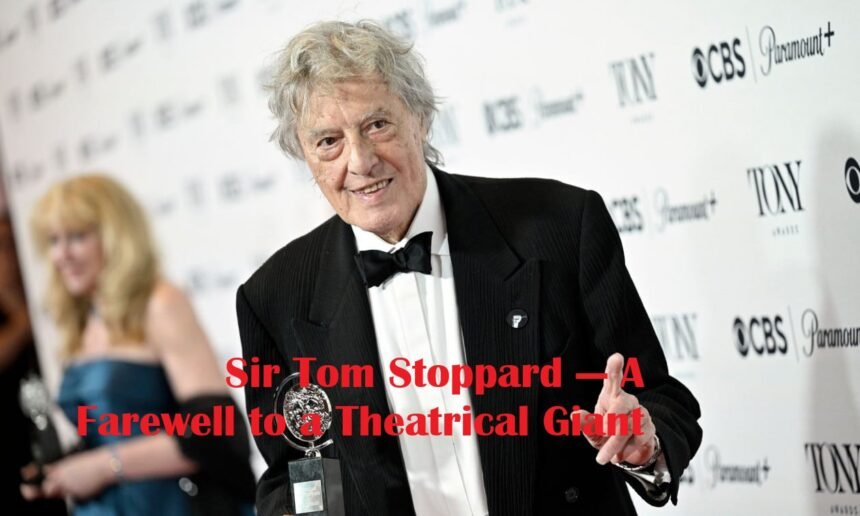
The worlds of theatre and literature have lost one of their most brilliant minds. Tom Stoppard has died at the age of 88. His death was confirmed on 29 November 2025, with his family stating he passed away peacefully at home, surrounded by loved ones. For more than six decades, Stoppard’s work reshaped modern drama.
From his early breakthrough to his final works, he remained fearless in blending wit, intellect, and emotional depth.
Early Life and Escape to England
Born as Tomáš Straussler in what was then Czechoslovakia, Stoppard’s early years were overshadowed by historical turmoil. His family, Jewish and under threat from the Nazi invasion, fled first to Singapore, and later, as Japanese forces advanced, to India. After the war, his mother remarried a British army major, and the family settled in England.
It was there that the young Straussler, adopting the name Tom Stoppard, would grow up immersed in a new language and culture, an experience that deeply shaped his future voice as a writer. Stoppard left formal education at 17 and began a modest career as a journalist, before publishing short radio plays. That modest start belied a towering talent that would soon revolutionise theatre.
Rise to Prominence: Playwright of “Stoppardian” Wit
Stoppard shot to fame in the 1960s with Rosencrantz and Guildenstern Are Dead, a daring re-imagining of two minor characters from Shakespeare’s Hamlet. That play, first seen at the Edinburgh Fringe in 1966, marked the beginning of a career that would challenge theatrical norms and delight audiences worldwide.
Throughout his career, he penned more than 30 stage plays and many radio and television works. On top of that, he built an impressive portfolio of screenplays, including an Oscar-winning credit for Shakespeare in Love. Stoppard’s writing was often characterised by dazzling intellect, philosophical depth, and a playful turn of phrase.
His plays mixed high ideas with accessible wit from philosophical gymnastics in Jumpers to the interplay of science and poetry in Arcadia. Critics and audiences alike came to call his style “Stoppardian.” But beyond clever wordplay, his later works revealed a deeper emotional sensitivity.
The 1982 drama The Real Thing, dealing with love, betrayal, and the tension between life and art, signalled a shift towards plays that married intellect with heart.
A Vast and Varied Body of Work
Among his most celebrated works were:
- Arcadia (1993), widely regarded by Stoppard himself as perhaps his finest play.
- The Invention of Love (1997), a meditation on poetry and human longing.
- Travesties and Jumpers, works that challenged conventional narrative structure while interrogating philosophical and historical themes.
- Leopoldstadt (2020), a powerful late-career play rooted in his own family history and Jewish heritage a personal reckoning with identity, memory, and loss.
Beyond the stage, he contributed to films and television. His adaptations and original screenplays included not just Shakespeare in Love, but also ambitious projects spanning genres and eras.
Recognition and Human Impact
Stoppard’s contributions were formally recognised when he was knighted in 1997 for services to literature. He was also admired for his generosity, curiosity, and ability to inspire those around him. Colleagues recalled him not just as a brilliant writer, but as a supportive presence, one who nurtured the talents of others even as he maintained his own towering standards.
Tributes poured in after his death. A statement from his representatives described him as a man whose work embodied “brilliance and humanity,” marked by wit, irreverence, and deep love for the English language. On 2 December 2025, theatres in London West End will dim their lights for two minutes in his memory, a symbolic gesture acknowledging the enormous void his passing leaves.
Legacy of an Immortal Voice
Tom Stoppard leaves behind a legacy of plays and screenwriting that combined intellectual daring with emotional resonance. His works challenged audiences to think, yet moved them to feel. His ability to straddle both worlds, head and heart, made him unique. From existential comedy to sweeping drama, from clever dialogue to heartfelt tragedy, his range was unmatched.
He showed repeatedly that theatre could be both intellectually rigorous and deeply human. As the lights dim across stages, his words, witty, profound, absurd, moving, will live on. For many generations, they will serve as both entertainment and provocation, as mirrors and as questions.
In remembering Tom Stoppard, the world honours not just a playwright, but a thinker, a storyteller, and a lover of language whose voice will remain timeless.