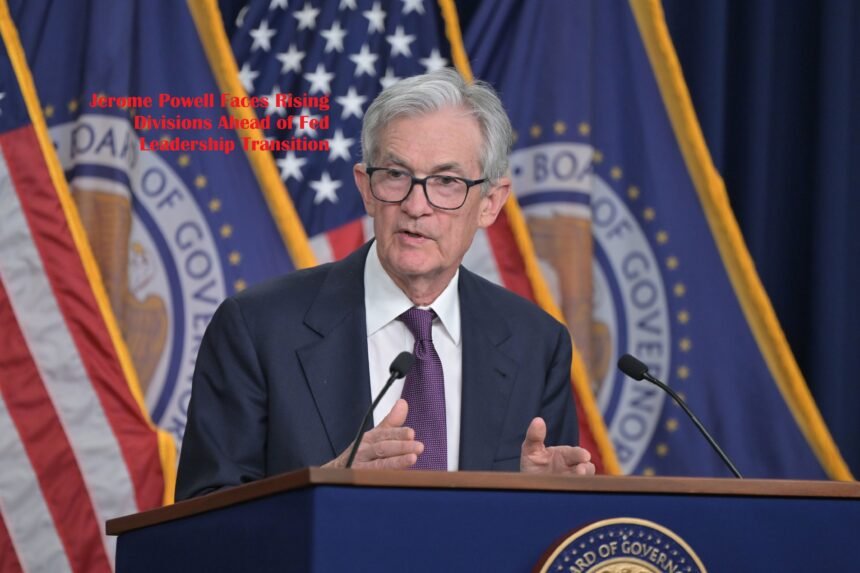
Jerome Powell, current chair of Federal Reserve (the Fed), is confronting a growing challenge in rallying support among his colleagues a development that may foreshadow serious tests for whoever becomes the bank’s next leader. With his term set to expire in May 2026, the tight votes and rising dissent internally could mark the end of an era of relative consensus at the central bank.
The Vote-Gathering Challenge: What’s Going On
The Fed is expected to announce a third straight interest-rate cut this week. But this move comes amid increasing pushback. Several policymakers are preparing to dissent yet again. Under Powell’s leadership, unanimous or near-unanimous decisions were once the norm. But recent developments have exposed deep divisions.
Fed officials broadly agree on the need to ease rates to avoid undue economic strain. But they disagree sharply on the timing and magnitude of those cuts. Some scholars of monetary policy say this fracturing of vote behavior signals a bigger problem: the next chair may struggle to build consensus.
Why the Rift Is Deepening
Two key pressures cause the discord. First, the dual challenge faced by the Fed inflation remains sticky even as the labor market shows signs of weakening. Policy can no longer rely on a single, neat tradeoff. Second, opinions differ on what constitutes a “neutral” rate, one that neither stimulates nor slows the economy.
That ambiguity fuels disagreement over whether current or future cuts should be deeper, shallower, or postponed. Officials who fear inflation relapse push for caution. Others, concerned about jobs and growth, argue for quicker cuts. That tug-of-war has made forging consensus more difficult than in previous years.
Implications for Powell and His Successor
For Powell, the increased dissent is an unwelcome sign. He built his reputation on being able to unite colleagues around complex decisions. Now, even with deep respect within the committee, he struggles to command unanimity. Observers warn that if Powell can’t maintain unity now with institutional memory and deference on his side, the next chair will face even steeper hurdles.
Consensus-driven governance may no longer be viable in today’s fractious environment. Moreover, the shift suggests the next chair might face internal pressure to pick one priority over another; inflation control or economic stimulus rarely both. That could change how the Fed functions structurally and politically.
What This Means for Markets and Policy
Markets are watching closely. Historically, clarity and unity within the Fed helped stabilise expectations. Growing dissent increases uncertainty about future monetary policy decisions. If the next chair struggles to unify the committee, markets may see greater volatility.
Investors may react not only to headline rate changes, but also to mixed signals and internal disagreement about the bank’s direction. Also, global economies, especially emerging markets, could feel ripple effects. Diverging views at the Fed may lead to abrupt shifts in U.S. interest rates, influencing capital flows and currency valuations worldwide.
The Broader Challenge for the Fed’s Future Leadership
The timeline is tightening. Powell’s term ends in mid-2026. In the coming months, potential successors may emerge under greater scrutiny. They will inherit a Fed facing structural divisions, economic pressures, and political scrutiny. Delivering a fresh rate path may be just the first hurdle.
Preserving credibility, rebuilding consensus, and shepherding an institution under stress will likely define the next chair’s tenure. This turning point could reshape the Fed’s decision-making culture from quiet consensus toward more public debate, sharper divides, and possibly a less predictable policy path.
Conclusion: A Pivotal Moment for Central Banking
Powell’s vote-gathering difficulties expose a fundamental challenge: when economic conditions grow more complex, consensus becomes harder. The next Fed chair may inherit not just a demanding economy but a divided institution.
How the Fed navigates this transition may determine its credibility, effectiveness, and ability to steer the U.S. economy through uncertain times. For now, Powell’s struggle to keep his colleagues united may be the clearest warning that the days of easy consensus at the Fed are fading.